
Level Order Insertion in a Binary Tree in Java
Level Order Insertion in a Binary Tree
Level Order Insertion in a Binary Tree in Java ensures that the tree remains as complete as possible. Unlike Binary Search Trees (BST), a normal binary tree does not follow ordering rules, so insertion is done based on the first available position.
This approach is commonly used in problems where we want to maintain a complete binary tree structure.

What is Level Order Insertion?
Level order insertion means:
- Traverse the tree level by level (left to right)
- Insert the new node at the first empty position
This is achieved using Breadth First Search (BFS) with a queue.
Why Do We Use Level Order Insertion?
Level order insertion is useful when:
- Maintaining a complete binary tree
- Implementing heap structures
- Ensuring balanced shape (not height-balanced like AVL, but complete)
- Used in real world systems like:
- Priority queues (heaps)
- Tree based storage structures
Core Idea of Level Order Insertion:
- Use a queue (FIFO)
- Traverse nodes level by level
- Insert at the first node where:
Left child is missing OR
Right child is missing
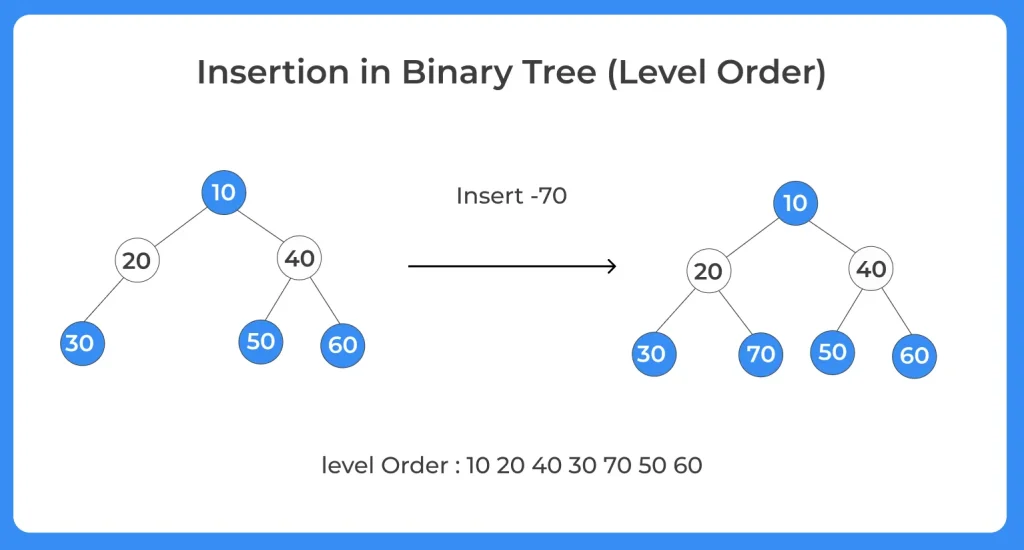
Approach (Queue Based BFS)
- Use queue to track nodes
- Traverse level by level
- Insert node where space is available
Algorithm for Level Order Insertion in a Binary Tree
- If root is null, create a new node and return
- Create a queue and add root
- While queue is not empty:
Remove front node
If left child is null:
Insert new node as left child
Stop
Else add left child to queue
If right child is null:
Insert new node as right child
Stop
- Else add right child to queue


Learn DSA
Prime Course Trailer
Related Banners
Get PrepInsta Prime & get Access to all 200+ courses offered by PrepInsta in One Subscription
Java Code for Level Order Insertion in a Binary Tree
import java.util.*;

class Node {
    int data;
    Node left, right;

    Node(int value) {
        data = value;
        left = right = null;
    }
}

public class BinaryTreeInsertion {

    // Level Order Insertion
    public static Node insert(Node root, int key) {
        if (root == null) {
            return new Node(key);
        }

        Queue queue = new LinkedList<>();
        queue.add(root);

        while (!queue.isEmpty()) {
            Node current = queue.poll();

            // Check left child
            if (current.left == null) {
                current.left = new Node(key);
                return root;
            } else {
                queue.add(current.left);
            }

            // Check right child
            if (current.right == null) {
                current.right = new Node(key);
                return root;
            } else {
                queue.add(current.right);
            }
        }

        return root;
    }

    // Level Order Traversal for verification
    public static void levelOrder(Node root) {
        if (root == null) return;

        Queue queue = new LinkedList<>();
        queue.add(root);

        while (!queue.isEmpty()) {
            Node current = queue.poll();
            System.out.print(current.data + " ");

            if (current.left != null)
                queue.add(current.left);

            if (current.right != null)
                queue.add(current.right);
        }
    }

    public static void main(String[] args) {
        Node root = null;

        int[] values = {10, 20, 30, 40, 50, 60};

        for (int val : values) {
            root = insert(root, val);
        }

        System.out.print("Level Order Traversal: ");
        levelOrder(root);
    }
}
Input:
Insert → 10, 20, 30, 40, 50, 60
Tree Formation:
        10
       /  \
     20    30
    /  \   /
   40  50 60
Output :
Level Order Traversal: 10 20 30 40 50 60
2. 20 → left of 10
3. 30 → right of 10
4. 40 → left of 20
5. 50 → right of 20
6. 60 → left of 30
Insertion always fills the tree level by level.

Space Complexity: O(n)
Conclusion:
Common Insights:
This method ensures complete binary tree structure
Different from BST insertion (no ordering rule)
Basis for heap construction
BFS is key to this approach
Best Practices:
Use Queue interface (LinkedList or ArrayDeque)
Always check for null root
Use traversal to verify structure
Avoid recursion for this problem
Keep insertion logic simple and iterative

Frequently Asked Questions
Answer:
It is the process of inserting nodes level by level using a queue to maintain a complete binary tree structure.
Answer:
It traverses the tree using BFS and inserts the node at the first available position from left to right.
Answer:
The time complexity is O(n) in the worst case.
Answer:
No, BST insertion follows ordering rules, while level order insertion focuses on tree completeness.
Answer:
It is used in heap data structures, priority queues, and complete binary tree implementations.
Get over 200+ course One Subscription
Courses like AI/ML, Cloud Computing, Ethical Hacking, C, C++, Java, Python, DSA (All Languages), Competitive Coding (All Languages), TCS, Infosys, Wipro, Amazon, DBMS, SQL and others
Introduction to Trees
Binary Trees
- Binary Tree in Data Structures (Introduction)
- Tree Traversals: Inorder Postorder Preorder : C | C++ | Java
- Inorder Postorder PreOrder Traversals Examples
- Tree Traversal without Recursion
Binary Search Trees
Traversals
- Traversal in Trees
- Tree Traversals: Breadth-First Search (BFS) : C | C++ | Java
- Tree Traversals: Depth First Search (DFS) : C | C++ | Java
- Construct a Binary Tree from Postorder and Inorder
B – Trees
AVL Trees
- AVL Trees
Complete Programs for Trees
- Depth First Traversals – C | C++ | Java
- Level Order Traversal – C | C++ | Java
- Construct Tree from given Inorder and Preorder traversals – C | C++ | Java
- Construct Tree from given Postorder and Inorder traversals – C | C++ | Java
- Construct Tree from given Postorder and Preorder traversal – C | C++ | Java
- Find size of the Binary tree – C | C++ | Java
- Find the height of binary tree – C | C++ | Java
- Find maximum in binary tree – C | C++ | Java
- Check whether two tree are identical- C| C++| Java
- Spiral Order traversal of Tree- C | C++| Java
- Level Order Traversal LIne by Line – C | C++| Java
- Hand shaking lemma and some Impotant Tree Properties.
- Check If binary tree if Foldable or not.- C| C++| Java
- check whether tree is Symmetric C| C++| Java.
- Check for Children-Sum in Binary Tree- C|C++| Java
- Sum of all nodes in Binary Tree- C | C++ | Java
- Lowest Common Ancestor in Binary Tree. C | C++ | Java
Introduction to Trees
Binary Trees
- Binary Tree in Data Structures (Introduction)
- Tree Traversals: Inorder Postorder Preorder : C | C++ | Java
- Inorder Postorder PreOrder Traversals Examples
- Tree Traversal without Recursion
Binary Search Trees
Traversals
- Traversal in Trees
- Tree Traversals: Breadth-First Search (BFS) : C | C++ | Java
- Tree Traversals: Depth First Search (DFS) : C | C++ | Java
- Construct a Binary Tree from Postorder and Inorder
B – Trees
AVL Trees
- AVL Trees
Complete Programs for Trees
- Depth First Traversals – C | C++ | Java
- Level Order Traversal – C | C++ | Java
- Construct Tree from given Inorder and Preorder traversals – C | C++ | Java
- Construct Tree from given Postorder and Inorder traversals – C | C++ | Java
- Construct Tree from given Postorder and Preorder traversal – C | C++ | Java
- Find size of the Binary tree – C | C++ | Java
- Find the height of binary tree – C | C++ | Java
- Find maximum in binary tree – C | C++ | Java
- Check whether two tree are identical- C| C++| Java
- Spiral Order traversal of Tree- C | C++| Java
- Level Order Traversal Line by Line – C | C++| Java
- Hand shaking lemma and some Impotant Tree Properties.
- Check If binary tree if Foldable or not.- C| C++| Java
- check whether tree is Symmetric – C| C++| Java.
- Check for Children-Sum in Binary Tree- C|C++| Java
- Sum of all nodes in Binary Tree- C | C++ | Java
- Lowest Common Ancestor in Binary Tree- C | C++ | Java


Login/Signup to comment