
Inorder Traversal in Binary Tree in Java
Inorder Traversal in Binary Tree
Inorder Traversal in Binary Tree in Java is one of the most important tree traversal techniques. It is a Depth First Traversal (DFS) method where nodes are visited in a specific order:
Left → Root → RightThis traversal is especially important because, in a Binary Search Tree (BST), inorder traversal gives the elements in sorted order.
What is Inorder Traversal?
In inorder traversal, we:
- Visit the left subtree
- Visit the root node
- Visit the right subtree
Steps to Find Inorder Traversal in Binary tree
Here are some of the steps for tree traversal :-
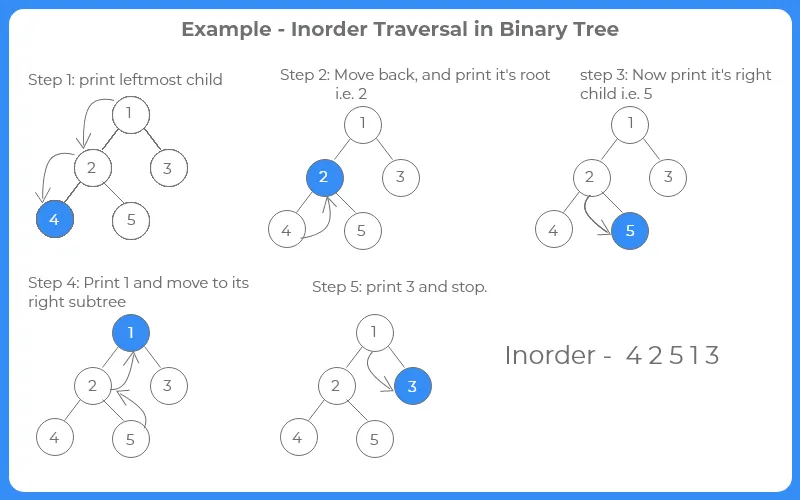
- Step 1: Traverse the left most child which is 4 in above example and print it.
- Step 2: Then print it’s parent which is 2 and look for the right child.
- Step3: Then move to right child and print it i.e. print 5
- Step 4: Print 1 which is the root and move to it’s right subtree.
- Step 5: At last print 3 and as all the nodes get visited , so stop. Therefore , the printing sequence will be 4 2 5 1 3 .
Example of Inorder Traversal:
Methods for Inorder Traversal in Binary Tree in Java
Inorder traversal in Binary tree can be performed using 2 methods using Java:


Learn DSA
Prime Course Trailer
Related Banners
Get PrepInsta Prime & get Access to all 200+ courses offered by PrepInsta in One Subscription
Methods for Inorder Traversal in Binary Tree
Method 1: Recursive Inorder Traversal
Algorithm for Inorder Traversal
inorder(node)
1. If node is null
      return
2. Call inorder(node.left)
3. Print node.data
4. Call inorder(node.right)
Java Code:
class Node {
    int data;
    Node left, right;

    Node(int value) {
        data = value;
        left = right = null;
    }
}

public class InorderTraversal {

    Node root;

    void inorder(Node node) {

        if (node == null)
            return;

        inorder(node.left);
        System.out.print(node.data + " ");
        inorder(node.right);
    }

    public static void main(String[] args) {

        InorderTraversal tree = new InorderTraversal();

        tree.root = new Node(10);
        tree.root.left = new Node(20);
        tree.root.right = new Node(30);
        tree.root.left.left = new Node(40);
        tree.root.left.right = new Node(50);

        System.out.print("Inorder Traversal: ");
        tree.inorder(tree.root);
    }
}
Output:
Inorder Traversal: 40 20 50 10 30

Method for Inorder Traversal in Binary Tree
Method 2: Iterative Inorder Traversal (Using Stack)
Algorithm for Iterative Inorder Traversal
1. Create an empty stack
2. Set current = root
3. While current is not null OR stack not empty:
       a. Push all left nodes into stack
       b. Pop from stack
       c. Print node
       d. Move to right subtree
Java Code:
import java.util.Stack;

class Node {
    int data;
    Node left, right;

    Node(int value) {
        data = value;
        left = right = null;
    }
}

public class InorderIterative {

    Node root;

    void inorder() {

        Stack stack = new Stack<>();
        Node current = root;

        while (current != null || !stack.isEmpty()) {

            // Reach the leftmost node
            while (current != null) {
                stack.push(current);
                current = current.left;
            }

            // Current is null here
            current = stack.pop();
            System.out.print(current.data + " ");

            // Visit right subtree
            current = current.right;
        }
    }

    public static void main(String[] args) {

        InorderIterative tree = new InorderIterative();

        tree.root = new Node(10);
        tree.root.left = new Node(20);
        tree.root.right = new Node(30);
        tree.root.left.left = new Node(40);
        tree.root.left.right = new Node(50);

        System.out.print("Inorder Traversal: ");
        tree.inorder();
    }
}
Output:
Inorder Traversal: 40 20 50 10 30
Space Complexity: O(h)
where, h = height of the binary tree
Skewed Tree → O(n)
To wrapping up with
Inorder Traversal in Binary Tree in Java:
- If root is null → traversal returns nothing
- Must check null before recursion or stack push
- Stack should not be empty before pop
Common Problem with Inorder traversal:
- If root is null → traversal returns nothing
- Must check null before recursion or stack push
- Stack should not be empty before pop

Frequently Asked Questions
Answer:
It is a traversal method where nodes are visited in Left → Root → Right order.
Answer:
Time complexity is O(n) because all nodes are visited once.
Answer:
It produces sorted output in Binary Search Trees.
Answer:
Yes, using a stack (iterative method).
Answer:
Space complexity is O(h), where h is the height of the tree.
Get over 200+ course One Subscription
Courses like AI/ML, Cloud Computing, Ethical Hacking, C, C++, Java, Python, DSA (All Languages), Competitive Coding (All Languages), TCS, Infosys, Wipro, Amazon, DBMS, SQL and others
Stacks
- Introduction to Stack in Data Structure
Click Here - Operations on a Stack
Click Here - Stack: Infix, Prefix and Postfix conversions
Click Here - Stack Representation in –
C | C++ | Java - Representation of a Stack as an Array. –
C | C++ | Java - Representation of a Stack as a Linked List. –
C | C++ | Java - Infix to Postfix Conversion –
C | C++ | Java - Infix to prefix conversion in –
C | C++ | Java - Postfix to Prefix Conversion in –
C | C++ | Java
Queues
- Queues in Data Structures (Introduction)
Click Here - Queues Program in C and implementation
Click Here - Implementation of Queues using Arrays | C Program
Click Here - Types of Queues in Data Structure
Click Here - Application of Queue Data Structure
Click Here - Insertion in Queues Program (Enqueuing) –
C | C++ | Java - Deletion (Removal) in Queues Program(Dequeuing) –
C | C++ | Java - Reverse a Queue –
C | C++ | Java - Queues using Linked Lists –
C | C++ | Java - Implement Queue using Stack –
C | C++ | Java - Implement Queue using two Stacks –
C | C++ | Java
Circular Queues
- Circular queue in Data Structure
Click Here - Applications of Circular Queues
Click Here - Circular queue in –
C | C++ | Java - Circular queue using Array –
C | C++ | Java - Circular Queue using Linked Lists –
C | C++ | Java
Priority Queue
Stacks
- Introduction to Stack in Data Structure
- Operations on a Stack
- Stack: Infix, Prefix and Postfix conversions
- Stack Representation in – C | C++ | Java
- Representation of a Stack as an Array. – C | C++ | Java
- Representation of a Stack as a Linked List. – C | C++ | Java
- Infix to Postfix Conversion – C | C++ | Java
- Infix to prefix conversion in – C | C++ | Java
- Postfix to Prefix Conversion in – C | C++ | Java
Queues
- Queues in Data Structures (Introduction)
- Queues Program in C and implementation
- Implementation of Queues using Arrays | C Program
- Types of Queues in Data Structure
- Application of Queue Data Structure
- Insertion in Queues Program (Enqueuing) – C | C++ | Java
- Deletion (Removal) in Queues Program(Dequeuing) – C | C++ | Java
- Reverse a Queue – C | C++ | Java
- Queues using Linked Lists – C | C++ | Java
- Implement Queue using Stack – C | C++ | Java
- Implement Queue using two Stacks – C | C++ | Java
Circular Queues
- Circular queue in Data Structure
- Applications of Circular Queues
- Circular queue in – C | C++ | Java
- Circular queue using Array – C | C++ | Java
- Circular Queue using Linked Lists – C | C++ | Java


Login/Signup to comment