
Insertion in B-Tree in Java
Insertion in B-Tree
Insertion in a Binary Search Tree (BST) is one of the most important operations in data structures. It helps in building a sorted tree structure dynamically, which allows efficient searching and data organization.
In this article, we will understand how insertion works in a BST using Java, along with algorithm, examples, code, and practical insights.

Insertion in B-Tree in Java
What is a Binary Search Tree?
A Binary Search Tree (BST) is a binary tree where:
- Left subtree contains values less than the node
- Right subtree contains values greater than the node
This property makes operations like search, insertion, and deletion efficient.
Why is Insertion Important in BST?
Insertion is used to:
- Build the tree dynamically
- Maintain sorted data
- Enable fast searching (O(log n) in balanced trees)
- Support real world applications like indexing and searching
Rules for Insertion in BST:
While inserting a new value:
- Start from the root
- Compare the value with current node
- If smaller → move left
- If greater → move right
- Insert at the first empty position
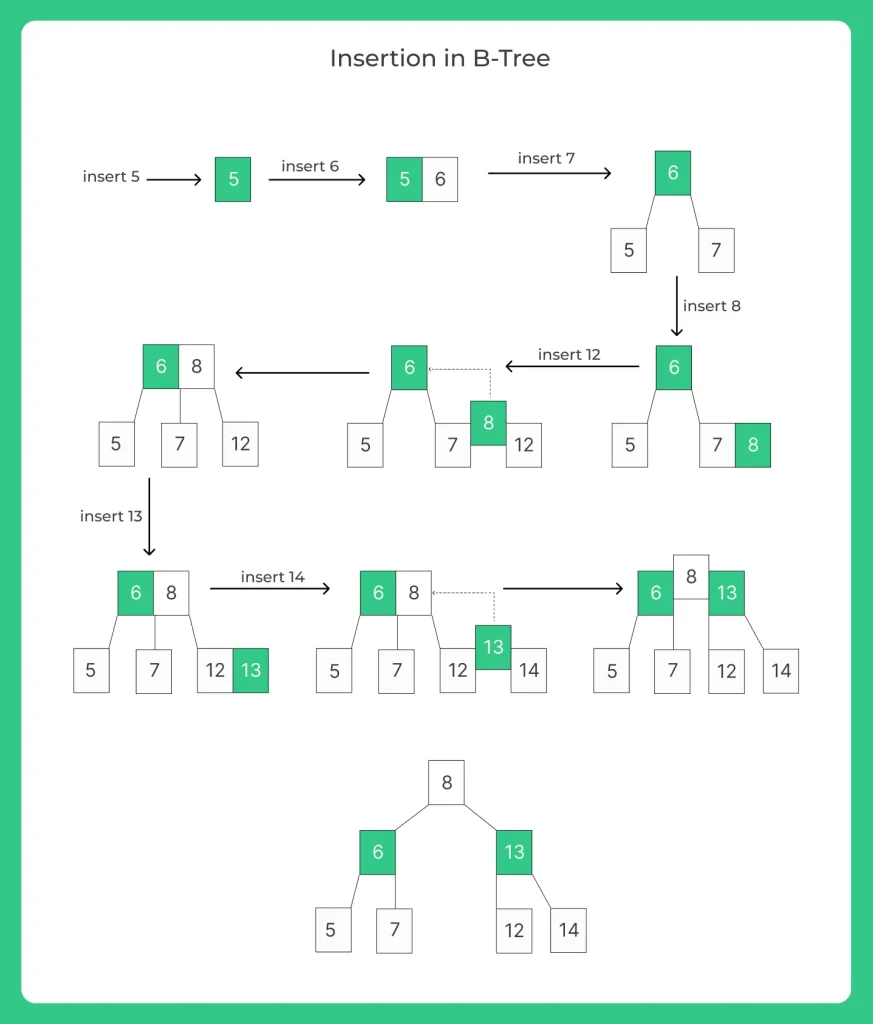


Algorithm for Insertion in B Tree in Java
Before practicing Insertion in Btree in java we have to analyze the Algorithm for Insertion in Btree mentioned as follows:
- If root is null, create a new node
- Compare key with root value
- If key < root → insert in left subtree
- If key > root → insert in right subtree
- Return the updated root
Learn DSA
Prime Course Trailer
Related Banners
Get PrepInsta Prime & get Access to all 200+ courses offered by PrepInsta in One Subscription
Java Code for Insertion in B Tree in Java
class Node {
    int data;
    Node left, right;

    Node(int value) {
        data = value;
        left = right = null;
    }
}

public class BSTInsertion {

    public static Node insert(Node root, int key) {
        if (root == null) {
            return new Node(key);
        }

        if (key < root.data) {
            root.left = insert(root.left, key);
        } else if (key > root.data) {
            root.right = insert(root.right, key);
        }

        return root;
    }

    public static void inorder(Node root) {
        if (root != null) {
            inorder(root.left);
            System.out.print(root.data + " ");
            inorder(root.right);
        }
    }

    public static void main(String[] args) {
        Node root = null;

        int[] values = {50, 30, 70, 10, 40, 60, 90};

        for (int val : values) {
            root = insert(root, val);
        }

        System.out.print("Inorder Traversal: ");
        inorder(root);
    }
}
Input:
Insert → 50, 30, 70, 10, 40, 60, 90
Output:
Inorder Traversal → 10 30 40 50 60 70 90
2. Final tree maintains sorted order.
3. Inorder traversal confirms correctness.
Best Case: O(log n) (balanced tree)
Worst Case: O(n) (skewed tree)
2. Space Complexity:
O(h) where h = height of tree
Due to recursion stack

Common Insights on Insertion in BTree
Edge Cases:
- Inserting into an empty tree
- Duplicate values (ignored or handled separately)
- Highly unbalanced trees
- Invalid input
Keep in mind that:
- BST insertion is similar to binary search
- Tree height directly affects performance
- Inorder traversal always gives sorted output
- Balanced BSTs improve efficiency
Best Practices:
- Avoid duplicates unless required
- Use iterative approach for large datasets
- Validate inputs before insertion
- Prefer self balancing trees (AVL/Red Black) in production

Frequently Asked Questions
Answer:
Insertion In Binary Search Tree In Java is the process of adding a new node into a BST while maintaining its sorted structure, where left nodes are smaller and right nodes are larger.
Answer:
Insertion starts from the root, compares values, moves left or right accordingly, and inserts the node at the first available null position.
Answer:
The time complexity is O(log n) in a balanced tree and O(n) in the worst case when the tree becomes skewed.
Answer:
It is used in databases, search engines, file systems, and applications where sorted data storage and fast lookup are required.
Answer:
Duplicates are usually ignored or handled using custom rules like storing counts or inserting consistently on one side.
Get over 200+ course One Subscription
Courses like AI/ML, Cloud Computing, Ethical Hacking, C, C++, Java, Python, DSA (All Languages), Competitive Coding (All Languages), TCS, Infosys, Wipro, Amazon, DBMS, SQL and others
Introduction to Trees
Binary Trees
- Binary Tree in Data Structures (Introduction)
- Tree Traversals: Inorder Postorder Preorder : C | C++ | Java
- Inorder Postorder PreOrder Traversals Examples
- Tree Traversal without Recursion
Binary Search Trees
Traversals
- Traversal in Trees
- Tree Traversals: Breadth-First Search (BFS) : C | C++ | Java
- Tree Traversals: Depth First Search (DFS) : C | C++ | Java
- Construct a Binary Tree from Postorder and Inorder
B – Trees
AVL Trees
- AVL Trees
Complete Programs for Trees
- Depth First Traversals – C | C++ | Java
- Level Order Traversal – C | C++ | Java
- Construct Tree from given Inorder and Preorder traversals – C | C++ | Java
- Construct Tree from given Postorder and Inorder traversals – C | C++ | Java
- Construct Tree from given Postorder and Preorder traversal – C | C++ | Java
- Find size of the Binary tree – C | C++ | Java
- Find the height of binary tree – C | C++ | Java
- Find maximum in binary tree – C | C++ | Java
- Check whether two tree are identical- C| C++| Java
- Spiral Order traversal of Tree- C | C++| Java
- Level Order Traversal Line by Line – C | C++| Java
- Hand shaking lemma and some Impotant Tree Properties.
- Check If binary tree if Foldable or not.- C| C++| Java
- check whether tree is Symmetric – C| C++| Java.
- Check for Children-Sum in Binary Tree- C|C++| Java
- Sum of all nodes in Binary Tree- C | C++ | Java
- Lowest Common Ancestor in Binary Tree- C | C++ | Java
Introduction to Trees
Binary Trees
- Binary Tree in Data Structures (Introduction)
- Tree Traversals: Inorder Postorder Preorder : C | C++ | Java
- Inorder Postorder PreOrder Traversals Examples
- Tree Traversal without Recursion
Binary Search Trees
Traversals
- Traversal in Trees
- Tree Traversals: Breadth-First Search (BFS) : C | C++ | Java
- Tree Traversals: Depth First Search (DFS) : C | C++ | Java
- Construct a Binary Tree from Postorder and Inorder
B – Trees
AVL Trees
- AVL Trees
Complete Programs for Trees
- Depth First Traversals – C | C++ | Java
- Level Order Traversal – C | C++ | Java
- Construct Tree from given Inorder and Preorder traversals – C | C++ | Java
- Construct Tree from given Postorder and Inorder traversals – C | C++ | Java
- Construct Tree from given Postorder and Preorder traversal – C | C++ | Java
- Find size of the Binary tree – C | C++ | Java
- Find the height of binary tree – C | C++ | Java
- Find maximum in binary tree – C | C++ | Java
- Check whether two tree are identical- C| C++| Java
- Spiral Order traversal of Tree- C | C++| Java
- Level Order Traversal LIne by Line – C | C++| Java
- Hand shaking lemma and some Impotant Tree Properties.
- Check If binary tree if Foldable or not.- C| C++| Java
- check whether tree is Symmetric C| C++| Java.
- Check for Children-Sum in Binary Tree- C|C++| Java
- Sum of all nodes in Binary Tree- C | C++ | Java
- Lowest Common Ancestor in Binary Tree. C | C++ | Java


Login/Signup to comment