
Searching In Binary Search Tree In Java
Searching in Binary Search Tree
Searching in Binary Search Tree in Java is one of the fastest and most important operations in tree based data structures. A Binary Search Tree (BST) allows efficient searching because it maintains a strict ordering:
Left Subtree < Root < Right SubtreeUsing this property, we can eliminate half of the tree at each step, making searching much faster than linear structures.

Example of Binary Search Tree
Search key = 40
Steps:
- Compare with 50 → go left
- Compare with 30 → go right
- Found at 40
        50
       /  \
     30    70
    / \    / \
  20  40  60  80
Properties Of Binary Search Tree:
- All the node’s in the left subtree are less than the root node.
- Similarly , All the node’s in right subtree are greater than the root node.
- The left and right subtree each must also be a binary search tree.
These properties provides an ordering so that the operations like searching ,insertion, deletion, finding maximum key , minimum key can be done fast.
Example for Searching in Binary Search Tree
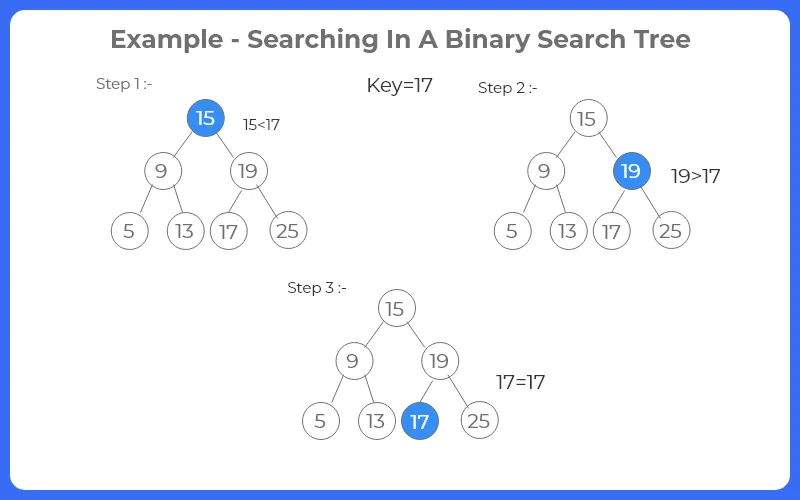
Steps to find a Node in Binary Search Tree
Suppose we want to search 17 in the above example:
- Step 1: Compare 17 with the root element which is 15.
- Step 2: 17>15 , so Search for a node in right subtree.
- Step 3: Compare 17 with 19 . i.e. 17<19 , so search for an element in left subtree.
- Step 4: compare 17 with the left child of 19 . i.e. 17==17 , Hence, stop searching and return true.


Learn DSA
Prime Course Trailer
Related Banners
Get PrepInsta Prime & get Access to all 200+ courses offered by PrepInsta in One Subscription
Methods for Searching in Binary Search Tree in Java
Searching in Binary Search Tree in Java can be performed in 2 ways:
Algorithms for Searching in Binary Search Tree
search(node, key)
1. If node is null
       return false
2. If node.data == key
       return true
3. If key < node.data
       search(node.left, key)
4. Else
       search(node.right, key)
1. Set current = root
2. While current is not null:
       a. If key == current.data → return true
       b. If key < current.data → move to left
       c. Else → move to right
3. Return false
Recursive Method for Searching in Binary Search Tree in Java
class Node {
    int data;
    Node left, right;

    Node(int value) {
        data = value;
        left = right = null;
    }
}

public class BSTSearchRecursive {

    Node root;

    boolean search(Node node, int key) {

        if (node == null)
            return false;

        if (node.data == key)
            return true;

        if (key < node.data)
            return search(node.left, key);
        else
            return search(node.right, key);
    }

    public static void main(String[] args) {

        BSTSearchRecursive tree = new BSTSearchRecursive();

        // Creating BST
        tree.root = new Node(50);
        tree.root.left = new Node(30);
        tree.root.right = new Node(70);
        tree.root.left.left = new Node(20);
        tree.root.left.right = new Node(40);
        tree.root.right.left = new Node(60);
        tree.root.right.right = new Node(80);

        int key = 40;

        if (tree.search(tree.root, key))
            System.out.println("Element found");
        else
            System.out.println("Element not found");
    }
}

Iterative Method for Searching in Binary Search Tree in Java
class Node {
    int data;
    Node left, right;

    Node(int value) {
        data = value;
        left = right = null;
    }
}

public class BSTSearchIterative {

    Node root;

    boolean search(int key) {

        Node current = root;

        while (current != null) {

            if (key == current.data)
                return true;

            if (key < current.data)
                current = current.left;
            else
                current = current.right;
        }

        return false;
    }

    public static void main(String[] args) {

        BSTSearchIterative tree = new BSTSearchIterative();

        // Creating BST
        tree.root = new Node(50);
        tree.root.left = new Node(30);
        tree.root.right = new Node(70);
        tree.root.left.left = new Node(20);
        tree.root.left.right = new Node(40);
        tree.root.right.left = new Node(60);
        tree.root.right.right = new Node(80);

        int key = 25;

        if (tree.search(key))
            System.out.println("Element found");
        else
            System.out.println("Element not found");
    }
}
Input 1:
Tree: 50, 30, 70, 20, 40, 60, 80
Search: 40
Output:
Element found
Input 2:
Search: 25
Output:
Element not found
For Average Case = O(log n)
For Worst Case = O(n)
For Iterative Method = O(1)

Frequently Asked Questions
Answer:
It is the process of finding a value using BST properties (left < root < right).
Answer:
Average is O(log n), worst case is O(n).
Answer:
Iterative is more space efficient, while recursive is easier to implement.
Answer:
BST is efficient because it eliminates half of the tree at each step.
Answer:
In Skewed BST tree behaves like a linked list, and search becomes O(n).
Get over 200+ course One Subscription
Courses like AI/ML, Cloud Computing, Ethical Hacking, C, C++, Java, Python, DSA (All Languages), Competitive Coding (All Languages), TCS, Infosys, Wipro, Amazon, DBMS, SQL and others


Login/Signup to comment