
Priority Queue Implementation using Array
Priority Queue Implementation using Array
Priority Queue Implementation using Array in Java demonstrates how a priority queue can be implemented manually using arrays. In a priority queue, elements are removed based on priority rather than insertion order. The element with the highest priority is processed first.
While Java provides a built in PriorityQueue class in the Java Collections Framework, understanding how to implement it using arrays helps you learn the internal working of priority based data structures.
Priority Queue using Array in Java
Every element in the priority queue is associated with a priority. It does not matter in which order we insert the items in the queue, the item with higher priority must be removed before the item with the lower priority.
If the two items have same priorities, the order of removal is not defined and depends on implementation
In an array based priority queue:
- Elements are stored in an array
- The element with the highest priority is located during deletion
- Elements may be rearranged to maintain priority order
There are 2 common approaches:
Operations on a Priority Queue
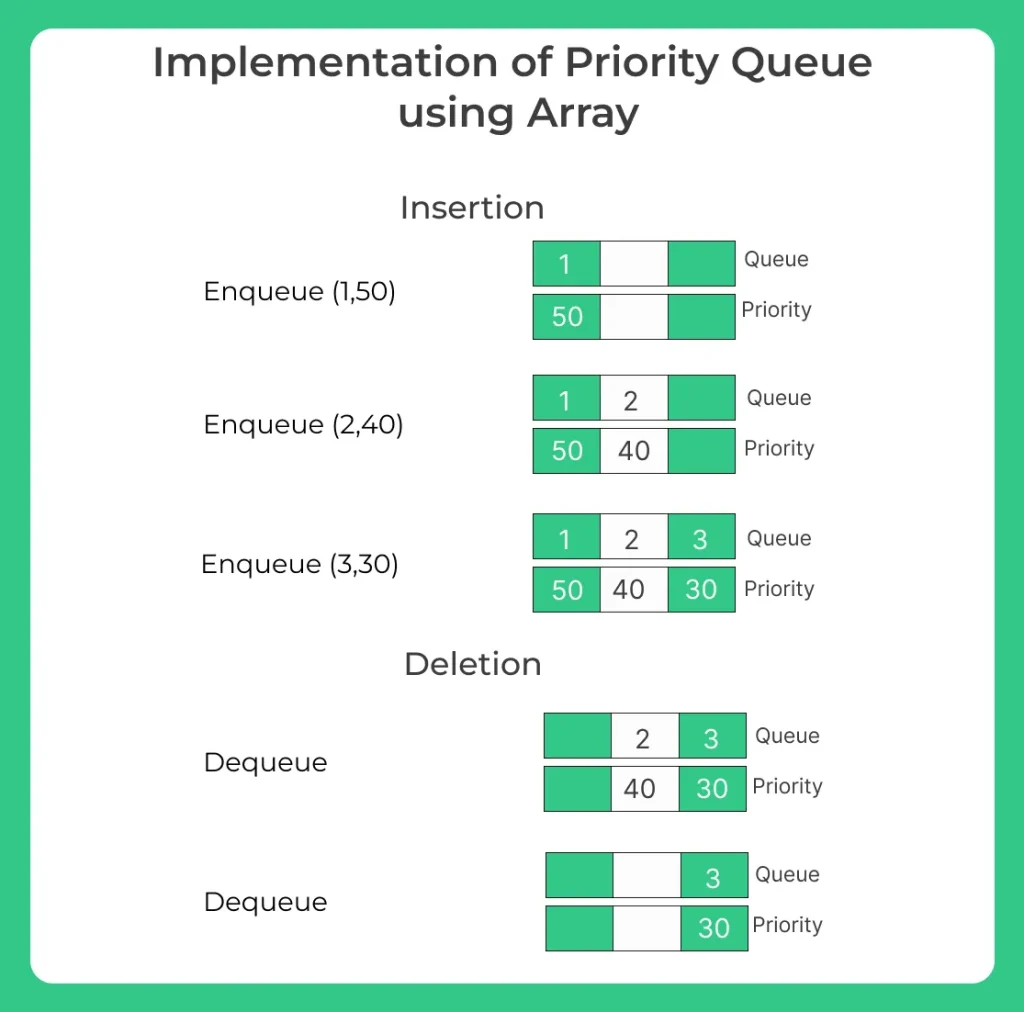
- EnQueue: EnQueue operation inserts an item into the queue. The item can be inserted at the end of the queue or at the front of the queue or at the middle. The item must have a priority.
- DeQueue: DeQueue operation removes the item with the highest priority from the queue.
- Peek: Peek operation reads the item with the highest priority.
Types of Priority Queue in Java
- Min Priority Queue: In min priority Queue minimum number of value gets the highest priority and lowest number of element gets the highest priority.
- Max Priority Queue: Max priority Queue is where maximum number value gets the highest priority and minimum number of value gets the minimum priority.


Circular Queue using Linked Lists
Priority Queue using Linked List
Priority Queue Insertion and Deletion
Learn DSA
Prime Course Trailer
Related Banners
Get PrepInsta Prime & get Access to all 200+ courses offered by PrepInsta in One Subscription
Priority Queue Implementation using Array in Java
Priority Queue can be implemented in two ways:
- Using ordered Array: In ordered array insertion or enqueue operation takes O(n) time complexity because it enters elements in sorted order in queue. And deletion takes O(1) time complexity.
- Using unordered Array: In unordered array deletion takes O(n) time complexity because it search for the element in Queue for the deletion and enqueue takes o(1) time complexity.
Method 1: Priority Queue using Unsorted Array
ALGORITHM:
1. Insert Element
1. If queue is full
        Print overflow
2. Insert element at rear
3. Increment size
2. Delete Highest Priority Element
1. If queue is empty
        Print underflow
2. Find element with highest priority
3. Remove it
4. Shift remaining elements
Java Code
public class PriorityQueueArray {

    int[] arr;
    int size;
    int capacity;

    public PriorityQueueArray(int cap) {
        capacity = cap;
        arr = new int[capacity];
        size = 0;
    }

    // Insert element
    public void insert(int value) {

        if (size == capacity) {
            System.out.println("Queue Overflow");
            return;
        }

        arr[size++] = value;
        System.out.println(value + " inserted");
    }

    // Delete highest priority element (smallest value)
    public int delete() {

        if (size == 0) {
            System.out.println("Queue Underflow");
            return -1;
        }

        int highestPriorityIndex = 0;

        for (int i = 1; i < size; i++) {
            if (arr[i] < arr[highestPriorityIndex]) {
                highestPriorityIndex = i;
            }
        }

        int removed = arr[highestPriorityIndex];

        // Shift elements
        for (int i = highestPriorityIndex; i < size - 1; i++) {
            arr[i] = arr[i + 1];
        }

        size--;

        return removed;
    }

    // Display queue
    public void display() {

        if (size == 0) {
            System.out.println("Queue is empty");
            return;
        }

        System.out.print("Priority Queue: ");

        for (int i = 0; i < size; i++) {
            System.out.print(arr[i] + " ");
        }

        System.out.println();
    }

    public static void main(String[] args) {

        PriorityQueueArray pq = new PriorityQueueArray(5);

        pq.insert(30);
        pq.insert(10);
        pq.insert(50);
        pq.insert(20);

        pq.display();

        System.out.println("Removed: " + pq.delete());
        System.out.println("Removed: " + pq.delete());

        pq.display();
    }
}
Input:
Insert: 30
Insert: 10
Insert: 50
Insert: 20
Delete
Delete
Output:
30 inserted
10 inserted
50 inserted
20 inserted
Priority Queue: 30 10 50 20
Removed: 10
Removed: 20
Priority Queue: 30 50
Insert = O(1)
Delete = O(n)
Display = O(n)
Space Complexity: O(n)
Priority Queue Implementation using Array in Java
Elements are stored in sorted order based on priority:
- Insert operation places element at correct position
- Delete operation removes the first element
Method 2: Priority Queue using Sorted Array
ALGORITHM:
1. Insert Element
1. If queue is full
      Print overflow
2. Find correct position
3. Shift elements
4. Insert element
2. Delete Highest Priority Element
1. If queue empty
      Print underflow
2. Remove first element
3. Shift elements left
Java Code
public class SortedPriorityQueue {

    int[] arr;
    int size;
    int capacity;

    public SortedPriorityQueue(int cap) {
        capacity = cap;
        arr = new int[capacity];
        size = 0;
    }

    public void insert(int value) {

        if (size == capacity) {
            System.out.println("Queue Overflow");
            return;
        }

        int i;

        for (i = size - 1; i >= 0 && arr[i] > value; i--) {
            arr[i + 1] = arr[i];
        }

        arr[i + 1] = value;
        size++;

        System.out.println(value + " inserted");
    }

    public int delete() {

        if (size == 0) {
            System.out.println("Queue Underflow");
            return -1;
        }

        return arr[--size];
    }

    public void display() {

        for (int i = 0; i < size; i++) {
            System.out.print(arr[i] + " ");
        }

        System.out.println();
    }

    public static void main(String[] args) {

        SortedPriorityQueue pq = new SortedPriorityQueue(5);

        pq.insert(30);
        pq.insert(10);
        pq.insert(50);
        pq.insert(20);

        pq.display();

        System.out.println("Removed: " + pq.delete());
        System.out.println("Removed: " + pq.delete());

        pq.display();
    }
}
Output:
10 inserted
20 inserted
30 inserted
50 inserted
10 20 30 50
Removed: 50
Removed: 30
10 20
Insert = O(n)
Delete = O(1)
Display = O(n)
Space Complexity: O(n)
Frequently Asked Questions
Answer:
It is a priority queue implementation where elements are stored in an array and removed based on priority.
Answer:
Insertion can be O(1) or O(n), while deletion can be O(n) or O(1) depending on implementation.
Answer:
Sorted array provides faster deletion, while unsorted array provides faster insertion.
Answer:
Yes, Java provides the PriorityQueue class in java.util.
Answer:
Heap provides O(log n) time for both insertion and deletion, making it more efficient.
Get over 200+ course One Subscription
Courses like AI/ML, Cloud Computing, Ethical Hacking, C, C++, Java, Python, DSA (All Languages), Competitive Coding (All Languages), TCS, Infosys, Wipro, Amazon, DBMS, SQL and others
Stacks
- Introduction to Stack in Data Structure
Click Here - Operations on a Stack
Click Here - Stack: Infix, Prefix and Postfix conversions
Click Here - Stack Representation in –
C | C++ | Java - Representation of a Stack as an Array. –
C | C++ | Java - Representation of a Stack as a Linked List. –
C | C++ | Java - Infix to Postfix Conversion –
C | C++ | Java - Infix to prefix conversion in –
C | C++ | Java - Postfix to Prefix Conversion in –
C | C++ | Java
Queues
- Queues in Data Structures (Introduction)
Click Here - Queues Program in C and implementation
Click Here - Implementation of Queues using Arrays | C Program
Click Here - Types of Queues in Data Structure
Click Here - Application of Queue Data Structure
Click Here - Insertion in Queues Program (Enqueuing) –
C | C++ | Java - Deletion (Removal) in Queues Program(Dequeuing) –
C | C++ | Java - Reverse a Queue –
C | C++ | Java - Queues using Linked Lists –
C | C++ | Java - Implement Queue using Stack –
C | C++ | Java - Implement Queue using two Stacks –
C | C++ | Java
Circular Queues
- Circular queue in Data Structure
Click Here - Applications of Circular Queues
Click Here - Circular queue in –
C | C++ | Java - Circular queue using Array –
C | C++ | Java - Circular Queue using Linked Lists –
C | C++ | Java
Priority Queue
Stacks
- Introduction to Stack in Data Structure
- Operations on a Stack
- Stack: Infix, Prefix and Postfix conversions
- Stack Representation in – C | C++ | Java
- Representation of a Stack as an Array. – C | C++ | Java
- Representation of a Stack as a Linked List. – C | C++ | Java
- Infix to Postfix Conversion – C | C++ | Java
- Infix to prefix conversion in – C | C++ | Java
- Postfix to Prefix Conversion in – C | C++ | Java
Queues
- Queues in Data Structures (Introduction)
- Queues Program in C and implementation
- Implementation of Queues using Arrays | C Program
- Types of Queues in Data Structure
- Application of Queue Data Structure
- Insertion in Queues Program (Enqueuing) – C | C++ | Java
- Deletion (Removal) in Queues Program(Dequeuing) – C | C++ | Java
- Reverse a Queue – C | C++ | Java
- Queues using Linked Lists – C | C++ | Java
- Implement Queue using Stack – C | C++ | Java
- Implement Queue using two Stacks – C | C++ | Java
Circular Queues
- Circular queue in Data Structure
- Applications of Circular Queues
- Circular queue in – C | C++ | Java
- Circular queue using Array – C | C++ | Java
- Circular Queue using Linked Lists – C | C++ | Java


Login/Signup to comment