
Implementation of Queues using two Stack in Java
Implementation of Queues using Two Stack
Implementation of Queues using Two Stacks in Java is a popular Data Structures problem that tests your understanding of how different data structures can be combined to simulate each other.
A queue follows FIFO (First In, First Out), while a stack follows LIFO (Last In, First Out). Since their behaviors are opposite, implementing a queue using stacks requires a smart rearrangement of elements.

What is a Queue Using Two Stacks?
Queue using Two Stacks means implementing queue operations (enqueue, dequeue) with the help of two stack data structures.
We use two stacks to reverse element order so that FIFO behavior is maintained.
- Queue → FIFO
- Stack → LIFO
By transferring elements between two stacks, we simulate queue behavior.
2. It is commonly asked in interviews
3. It demonstrates amortized analysis
4. It helps in algorithmic thinking
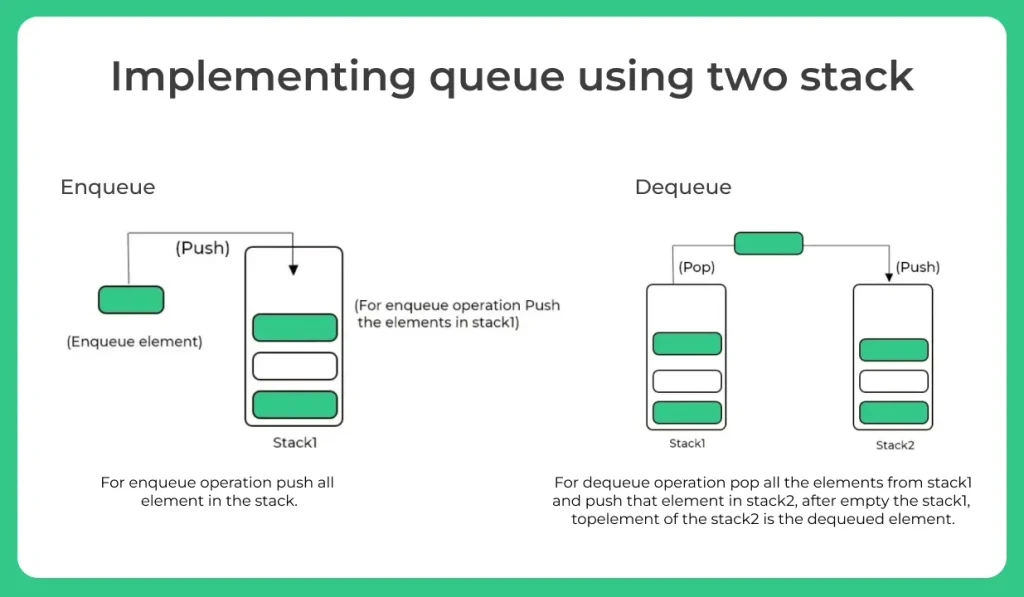


Approach to Implement Queue Using Two Stacks in Java
We use two stacks:
- stack1 → For insertion (enqueue)
- stack2 → For deletion (dequeue)
Working Principle:
- Enqueue always happens in stack1
- Dequeue happens from stack2
- If stack2 is empty, elements are moved from stack1 to stack2
This reversal maintains FIFO order.
Algorithm to Implement Queue Using Stack in Java
Algorithm:
1. Enqueue Operation
- Push element into stack1
2. Dequeue Operation
- If stack1 is empty AND stack2 is empty
- If stack1 is empty AND stack2 is empty
- Underflow (Queue is empty)
- If stack2 is empty
- Pop from stack1
- Push into stack2
- If stack2 is empty
- Pop and return top of stack2
Learn DSA
Prime Course Trailer
Related Banners
Get PrepInsta Prime & get Access to all 200+ courses offered by PrepInsta in One Subscription
Java Code to Implement Queues Using Two Stacks
import java.util.Stack;

class QueueUsingTwoStacks {

    private Stack stack1;
    private Stack stack2;

    // Constructor
    public QueueUsingTwoStacks() {
        stack1 = new Stack<>();
        stack2 = new Stack<>();
    }

    // Enqueue operation
    public void enqueue(int value) {
        stack1.push(value);
        System.out.println(value + " inserted");
    }

    // Dequeue operation
    public int dequeue() {

        // Underflow check
        if (stack1.isEmpty() && stack2.isEmpty()) {
            System.out.println("Queue is empty (Underflow)");
            return -1;
        }

        // Transfer elements if needed
        if (stack2.isEmpty()) {
            while (!stack1.isEmpty()) {
                stack2.push(stack1.pop());
            }
        }

        return stack2.pop();
    }

    // Peek operation
    public int peek() {

        if (stack1.isEmpty() && stack2.isEmpty()) {
            System.out.println("Queue is empty");
            return -1;
        }

        if (stack2.isEmpty()) {
            while (!stack1.isEmpty()) {
                stack2.push(stack1.pop());
            }
        }

        return stack2.peek();
    }

    // Check if queue is empty
    public boolean isEmpty() {
        return stack1.isEmpty() && stack2.isEmpty();
    }

    // Display queue elements
    public void display() {

        if (isEmpty()) {
            System.out.println("Queue is empty");
            return;
        }

        System.out.print("Queue: ");

        // Print stack2 (top to bottom)
        for (int i = stack2.size() - 1; i >= 0; i--) {
            System.out.print(stack2.get(i) + " ");
        }

        // Print stack1 (bottom to top)
        for (int i = 0; i < stack1.size(); i++) {
            System.out.print(stack1.get(i) + " ");
        }

        System.out.println();
    }

    // Main method
    public static void main(String[] args) {

        QueueUsingTwoStacks queue = new QueueUsingTwoStacks();

        // Enqueue
        queue.enqueue(10);
        queue.enqueue(20);
        queue.enqueue(30);

        // Display
        queue.display();

        // Peek
        System.out.println("Front element: " + queue.peek());

        // Dequeue
        System.out.println("Removed: " + queue.dequeue());
        System.out.println("Removed: " + queue.dequeue());

        // Display
        queue.display();

        // Enqueue again
        queue.enqueue(40);
        queue.enqueue(50);

        queue.display();

        // Dequeue remaining
        System.out.println("Removed: " + queue.dequeue());
        System.out.println("Removed: " + queue.dequeue());
        System.out.println("Removed: " + queue.dequeue());

        // Underflow test
        System.out.println("Removed: " + queue.dequeue());
    }
}
Input:
enqueue(10)
enqueue(20)
enqueue(30)
dequeue()
dequeue()
enqueue(40)
enqueue(50)
dequeue()
dequeue()
dequeue()
Output:
10 inserted
20 inserted
30 inserted
Queue: 10 20 30
Front element: 10
Removed: 10
Removed: 20
Queue: 30
40 inserted
50 inserted
Queue: 30 40 50
Removed: 30
Removed: 40
Removed: 50
Queue is empty (Underflow)
Removed: -1
Space Complexity: O(n)
Comparison with Other Queue Implementations
| Method using queue | Time Complexity | Space Complexity |
|---|---|---|
| Array Queue | O(1) | O(n) |
| Circular Queue | O(1) | O(n) |
| Linked List Queue | O(1) | O(n) |
| Two Stacks Queue | O(1)* | O(n) |

Frequently Asked Questions
Answer:
It is a method of building a queue using two stacks to maintain FIFO order.
Answer:
Two stacks help reverse element order, converting LIFO behavior into FIFO.
Answer:
Enqueue is O(1), and dequeue is O(1) amortized.
Answer:
Yes, using recursion, but it is less efficient.
Answer:
Mostly for interviews and learning. Real systems use built in queue structures.
Get over 200+ course One Subscription
Courses like AI/ML, Cloud Computing, Ethical Hacking, C, C++, Java, Python, DSA (All Languages), Competitive Coding (All Languages), TCS, Infosys, Wipro, Amazon, DBMS, SQL and others
Stacks
- Introduction to Stack in Data Structure
Click Here - Operations on a Stack
Click Here - Stack: Infix, Prefix and Postfix conversions
Click Here - Stack Representation in –
C | C++ | Java - Representation of a Stack as an Array. –
C | C++ | Java - Representation of a Stack as a Linked List. –
C | C++ | Java - Infix to Postfix Conversion –
C | C++ | Java - Infix to prefix conversion in –
C | C++ | Java - Postfix to Prefix Conversion in –
C | C++ | Java
Queues
- Queues in Data Structures (Introduction)
Click Here - Queues Program in C and implementation
Click Here - Implementation of Queues using Arrays | C Program
Click Here - Types of Queues in Data Structure
Click Here - Application of Queue Data Structure
Click Here - Insertion in Queues Program (Enqueuing) –
C | C++ | Java - Deletion (Removal) in Queues Program(Dequeuing) –
C | C++ | Java - Reverse a Queue –
C | C++ | Java - Queues using Linked Lists –
C | C++ | Java - Implement Queue using Stack –
C | C++ | Java - Implement Queue using two Stacks –
C | C++ | Java
Circular Queues
- Circular queue in Data Structure
Click Here - Applications of Circular Queues
Click Here - Circular queue in –
C | C++ | Java - Circular queue using Array –
C | C++ | Java - Circular Queue using Linked Lists –
C | C++ | Java
Priority Queue
Stacks
- Introduction to Stack in Data Structure
- Operations on a Stack
- Stack: Infix, Prefix and Postfix conversions
- Stack Representation in – C | C++ | Java
- Representation of a Stack as an Array. – C | C++ | Java
- Representation of a Stack as a Linked List. – C | C++ | Java
- Infix to Postfix Conversion – C | C++ | Java
- Infix to prefix conversion in – C | C++ | Java
- Postfix to Prefix Conversion in – C | C++ | Java
Queues
- Queues in Data Structures (Introduction)
- Queues Program in C and implementation
- Implementation of Queues using Arrays | C Program
- Types of Queues in Data Structure
- Application of Queue Data Structure
- Insertion in Queues Program (Enqueuing) – C | C++ | Java
- Deletion (Removal) in Queues Program(Dequeuing) – C | C++ | Java
- Reverse a Queue – C | C++ | Java
- Queues using Linked Lists – C | C++ | Java
- Implement Queue using Stack – C | C++ | Java
- Implement Queue using two Stacks – C | C++ | Java
Circular Queues
- Circular queue in Data Structure
- Applications of Circular Queues
- Circular queue in – C | C++ | Java
- Circular queue using Array – C | C++ | Java
- Circular Queue using Linked Lists – C | C++ | Java


Login/Signup to comment