
Circular Queue using Linked List in Java
Circular Queue using Linked List
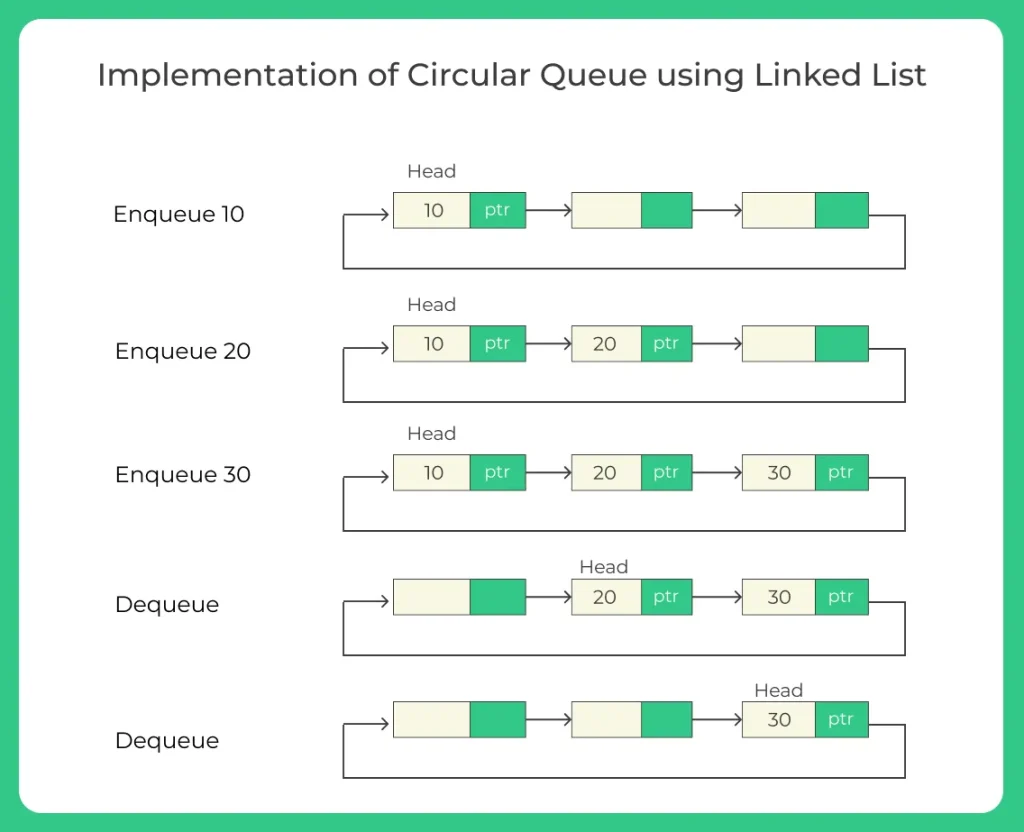
Circular Queue using Linked List in Java is a dynamic implementation of a circular queue where nodes are connected in a circular manner.
Unlike an array based circular queue (which has fixed capacity), a linked list circular queue grows dynamically and avoids overflow until memory is exhausted.
What is a Circular Queue using Linked List?
In a normal linked list queue:
front → 10 → 20 → 30 → null
In a circular linked list queue, the last node points back to the first node:
front → 10 → 20 → 30
           ↑        ↓
           ← ← ← ← ←
The following are the operations that can be performed on a circular queue:
- Front: It is used to get the front item from the Queue.
- Rear: It is used to get the last element from the Queue.
- enQueue() This operation adds a new node after rear and moves rear to the next node.
- deQueue() This operation removes the front node and moves front to the next node.
Why Use Circular Queue with Linked List?
| Feature | Circular Array | Circular Linked List |
|---|---|---|
| Size | Fixed | Dynamic |
| Overflow | Yes | No (until memory full) |
| Memory Use | Continuous | Non-contiguous |
| Flexibility | Medium | High |
Use it when:
- Queue size is unpredictable
- Circular traversal is required
- Memory flexibility is needed
Algorithm for Implementation of Circular Queue using Linked List
1. Create new node
2. If queue is empty:
       front = rear = newNode
       rear.next = front
3. Else:
       rear.next = newNode
       rear = newNode
       rear.next = front
1. If queue is empty:
       Print "Queue is empty"
       Return -1
2. If front == rear (only one element):
       value = front.data
       front = rear = null
       Return value
3. Else:
       value = front.data
       front = front.next
       rear.next = front
       Return value
1. If queue is empty:
       Return -1
2. Else:
       Return front.data
Return front == null


Learn DSA
Prime Course Trailer
Related Banners
Get PrepInsta Prime & get Access to all 200+ courses offered by PrepInsta in One Subscription
Java Code for Circular Queue using Linked List
class Node {
    int data;
    Node next;

    Node(int data) {
        this.data = data;
        this.next = null;
    }
}

public class CircularQueueLinkedList {

    private Node front;
    private Node rear;

    public CircularQueueLinkedList() {
        front = rear = null;
    }

    // Check if queue is empty
    public boolean isEmpty() {
        return front == null;
    }

    // Enqueue operation
    public void enqueue(int value) {

        Node newNode = new Node(value);

        if (isEmpty()) {
            front = rear = newNode;
            rear.next = front; // circular link
        } else {
            rear.next = newNode;
            rear = newNode;
            rear.next = front;
        }

        System.out.println(value + " inserted");
    }

    // Dequeue operation
    public int dequeue() {

        if (isEmpty()) {
            System.out.println("Queue is empty (Underflow)");
            return -1;
        }

        int value;

        // If only one element
        if (front == rear) {
            value = front.data;
            front = rear = null;
        } else {
            value = front.data;
            front = front.next;
            rear.next = front;
        }

        return value;
    }

    // Peek operation
    public int peek() {
        if (isEmpty()) {
            System.out.println("Queue is empty");
            return -1;
        }
        return front.data;
    }

    // Display queue
    public void display() {

        if (isEmpty()) {
            System.out.println("Queue is empty");
            return;
        }

        System.out.print("Circular Queue: ");

        Node temp = front;
        do {
            System.out.print(temp.data + " ");
            temp = temp.next;
        } while (temp != front);

        System.out.println();
    }

    // Main method
    public static void main(String[] args) {

        CircularQueueLinkedList queue = new CircularQueueLinkedList();

        queue.enqueue(10);
        queue.enqueue(20);
        queue.enqueue(30);

        queue.display();

        System.out.println("Removed: " + queue.dequeue());
        System.out.println("Removed: " + queue.dequeue());

        queue.display();

        queue.enqueue(40);
        queue.enqueue(50);

        queue.display();

        System.out.println("Front element: " + queue.peek());

        System.out.println("Removed: " + queue.dequeue());
        System.out.println("Removed: " + queue.dequeue());
        System.out.println("Removed: " + queue.dequeue());

        queue.display();  // underflow case
    }
}

Input:
enqueue(10)
enqueue(20)
enqueue(30)
dequeue()
dequeue()
enqueue(40)
enqueue(50)
dequeue()
dequeue()
dequeue()
Output:
10 inserted
20 inserted
30 inserted
Circular Queue: 10 20 30
Removed: 10
Removed: 20
Circular Queue: 30
40 inserted
50 inserted
Circular Queue: 30 40 50
Front element: 30
Removed: 30
Removed: 40
Removed: 50
Queue is empty
Space Complexity: O(n)
Note:
In some cases like:
- Empty queue:
front == null → prevent dequeue and peek - Single element case:
After deletion, set both front and rear to null - Circular link maintenance:
Always update rear.next = front

Frequently Asked Questions
Answer:
It is a queue where the last node connects back to the first node, forming a circular structure.
Answer:
Enqueue and dequeue operations take O(1) time.
Answer:
No fixed overflow, it grows dynamically until memory is exhausted.
Answer:
Array version has fixed size; linked list version is dynamic.
Answer:
To preserve the circular structure of the queue.
Get over 200+ course One Subscription
Courses like AI/ML, Cloud Computing, Ethical Hacking, C, C++, Java, Python, DSA (All Languages), Competitive Coding (All Languages), TCS, Infosys, Wipro, Amazon, DBMS, SQL and others
Stacks
- Introduction to Stack in Data Structure
Click Here - Operations on a Stack
Click Here - Stack: Infix, Prefix and Postfix conversions
Click Here - Stack Representation in –
C | C++ | Java - Representation of a Stack as an Array. –
C | C++ | Java - Representation of a Stack as a Linked List. –
C | C++ | Java - Infix to Postfix Conversion –
C | C++ | Java - Infix to prefix conversion in –
C | C++ | Java - Postfix to Prefix Conversion in –
C | C++ | Java
Queues
- Queues in Data Structures (Introduction)
Click Here - Queues Program in C and implementation
Click Here - Implementation of Queues using Arrays | C Program
Click Here - Types of Queues in Data Structure
Click Here - Application of Queue Data Structure
Click Here - Insertion in Queues Program (Enqueuing) –
C | C++ | Java - Deletion (Removal) in Queues Program(Dequeuing) –
C | C++ | Java - Reverse a Queue –
C | C++ | Java - Queues using Linked Lists –
C | C++ | Java - Implement Queue using Stack –
C | C++ | Java - Implement Queue using two Stacks –
C | C++ | Java
Circular Queues
- Circular queue in Data Structure
Click Here - Applications of Circular Queues
Click Here - Circular queue in –
C | C++ | Java - Circular queue using Array –
C | C++ | Java - Circular Queue using Linked Lists –
C | C++ | Java
Priority Queue
Stacks
- Introduction to Stack in Data Structure
- Operations on a Stack
- Stack: Infix, Prefix and Postfix conversions
- Stack Representation in – C | C++ | Java
- Representation of a Stack as an Array. – C | C++ | Java
- Representation of a Stack as a Linked List. – C | C++ | Java
- Infix to Postfix Conversion – C | C++ | Java
- Infix to prefix conversion in – C | C++ | Java
- Postfix to Prefix Conversion in – C | C++ | Java
Queues
- Queues in Data Structures (Introduction)
- Queues Program in C and implementation
- Implementation of Queues using Arrays | C Program
- Types of Queues in Data Structure
- Application of Queue Data Structure
- Insertion in Queues Program (Enqueuing) – C | C++ | Java
- Deletion (Removal) in Queues Program(Dequeuing) – C | C++ | Java
- Reverse a Queue – C | C++ | Java
- Queues using Linked Lists – C | C++ | Java
- Implement Queue using Stack – C | C++ | Java
- Implement Queue using two Stacks – C | C++ | Java
Circular Queues
- Circular queue in Data Structure
- Applications of Circular Queues
- Circular queue in – C | C++ | Java
- Circular queue using Array – C | C++ | Java
- Circular Queue using Linked Lists – C | C++ | Java


Login/Signup to comment