Question 1

Time: 00:00:00
Merge sort algorithm uses___________________technique

Brute force

Brute force

Dynamic programming

Dynamic programming

Greedy

Greedy

Divide and conquer

Divide and conquer

Once you attempt the question then PrepInsta explanation will be displayed.

Please login to submit your explanation

Question 2

Time: 00:00:00
Which of the following is a stable sorting algorithm?

Merge sort

Merge sort

Typical in-place quick sort

Typical in-place quick sort

Heap sort

Heap sort

Selection sort

Selection sort

Once you attempt the question then PrepInsta explanation will be displayed.

Please login to submit your explanation

Question 3

Time: 00:00:00
Which of the following is not an in-place sorting algorithm?


Selection sort

Selection sort

Heap sort

Heap sort

Quick sort

Quick sort

Merge sort

Merge sort

Once you attempt the question then PrepInsta explanation will be displayed.

Please login to submit your explanation

Question 4

Time: 00:00:00
Running merge sort on an array of size n which is already sorted is

O(n)

O(n)

O(nlogn)

O(nlogn)

O(n2)

O(n2)

None

None

Once you attempt the question then PrepInsta explanation will be displayed.

Please login to submit your explanation

Question 5

Time: 00:00:00
If the given input array is sorted or nearly sorted, which of the following algorithm gives the best performance?

Insertion sort

Insertion sort

Selection sort

Selection sort

Quick sort

Quick sort

Merge sort

Merge sort

Once you attempt the question then PrepInsta explanation will be displayed.

Please login to submit your explanation

Question 6

Time: 00:00:00
Which of the following algorithms has lowest worst case time complexity?

Insertion sort

Insertion sort

Selection sort

Selection sort

Quick sort

Quick sort

Heap sort

Heap sort

Once you attempt the question then PrepInsta explanation will be displayed.

Please login to submit your explanation

Question 7

Time: 00:00:00
Which of the following sorting algorithm has the running time that is least dependant on the initial ordering of the input?

Insertion sort

Insertion sort

Quick sort

Quick sort

Merge sort

Merge sort

Selection sort

Selection sort

Once you attempt the question then PrepInsta explanation will be displayed.

Please login to submit your explanation

Question 8

Time: 00:00:00
If the number of records to be sorted is small, then …… sorting can be efficient.

Merge

Merge

Heap

Heap

Selection

Selection

Bubble

Bubble

Once you attempt the question then PrepInsta explanation will be displayed.

Please login to submit your explanation

Question 9

Time: 00:00:00
Partition and exchange sort is ........


quick sort

quick sort

tree sort

tree sort

heap sort

heap sort

bubble sort

bubble sort

Once you attempt the question then PrepInsta explanation will be displayed.

Please login to submit your explanation

Question 10

Time: 00:00:00
Which of the following sorting algorithm is of priority queue sorting type?

Bubble sort

Bubble sort

Insertion sort

Insertion sort

Merge sort

Merge sort

Selection sort

Selection sort

Once you attempt the question then PrepInsta explanation will be displayed.

Please login to submit your explanation

["0","40","60","80","100"]
["Need more practice!","Keep trying!","Not bad!","Good work!","Perfect!"]

Personalized Analytics only Availble for Logged in users

Analytics below shows your performance in various Mocks on PrepInsta

Your average Analytics for this Quiz

Rank

-

Percentile

0%

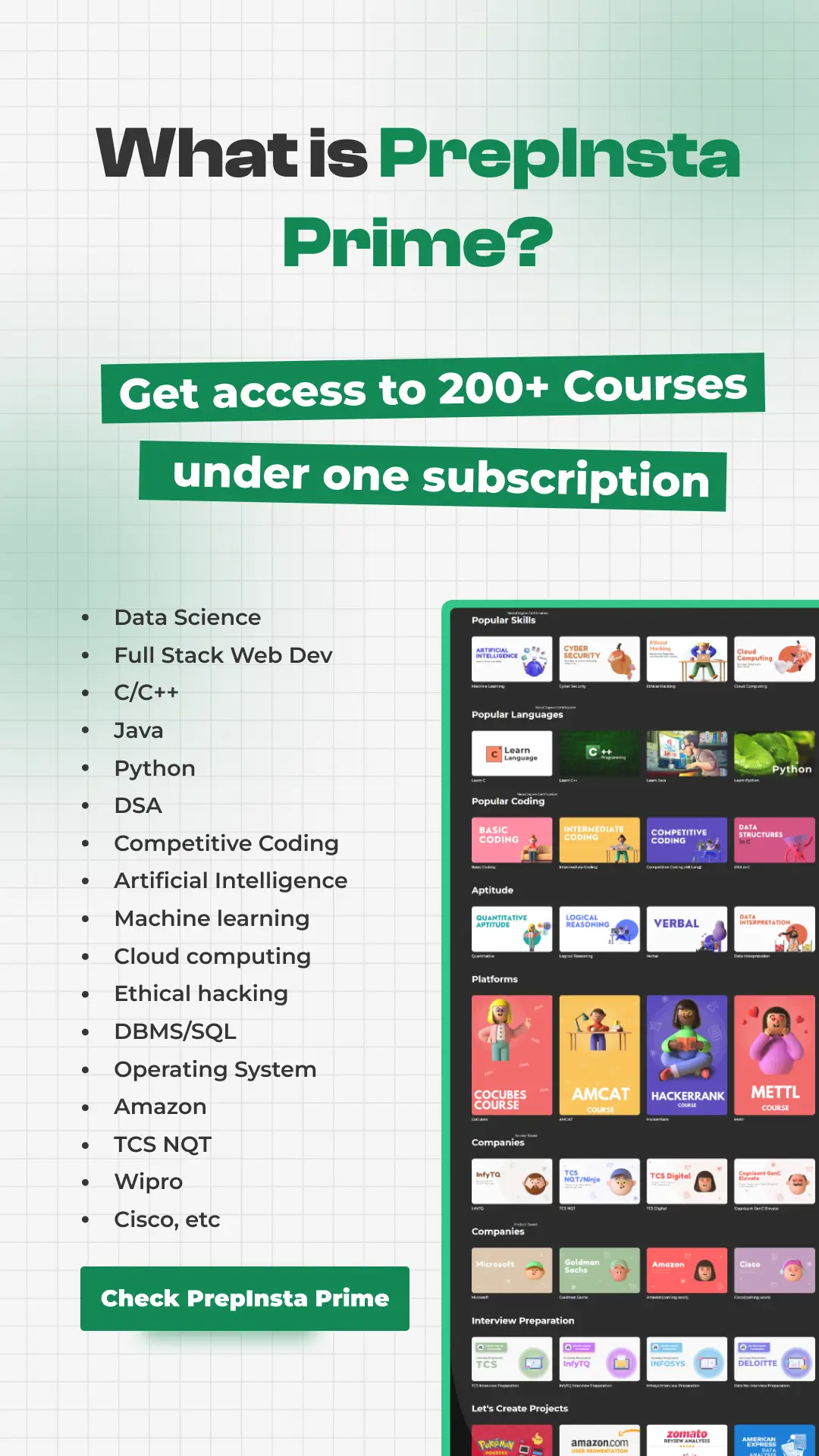
Get over 200+ Courses under One Subscription

mute

Don’t settle Learn from the Best with PrepInsta Prime Subscription

Learn from Top 1%

One Subscription, For Everything

The new cool way of learning and upskilling -

Limitless Learning

One Subscription access everything

Job Assistance

Get Access to PrepInsta Prime

Top Faculty

from FAANG/IITs/TOP MNC's

Get over 200+ course One Subscription

Courses like AI/ML, Cloud Computing, Ethical Hacking, C, C++, Java, Python, DSA (All Languages), Competitive Coding (All Languages), TCS, Infosys, Wipro, Amazon, DBMS, SQL and others.