
Why SQL and Python Are Important Data Analyst Skills in 2026
Why SQL and Python Are Important Data Analyst Skills in 2026
In 2026, businesses are generating more data than ever before. Companies across healthcare, finance, e-commerce, marketing, and technology depend on data analysts to organize, process, and interpret large amounts of information. Among all technical abilities, SQL and Python remain two of the most valuable and in-demand data analyst skills.
These tools help analysts collect data, automate tasks, create reports, and uncover insights that support business decisions. Whether someone is starting a career in analytics or planning to improve existing expertise, learning SQL and Python has become essential for long term career growth.
What Makes SQL Important for Data Analysts?
SQL, or Structured Query Language, is the standard language used to manage and retrieve data from databases. Most companies store business data inside relational database systems, making SQL one of the core skills every analyst must learn.
Data analysts use SQL to:
- Extract data from large databases
- Filter and sort business information
- Combine multiple datasets
- Create reports and dashboards
- Analyze customer behavior
- Track sales and performance metrics
SQL allows analysts to work directly with raw data efficiently. Without SQL knowledge, handling business databases becomes difficult in modern analytics environments.
Common SQL Operations Used by Analysts
In the modern data driven business environment, SQL plays a major role in helping analysts manage, organize, and interpret large volumes of information. Almost every company that works with customer data, sales reports, website traffic, or financial records relies on SQL to extract meaningful insights from databases. For this reason, understanding common SQL operations has become one of the most valuable technical skills for professionals working in data analysis.
Data analysts use SQL daily to clean datasets, filter information, combine tables, identify trends, and generate reports for decision making. These operations help businesses understand customer behavior, improve performance, and make smarter strategic decisions. Whether working in healthcare, finance, marketing, retail, or technology, analysts depend heavily on SQL functions to handle structured data efficiently.
Some of the most commonly used SQL operations include:
- SELECT Statements — Used to retrieve specific columns or records from a database table.
- WHERE Conditions — Help filter data based on conditions such as date, category, revenue, or customer location.
- JOIN Operations — Combine data from multiple tables to create more detailed and meaningful reports.
- GROUP BY Functions — Organize similar data into groups for easier analysis and summarization.
- Aggregate Functions — Functions like SUM(), COUNT(), AVG(), MIN(), and MAX() help analysts calculate totals, averages, and other important metrics.
- Subqueries — Allow analysts to perform complex filtering and calculations within a larger query.
- Window Functions — Useful for ranking, running totals, trend analysis, and advanced reporting tasks.
These SQL operations are essential because they allow analysts to transform raw and unorganized data into structured business insights. Instead of manually reviewing thousands of records, SQL automates the process and delivers accurate results much faster. This improves productivity and helps organizations make data-backed decisions with confidence.
Some key benefits of using SQL operations in data analysis include:
- Faster data extraction and reporting
- Improved data accuracy and consistency
- Better business intelligence and forecasting
- Easier identification of trends and patterns
- Efficient handling of large datasets
- Simplified reporting for management teams
As businesses continue adopting data analytics and artificial intelligence technologies, SQL remains one of the most important tools for data professionals. Learning these common SQL operations can significantly improve analytical skills and open opportunities for higher-paying roles in the data industry.
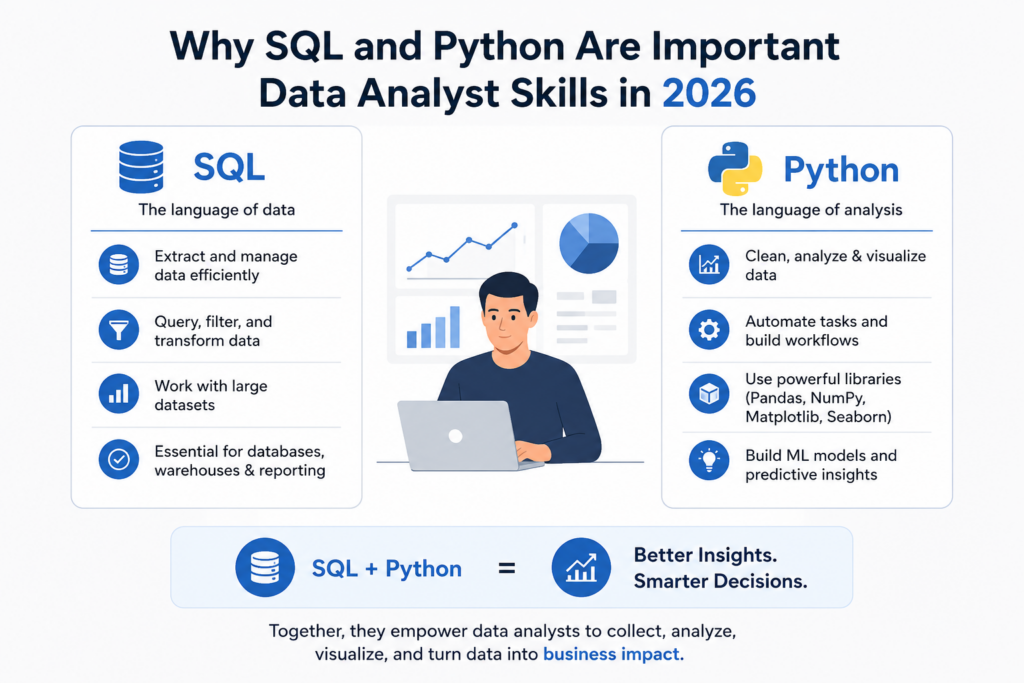
Why Python Is a Powerful Data Analyst Skill
In today’s fast growing digital world, Python has become one of the most important tools for data analysts. Companies across industries use Python to manage large datasets, automate repetitive tasks, and generate valuable business insights more efficiently. Its simple syntax and beginner-friendly structure make it easier to learn compared to many other programming languages, which is one reason why Python continues to dominate the data analytics industry in 2026.
Unlike traditional spreadsheet software that has limitations with large-scale data handling, Python allows analysts to work with massive datasets quickly and accurately. It also supports advanced analytics techniques that help businesses improve decision-making, forecasting, customer targeting, and operational efficiency. Because of its flexibility, Python is now considered a core skill for modern data professionals.
Major Areas Where Python Is Used in Data Analytics
Data Cleaning and Preparation
Raw business data is often incomplete, unorganized, or filled with errors. Python helps analysts clean datasets by removing duplicates, handling missing values, correcting formatting issues, and preparing information for analysis.
Data Visualization
Python allows analysts to create professional charts, dashboards, graphs, and visual reports. Visual representation of data makes it easier for businesses to understand trends, customer behavior, and performance metrics.
Statistical Analysis
Analysts use Python to perform statistical calculations, hypothesis testing, correlation analysis, and probability-based reporting. These insights help companies make data-driven business decisions.
Predictive Analytics
Python supports predictive modeling techniques that help organizations forecast future sales, customer trends, market demand, and financial performance using historical data.
Machine Learning
One of Python’s biggest advantages is its strong support for machine learning and artificial intelligence. Analysts can build intelligent systems that detect patterns, automate decisions, and improve business efficiency.
Automation
Python automates repetitive tasks such as report generation, data collection, email processing, and workflow management. This saves time and increases productivity for data teams.
Big Data Processing
Modern organizations generate enormous amounts of data every day. Python helps analysts process and analyze large datasets efficiently using advanced data-processing frameworks and libraries.
Why Businesses Value Python Skills in 2026
As companies continue investing in artificial intelligence, cloud computing, and business automation, the demand for Python skills has increased significantly. Employers now prefer analysts who can combine technical knowledge with automation and analytical thinking.
Some major reasons businesses value Python include:
- Faster data processing and analysis
- Strong integration with AI technologies
- Easy automation of repetitive tasks
- Better scalability for large projects
- Support for advanced business intelligence
- High compatibility with modern analytics tools
Python is no longer just an optional technical skill. In 2026, it has become a critical requirement for data analysts who want to work on advanced analytics projects and secure high-paying career opportunities in the growing data industry.
- Pandas
- NumPy
- Matplotlib and Seaborn
- Scikit-learn

How SQL and Python Work Together
In modern data analytics, SQL and Python are considered one of the most powerful combinations for handling business data efficiently. While SQL is mainly used to retrieve, filter, and organize structured data from databases, Python helps analysts perform deeper analysis, automation, and visualization. Together, they create a complete workflow that allows businesses to turn raw information into actionable insights.
Most organizations use SQL to access important business data such as customer records, sales reports, website activity, and financial transactions. Once the data is extracted, Python is used to clean datasets, identify trends, build predictive models, and generate visual reports for decision-making.
Typical Workflow of SQL and Python in Data Analytics
- SQL retrieves data from company databases and organizes it into structured formats.
- Python cleans and processes data by removing errors, duplicates, and missing values.
- Python performs advanced analysis such as forecasting, trend analysis, and automation.
- Visualization tools create dashboards and reports for business teams and stakeholders.
- Analysts share insights that help companies improve strategy and performance.
Benefits of Learning SQL and Python in 2026
As businesses continue investing in artificial intelligence, automation, and data-driven strategies, SQL and Python have become two of the most valuable technical skills for data professionals. Learning these technologies not only improves analytical capabilities but also increases career opportunities across multiple industries.
Growing Industry Demand
Companies in finance, healthcare, retail, marketing, technology, and e-commerce actively hire professionals who can work with data efficiently. Analysts with strong SQL and Python knowledge are highly preferred because they can manage databases, automate workflows, and generate business insights faster.
Excellent Career Opportunities
Mastering these skills can open doors to several high-paying career paths, including:
- Business Analytics
- Data Science
- Marketing Analytics
- Financial Analysis
- AI and Machine Learning
- Data Engineering
- Faster Automation and Productivity
Python helps automate repetitive tasks such as report generation, data cleaning, and data processing. This improves efficiency, reduces manual work, and allows analysts to focus more on strategic decision-making.
Strong Database Management Skills
SQL enables analysts to retrieve, filter, and organize massive amounts of business data accurately. It also helps professionals work confidently with large databases used by modern organizations.
Better Future Career Security
With the rapid growth of AI-powered analytics and cloud technologies in 2026, SQL and Python continue to remain essential skills in the data industry. Professionals who learn both technologies are more likely to secure long-term career growth and better salary opportunities.
Future of Data Analyst Skills in 2026
The demand for data-driven decision-making continues to grow globally. As artificial intelligence and cloud technologies evolve, analysts who understand SQL and Python will remain highly valuable.
Future trends include:
- AI-powered analytics
- Real-time data processing
- Cloud-based databases
- Automated reporting systems
- Predictive business intelligence
Organizations now prefer professionals who can combine database management with programming and automation skills.
Best Ways to Learn SQL and Python
Beginners can start learning these skills through online courses, practice projects, and certification programs.
Effective learning methods include:
- Building real-world projects
- Practicing SQL queries daily
- Working with datasets
- Learning Python libraries
- Creating dashboards and reports
- Participating in analytics competitions
Consistent practice is the fastest way to improve analytical and technical abilities.
Conclusion
SQL and Python have become essential data analyst skills in 2026 because they help professionals manage, analyze, and automate large amounts of business data. SQL provides strong database handling capabilities, while Python supports advanced analytics, visualization, and machine learning.
Professionals who develop expertise in both technologies can improve career opportunities, increase productivity, and stay competitive in the rapidly growing analytics industry. As businesses continue relying on data-driven strategies, SQL and Python will remain among the most valuable technical skills for future data analysts.
Frequently Asked Questions
Answer:
SQL and Python are important because companies rely heavily on data-driven decisions. SQL helps analysts access and manage data stored in databases, while Python supports automation, visualization, and advanced analytics. Together, these tools improve efficiency and help businesses understand large datasets more effectively.
Answer:
Both SQL and Python are equally important because they serve different purposes. SQL is mainly used for retrieving and organizing data from databases, whereas Python is used for cleaning, analyzing, automating, and visualizing data. Most professional data analysts use both tools together in real-world projects.
Answer:
Yes, beginners can learn SQL and Python with regular practice and project-based learning. SQL is considered beginner-friendly because of its simple query structure, while Python has easy-to-read syntax compared to many programming languages. Many online platforms also provide beginner courses and practical exercises.
Answer:
Learning SQL and Python can open opportunities in several data-related careers. Common job roles include data analyst, business analyst, reporting analyst, data scientist, financial analyst, and marketing analyst. These skills are also useful in machine learning, artificial intelligence, and business intelligence careers.
Answer:
Yes, the demand for SQL and Python skills continues to grow in 2026. Companies across healthcare, finance, e-commerce, and technology industries actively hire professionals who can analyze and automate data processes. These skills remain essential because businesses increasingly depend on analytics and AI-based systems.