
What You Learn in IBM Data Analyst Professional Certificate
What You Learn in IBM Data Analyst Professional Certificate
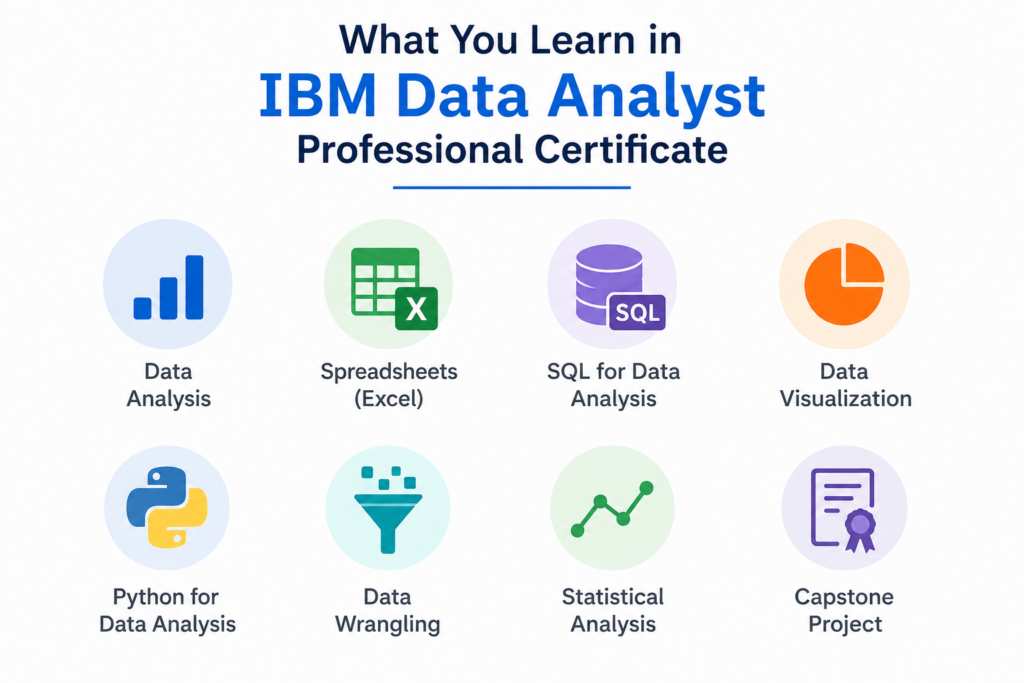
The IBM Data Analyst Professional Certificate is one of the most popular online programs for beginners who want to build strong data analytics skills. It is designed to help learners understand how data is collected, analyzed, visualized, and used for business decision making.
Whether you are a student, job seeker, or working professional, the IBM Data Analyst Professional Certificate provides practical knowledge that helps you prepare for real-world data analyst roles.

Introduction to Data Analytics
The course begins with the fundamentals of data analytics and introduces learners to the role of a data analyst in modern organizations.
Students learn:
- What data analytics means
- Different types of data
- How companies use data
- The responsibilities of a data analyst
- Basic problem solving methods
- The importance of data driven decision making
This foundational knowledge helps beginners understand how analytics supports business growth and operational efficiency.
The course also explains how data analysts collect information, identify patterns, and convert raw numbers into meaningful business insights.
Learning Microsoft Excel for Data Analysis
Excel remains one of the most widely used tools in the data analytics industry. The IBM Data Analyst Professional Certificate helps learners build strong Excel skills that are essential for organizing, cleaning, analyzing, and presenting data effectively. Since many businesses still use spreadsheets for daily reporting and decision-making, Excel knowledge continues to be highly valuable for beginners entering the analytics field.
The course introduces learners to important Excel functions that improve productivity and data handling accuracy. Students learn how to work with structured datasets, business records, and numerical information in a professional way.
- Topics Covered in Excel Training
- Spreadsheet formatting and data organization
- Data sorting and filtering techniques
- Formulas and built-in Excel functions
- Conditional formatting for highlighting insights
- Pivot tables for data summarization
- Charts and graphs for visualization
- Data cleaning and preparation methods
- Basic reporting and dashboard creation
- Trend analysis and performance tracking
Learners also practice creating reports and dashboards that help present business information clearly. Visual elements such as charts, tables, and summaries make it easier to identify trends and support decision making processes.
Another important part of the training focuses on improving analytical thinking through spreadsheet based problem solving. Students learn how to manage large datasets efficiently and extract meaningful insights from raw information.
Understanding Data Visualization
Data visualization is one of the most important skills for a data analyst because it helps communicate insights clearly.
The IBM Data Analyst Professional Certificate teaches how to present complex information using visual tools and charts.
Learners practice creating:
- Bar charts
- Pie charts
- Line graphs
- Histograms
- Dashboards
- Interactive visual reports
Visualization techniques make it easier for businesses to identify trends, compare performance, and make informed decisions quickly.
The program also teaches how good visual design improves readability and helps audiences understand analytical findings more effectively.
SQL and Database Skills
Databases are an essential part of modern data analysis. Companies store large amounts of information inside database systems, and analysts use SQL to access and analyze that data.
The certification provides beginner-friendly SQL training, including:
- Database fundamentals
- Writing SQL queries
- Selecting and filtering records
- Sorting data
- Using aggregate functions
- Combining tables with joins
- Extracting business insights from databases
SQL skills are considered essential for many entry-level data analyst jobs because analysts frequently work with large datasets stored in relational databases.
Learning SQL also improves logical thinking and helps learners understand how business information is organized.
Python Programming for Data Analysis
Python has become one of the most important programming languages in data analytics. The IBM Data Analyst Professional Certificate introduces Python in a simple and beginner-friendly way.
Students learn:
- Python basics
- Variables and data types
- Loops and functions
- Working with datasets
- Data manipulation
- Data analysis libraries
The program also introduces popular Python libraries such as:
- Pandas
- NumPy
- Matplotlib
These tools help analysts clean, process, and visualize large amounts of data efficiently.
Python skills provide a major advantage because many companies now use automation and advanced analytics techniques for faster business insights.

Data Cleaning and Preparation
Real world data is often incomplete, inconsistent, or messy. One of the most important responsibilities of a data analyst is preparing data before analysis.
The course teaches students how to:
- Remove duplicate records
- Handle missing values
- Correct formatting errors
- Standardize datasets
- Improve data quality
- Organize information for reporting
Data cleaning is a critical skill because poor-quality data can lead to inaccurate analysis and wrong business decisions.
By learning proper data preparation methods, students understand how to improve analytical accuracy and reliability.
Working With Real World Projects
A major strength of the IBM Data Analyst Professional Certificate is its project-based learning approach.
Instead of only reading theory, students complete hands-on assignments and practical exercises that simulate real business scenarios.
Projects may involve:
- Analyzing sales data
- Creating dashboards
- Cleaning datasets
- Writing SQL queries
- Building reports
- Performing trend analysis
These practical exercises help learners apply their knowledge in realistic situations and improve problem solving skills.
Project experience also helps students build a professional portfolio that can be added to resumes or job applications.
Learning Data Analysis Workflows
The IBM Data Analyst Professional Certificate teaches learners a structured data analysis workflow that is commonly used by professional analysts in real business environments. Understanding this step by step process helps beginners develop a systematic approach to handling data and solving analytical problems efficiently.
The course explains how raw data moves through different stages before it becomes meaningful business insight. By following a proper workflow, analysts can improve accuracy, reduce errors, and make better data-driven decisions.
Major Stages of Data Analysis
1. Data Collection
The first step involves gathering information from multiple sources such as:
- Spreadsheets
- Databases
- APIs
- Cloud platforms
- CSV files
- Business reports
Students learn how to identify reliable data sources and organize collected information for further analysis.
2. Data Cleaning
Raw data often contains missing values, duplicate entries, formatting issues, and inconsistencies. Learners understand how to clean and prepare datasets to improve analysis accuracy and maintain data quality.
3. Data Exploration
In this stage, students examine datasets to identify patterns, trends, correlations, and unusual observations. They learn how to interpret data and discover useful insights that can support business strategies and decision-making.
4. Data Visualization
The certification also teaches learners how to present information visually using:
- Charts
- Graphs
- Dashboards
- Tables
- Visual reports
Visualization helps simplify complex information and makes insights easier to understand for teams and organizations.
5. Reporting Insights
Students learn how to communicate analytical findings clearly and professionally. This includes explaining trends, summarizing results, and presenting recommendations in a way that supports business decisions.
The workflow-based training in the IBM Data Analyst Professional Certificate helps learners develop practical problem-solving abilities and professional analytical thinking. By understanding each stage of the process, beginners become more confident in handling real-world analytics tasks and business data projects.
- Junior Data Analyst
- Reporting Analyst
- Data Coordinator
- Business Intelligence Assistant
Why Beginners Choose IBM Data Analyst Professional Certificate
Many beginners prefer this certification because it combines technical learning with practical projects. The program does not require advanced coding experience, making it accessible for non technical learners.
Key reasons why learners choose this certification include:
- Beginner-friendly structure
- Practical learning approach
- Flexible study schedule
- Real-world projects
- Industry-recognized training
- Strong focus on job-ready skills
The combination of theory and practical experience makes the certification useful for developing professional analytical capabilities.
Conclusion
The IBM Data Analyst Professional Certificate provides comprehensive training in data analytics, visualization, spreadsheets, SQL, Python, reporting, and business problem-solving. It helps beginners build both technical and analytical skills required for modern data-focused careers.
By combining structured lessons with hands-on projects, the certification prepares learners to understand real-world datasets, create meaningful reports, and support data-driven decision-making processes.
For anyone interested in starting a career in analytics, the IBM Data Analyst Professional Certificate offers a strong learning foundation and practical industry-relevant experience.
Frequently Asked Questions
Answer:
Learners can develop practical skills in Excel, SQL, Python, data visualization, reporting, and dashboard creation. The course also teaches data cleaning and analytical thinking. These skills help beginners understand how businesses use data for decision-making.
Answer:
Yes, the IBM Data Analyst Professional Certificate is designed for beginners and does not require advanced coding knowledge. The lessons start with basic concepts and gradually introduce technical tools. This makes the program suitable for students, freshers, and career changers.
Answer:
Yes, the program includes hands-on assignments and real-world projects that help learners apply their knowledge practically. Students work with datasets, create visual reports, and practice analytical workflows. These projects also help build a professional portfolio.
Answer:
After completing the course, learners may apply for entry-level roles such as junior data analyst, reporting assistant, business analyst support, or data visualization assistant. The skills learned in the program are useful in many industries including finance, healthcare, and marketing.
Answer:
The IBM Data Analyst Professional Certificate can usually be completed within a few months depending on the learner’s pace and study schedule. Since the program is online and flexible, students can learn according to their own availability and comfort level.