
Types Of Data Analytics
Types of Data Analytics: A Simple Guide
- Data analytics has revolutionized how organizations make decisions, solve problems, and predict future trends. To fully leverage its potential, it’s important to understand the types of data analytics and their applications.
- In this article, we’ll explore the four main types of data analytics, their uses, and how they benefit businesses and industries.

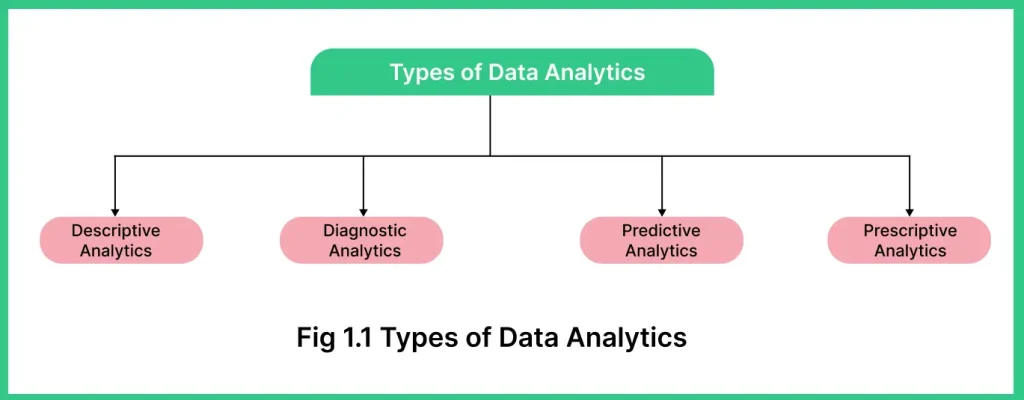
The Four Types of Data Analytics
Descriptive Analytics
This type of data analytics focuses on summarizing historical data to understand what has happened in the past.
- Purpose: Provides a clear picture of past performance.
- Example: Monthly sales reports or website traffic analysis.
- Tools: Excel, Google Analytics, and Tableau.
Diagnostic Analytics
Diagnostic analytics delves deeper into the data to uncover the reasons behind past outcomes.
- Purpose: Answers the question, “Why did this happen?”
- Example: Analyzing a sudden drop in sales by examining customer feedback and market trends.
- Tools: SQL, Python, and R.
Predictive Analytics
Predictive analytics uses statistical models and machine learning to forecast future outcomes based on historical data.
- Purpose: Helps organizations anticipate future trends and behaviors.
- Example: Predicting customer churn in a subscription-based business.
- Tools: Scikit-learn, TensorFlow, and SAS.
Prescriptive Analytics
Prescriptive analytics suggests specific actions to achieve desired outcomes. It uses optimization and simulation algorithms to recommend the best course of action.
- Purpose: Answers the question, “What should we do?”
- Example: Determining optimal pricing strategies or supply chain management.
- Tools: IBM CPLEX, Gurobi, and AIMMS.
Applications of Different Types of Data Analytics
- Descriptive Analytics: Performance monitoring, financial reporting.
- Diagnostic Analytics: Root cause analysis, process improvement.
- Predictive Analytics: Demand forecasting, fraud detection.
- Prescriptive Analytics: Strategic planning, resource allocation.
Tools for Data Analytics
How to Learn Data Analytics?
If you’re interested in pursuing a career in data analytics, here’s how to get started:
- Learn the Basics: Understand the types and techniques of data analytics.
- Master Tools: Gain hands-on experience with Excel, Python, and Tableau.
- Take Courses: Platforms like Coursera, Udemy, and FutureLearn offer excellent courses.
- Work on Projects: Analyze datasets to strengthen your skills.
Conclusion
Understanding the types of data analytics—descriptive, diagnostic, predictive, and prescriptive—is vital for making informed decisions in any industry. Each type has unique applications, and together they provide a holistic approach to solving business challenges. By mastering these analytics types and the tools associated with them, you can unlock the full potential of data-driven insights.