
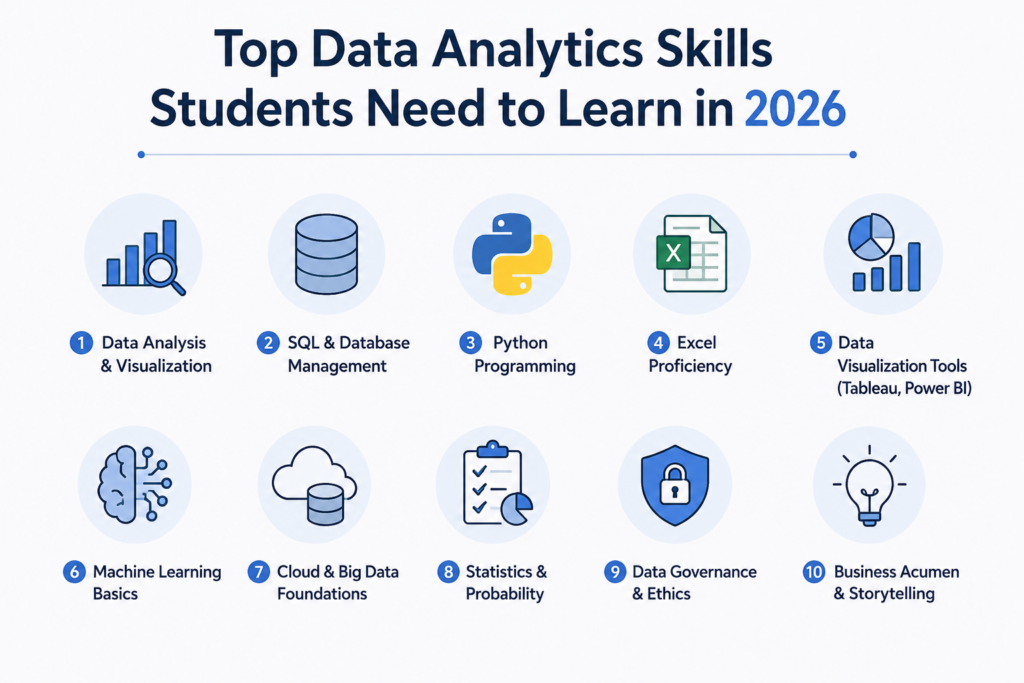
Top Data Analytics Skills Students Need to Learn in 2026
Top Data Analytics Skills Students Need to Learn in 2026
The demand for data professionals is growing rapidly across industries. From healthcare and finance to marketing and e-commerce, companies are using data to make smarter business decisions. Because of this, students who want successful careers in technology and business must focus on learning the right Data Analytics Skills in 2026.
Modern organizations are no longer looking for only theoretical knowledge. They want professionals who can analyze information, solve business problems, and create meaningful insights from data. Learning the latest analytics tools and technologies can help students improve job opportunities and stay ahead in the competitive market.

Why Data Analytics Is Becoming a Top Career Choice
The digital world is generating enormous amounts of data every second. Businesses collect information from websites, social media, online transactions, customer feedback, mobile applications, and cloud platforms. However, raw data alone has no value unless professionals can analyze and convert it into useful insights.
This is where analytics professionals play a major role. Companies are actively hiring skilled candidates who can understand patterns, predict trends, and support business growth using data-driven strategies.
Some major reasons why analytics careers are growing rapidly include:
- Increased adoption of Artificial Intelligence
- Expansion of cloud computing technologies
- Rising demand for business intelligence solutions
- Growth of digital marketing analytics
- Need for real-time decision making
- Higher focus on customer experience optimization
Because of these industry trends, learning modern analytics tools has become essential for students preparing for future careers.
1. SQL and Database Management
SQL is considered one of the most important technical skills for aspiring analysts. Almost every organization stores data in databases, and SQL helps professionals retrieve, organize, and analyze that information efficiently.
Students should focus on understanding:
- Basic and advanced SQL queries
- Database structures and relationships
- Data filtering and sorting
- Table joins and aggregations
- Data cleaning processes
- Working with large datasets
Having strong SQL knowledge allows students to work on real-world business projects and improves practical understanding of analytics workflows.
In many companies, SQL is used daily for generating reports, tracking customer behavior, monitoring sales, and analyzing operational performance. This makes it a foundational skill for beginners entering the analytics field.
2. Python Programming for Analytics
Python has become one of the most widely used programming languages in analytics and data science. Its simple syntax and powerful libraries make it ideal for beginners as well as professionals.
Students learning analytics should practice:
- Data analysis using Pandas
- Numerical operations with NumPy
- Data visualization using Matplotlib
- Data preprocessing techniques
- Automation scripts
- Basic machine learning models
Learning Python can significantly improve practical Data Analytics Skills and help students work on industry level projects.
Python also supports automation, which helps companies save time and improve efficiency. Many organizations use Python for predictive analytics, forecasting, and business intelligence tasks.
3. Data Visualization and Dashboarding
Data visualization is one of the most valuable business skills in modern organizations. Companies prefer professionals who can present complex information in a simple and visually appealing format.
Visualization tools help businesses:
- Understand market trends
- Track business performance
- Identify customer behavior patterns
- Improve strategic planning
- Make faster decisions
Popular visualization tools students should learn include:
- Power BI
- Tableau
- Google Looker Studio
- Microsoft Excel Dashboards
Creating dashboards and reports improves communication between technical teams and business stakeholders. Strong visualization skills also increase employability in analytics roles.
4. Statistical and Analytical Thinking
Statistics is the backbone of analytics because it helps professionals interpret data accurately. Students should understand how to identify trends, compare results, and make predictions using statistical methods.
Important statistical concepts include:
- Mean, median, and mode
- Correlation analysis
- Probability concepts
- Regression techniques
- Hypothesis testing
- Data distribution analysis
These concepts help analysts make informed business decisions instead of relying on assumptions.
Analytical thinking is equally important because businesses expect professionals to solve problems logically and efficiently. Students should practice working with case studies and real datasets to strengthen decision making abilities.

5. Machine Learning Fundamentals
Machine learning is becoming an important part of modern analytics systems. While advanced AI concepts may not be necessary for beginners, students should understand the basics of machine learning models and predictive analytics.
Key topics to learn include:
- Predictive modeling
- Classification techniques
- Recommendation systems
- Forecasting models
- Model evaluation basics
Machine learning helps companies automate decisions and improve operational efficiency. Understanding these technologies can strengthen overall Data Analytics Skills for future job opportunities.
6. Excel and Spreadsheet Analysis
Even in 2026, Excel remains one of the most widely used business tools across industries. Many organizations still depend on spreadsheets for reporting, budgeting, and operational analysis.
Students should learn:
- Pivot tables
- Advanced formulas
- Charts and graphs
- Data filtering
- Conditional formatting
- Dashboard creation
Excel is especially useful for beginners because it helps them understand data organization and reporting fundamentals before moving to advanced analytics platforms.
7. Communication and Business Understanding
Technical skills alone are not enough in analytics careers. Companies prefer professionals who can explain insights clearly to non-technical teams and management.
Important soft skills include:
- Communication skills
- Presentation abilities
- Problem-solving mindset
- Critical thinking
- Team collaboration
- Business understanding
A good analyst not only works with data but also understands how data impacts business growth and decision making.
Students should also improve storytelling skills because businesses value professionals who can convert complex analytics into simple recommendations.
8. Understanding Cloud and AI Based Analytics Tools
Modern businesses are rapidly shifting toward cloud-based analytics platforms. Students should stay updated with the latest technologies and industry trends.
Some important technologies include:
- Google Cloud Analytics
- Microsoft Azure Analytics
- AWS Data Tools
- AI-powered reporting systems
- Automated business intelligence platforms
AI tools are transforming how companies collect and process data. Understanding these platforms helps students build future-ready Data Analytics Skills that align with industry requirements.
9. Real World Projects and Practical Experience
Practical learning is one of the most important aspects of analytics education. Employers often prefer candidates with project experience because it demonstrates problem-solving ability and technical understanding.
Students should work on:
- Business case studies
- Dashboard projects
- SQL practice datasets
- Python mini-projects
- Data cleaning assignments
- Visualization portfolios
Building practical projects improves confidence and strengthens resumes for internships and job applications.
Online certifications, internships, and live projects can also help students gain industry exposure and understand real business challenges.
Career Opportunities After Learning Data Analytics
Data analytics has become one of the most in-demand career fields in today’s digital world. Companies across industries are using data to improve business decisions, understand customer behavior, increase revenue, and optimize operations. Because of this growing demand, students who learn data analytics can explore a wide range of high-paying and future-focused career opportunities.
The analytics industry offers multiple career opportunities for students across different sectors. From startups to multinational companies, businesses are actively hiring professionals who can collect, analyze, and interpret data effectively. With the rise of artificial intelligence, automation, and digital transformation, the need for skilled analytics professionals is increasing every year.
Popular Job Roles in Data Analytics
Some of the most popular career options after learning data analytics include:
- Data Analyst – Works with raw data to identify trends, patterns, and business insights.
- Business Analyst – Helps companies improve business performance using data-driven strategies.
- Marketing Analyst – Analyzes customer behavior, campaign performance, and market trends.
- Financial Analyst – Uses analytics to support budgeting, forecasting, and financial planning.
- Business Intelligence Developer – Creates dashboards and reporting systems for business decision-making.
- Data Visualization Specialist – Converts complex data into easy-to-understand charts and visual reports.
- Product Analyst – Helps companies improve products by analyzing user behavior and feedback.
Industries Hiring Data Analytics Professionals
Today, almost every industry relies on data analytics to make smarter decisions. Some of the top industries hiring analytics professionals are:
- Healthcare
- Banking and Finance
- Retail
- E-commerce
- Education
- Technology
- Telecommunications
- Manufacturing
- Logistics and Supply Chain
For example, healthcare companies use analytics to improve patient care, while e-commerce platforms use data to recommend products and improve customer experience.
Why Data Analytics Is a High Growth Career
One of the biggest advantages of learning data analytics is career growth and job security. Companies are generating huge amounts of data every day, and they need skilled professionals to turn that data into useful insights. As businesses continue adopting digital technologies, the demand for analytics experts is expected to grow even more in the coming years.
Data analytics also offers:
- Competitive salary packages
- Opportunities in global companies
- Remote and hybrid job options
- Fast career growth
- Strong future demand
Students with knowledge of tools like Excel, SQL, Python, Power BI, and Tableau can gain a competitive advantage in the job market.
Final Thoughts
Data analytics is no longer limited to technology companies. Today, almost every industry uses data to improve decision-making, customer experience, and business growth. Students who start learning analytics early can build strong career opportunities in the future.
By focusing on programming, visualization, statistics, machine learning, and business understanding, students can develop industry-ready Data Analytics Skills that companies actively seek in 2026.
Continuous learning, practical projects, and staying updated with modern technologies will help students stand out in the competitive job market and prepare for long-term career success in the digital economy.
Frequently Asked Questions
Answer:
Students should focus on learning SQL, Python, data visualization, statistics, Excel, and basic machine learning concepts. These skills help in analyzing business data, creating reports, and making data-driven decisions. Companies across industries are actively hiring professionals with strong analytics knowledge.
Answer:
Basic coding knowledge is highly beneficial for data analytics careers. Languages like Python and SQL help students clean data, automate tasks, and perform advanced analysis. However, beginners can start with tools like Excel and Power BI before moving into programming languages.
Answer:
Some of the most popular analytics tools include Power BI, Tableau, SQL, Python, Excel, and Google Looker Studio. These tools are widely used for data visualization, reporting, and business analysis. Learning these platforms improves practical industry skills and job opportunities.
Answer:
Students can apply for roles such as Data Analyst, Business Analyst, Marketing Analyst, Financial Analyst, and BI Developer. Analytics professionals are in demand across industries like healthcare, banking, e-commerce, retail, and technology. The field also offers strong salary growth and long-term career stability.
Answer:
Students can improve their analytics skills by working on real-world projects, practicing SQL and Python regularly, and creating dashboards using visualization tools. Online certifications, internships, and case studies also help build practical experience and industry knowledge.