
Top Data Analyst Skills Required for High Paying Jobs in 2026
Top Data Analyst Skills Required for High Paying Jobs in 2026
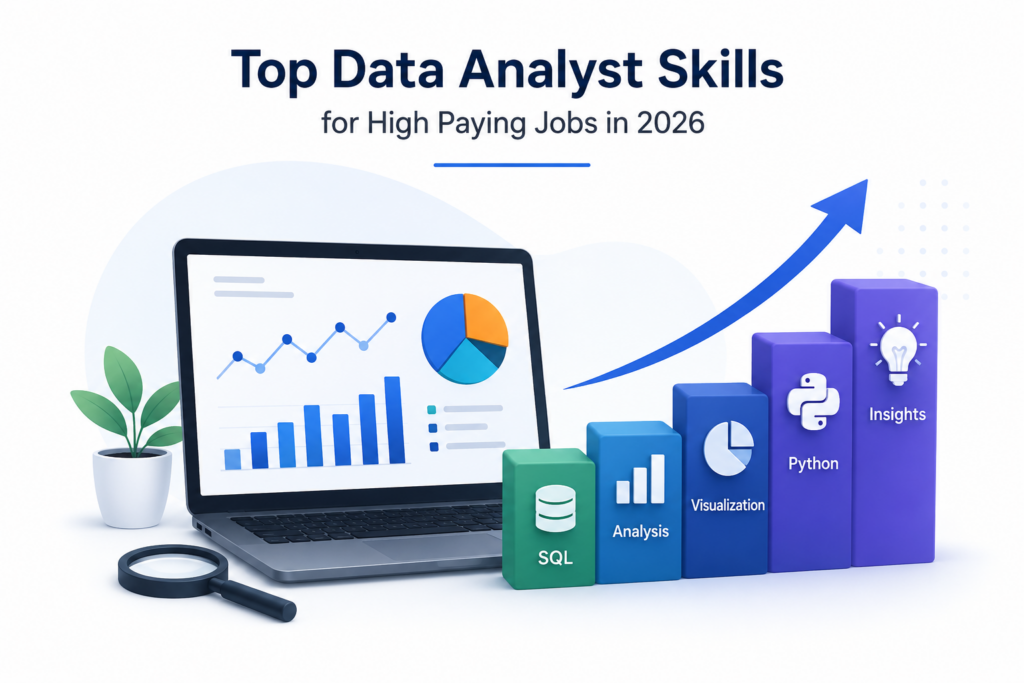
The demand for skilled data professionals is growing rapidly across industries. From healthcare and finance to eCommerce and artificial intelligence, companies are investing heavily in data driven decision making. Because of this shift, professionals with strong Data Analyst Skills are securing some of the highest paying jobs in the tech industry.
In 2026, employers are not only looking for candidates who can read spreadsheets. They want professionals who can analyze complex datasets, create meaningful reports, and help businesses make smarter decisions. Understanding the most important Data Analyst Skills can help beginners and professionals stay competitive in the modern job market.

Why Data Analyst Skills Are Important in 2026
Businesses generate massive amounts of data every day. Without proper analysis, this information has little value. Data analysts help companies transform raw data into useful insights that improve marketing, operations, customer experience, and profitability.
Modern organizations now rely on:
- Business intelligence
- Predictive analytics
- Real-time reporting
- Data visualization
- AI-driven insights
Because of these trends, professionals with advanced Data Analyst Skills are in high demand worldwide.
SQL and Database Management
SQL is one of the most important skills for data analysts because almost every company stores its business data in databases. Analysts use SQL to collect, organize, filter, and analyze that data to support business decisions. From customer records to sales reports, SQL helps professionals work with large amounts of structured information quickly and accurately.
Key SQL abilities include:
- Writing queries
- Using joins and subqueries
- Managing databases
- Creating reports
- Filtering large datasets
- Cleaning and organizing data
- Using aggregate functions
- Analyzing grouped data
SQL also helps analysts identify trends, compare business performance, and generate detailed reports. By combining data from multiple tables, analysts can better understand customer behavior, revenue growth, and operational performance.
Another important advantage of SQL is improving data accuracy. Analysts often use SQL to remove duplicate records, fix missing values, and maintain clean datasets. This makes reports more reliable and helps companies make better decisions.
Database management skills are equally valuable because analysts regularly work with large databases containing thousands or even millions of records. Understanding database structures helps improve query performance and makes data retrieval faster and more efficient.
Strong SQL knowledge allows data analysts to work confidently with business data, improve reporting accuracy, and support data driven decision making in modern organizations.
Excel and Spreadsheet Expertise
Even with the growth of modern analytics tools, Excel continues to be one of the most widely used tools in data analysis. Many businesses still depend on spreadsheets for daily reporting, budgeting, forecasting, and tracking business performance. Because of its flexibility and ease of use, Excel remains an essential skill for data analysts across different industries.
Important Excel features include:
- Pivot tables
- VLOOKUP and XLOOKUP
- Conditional formatting
- Data cleaning
- Dashboard creation
- Charts and graphs
- Formula based calculations
- Data filtering and sorting
Data analysts use Excel to organize large datasets, identify trends, and create easy-to-understand reports. Pivot tables help summarize complex data quickly, while formulas and lookup functions make data processing faster and more accurate.
Excel is also useful for creating dashboards and visual reports that help management understand business performance clearly. Strong spreadsheet skills improve productivity, reduce manual work, and help analysts present data in a more professional way.
Even in 2026, advanced spreadsheet expertise continues to be one of the most valuable Data Analyst Skills for high paying jobs and business reporting roles.
Python Programming for Data Analysis
Python is now considered one of the most important technologies in the data analytics industry. Its simple syntax, powerful libraries, and automation capabilities make it a preferred programming language for both beginners and experienced professionals. Companies use Python to handle large datasets, automate repetitive tasks, and perform advanced analysis more efficiently.
One of the biggest advantages of Python is its ability to simplify complex data processes. Analysts can clean raw data, organize information, identify trends, and generate reports using fewer lines of code compared to many traditional tools. This improves productivity and saves valuable time in business operations.
Popular Python Libraries Used in Data Analysis
- Pandas – Used for data cleaning, filtering, and manipulation
- NumPy – Helps perform mathematical and numerical operations
- Matplotlib – Used for creating charts and data visualizations
- Scikit-learn – Supports machine learning and predictive modeling
- Seaborn – Creates advanced and visually attractive graphs
Python is also highly useful for automation. Data analysts can automate reporting tasks, update dashboards, and process large amounts of business data without manual effort. This makes workflows faster and reduces the chances of human error.
Another reason Python is becoming more valuable is its strong role in machine learning and predictive analytics. Businesses now rely on data driven forecasting to improve decision-making, customer targeting, and business growth. Python provides the tools needed to build predictive models and analyze future trends more effectively.
Why Python is Important for Data Analysts
- Handles large datasets efficiently
- Automates repetitive tasks
- Improves reporting speed
- Supports data visualization
- Helps build predictive models
- Widely used across industries
As companies continue investing in artificial intelligence and advanced analytics, Python programming remains one of the most valuable and in-demand skills for data analysts in 2026.
Data Visualization Skills
Data visualization has become an essential part of modern data analysis because businesses prefer clear and visual reports over complex spreadsheets and raw numbers. Visual data helps companies understand performance, identify patterns, and make faster business decisions. A skilled data analyst must know how to present information in a simple and visually engaging way.
Today, organizations use visualization tools to transform large datasets into easy-to-read dashboards, reports, and charts. These visuals help managers and teams quickly understand important business insights without needing technical knowledge.
Commonly Used Data Visualization Tools
- Tableau
- Power BI
- Google Data Studio
- Looker
These platforms allow analysts to create professional reports, automate dashboards, and monitor business performance in real time. Many companies use them for sales analysis, customer tracking, marketing performance, and financial reporting.
Important Visualization Skills for Data Analysts
- Creating interactive dashboards
- Designing charts and graphs
- Building KPI reports
- Developing trend analysis visuals
- Presenting business insights clearly
- Using filters and data comparisons
- Creating visual storytelling reports
Good visualization skills help businesses communicate complex information more effectively. Instead of reading long reports, decision makers can quickly understand trends through graphs, charts, and visual summaries.
Data visualization also improves communication between technical and non technical teams. It allows analysts to explain insights in a simple format that managers, clients, and stakeholders can easily understand.
As data driven decision making continues to grow, visualization remains one of the most valuable Data Analyst Skills for high paying jobs in 2026.

Statistical and Analytical Thinking
Strong analytical thinking is one of the most important qualities of a successful data analyst. Companies not only look for technical skills but also want professionals who can understand data, solve problems, and make smart business decisions using logical analysis.
Statistical knowledge helps analysts identify patterns, measure performance, and make accurate predictions based on available data. These skills are widely used in business forecasting, customer analysis, market research, and performance tracking.
Important Statistical Concepts
- Probability
- Regression analysis
- Hypothesis testing
- Correlation
- Forecasting
- Data interpretation
- Trend analysis
Analytical thinking also helps data analysts find hidden insights inside complex datasets. Instead of only creating reports, analysts use statistics to explain why trends happen and what actions businesses should take next.
Professionals with strong statistical and analytical skills can improve decision making, reduce business risks, and support long term growth strategies. In 2026, these abilities continue to be highly valuable for high paying data analyst roles.
Machine Learning Basics
In 2026, machine learning is becoming an important part of the data analytics industry. Many companies now expect data analysts to understand the basic concepts of artificial intelligence and predictive analytics. Although data analysts may not always build advanced AI systems, they are often required to work with machine learning models, understand predictions, and analyze automated insights.
Machine learning helps businesses identify patterns, predict future outcomes, and improve decision-making using historical data. Companies use these technologies in areas like customer behavior analysis, sales forecasting, fraud detection, product recommendations, and marketing optimization.
Useful Machine Learning Concepts
- Classification models
- Clustering techniques
- Data prediction
- Recommendation systems
- Model evaluation
- Pattern recognition
- Forecasting models
- Data training and testing
Understanding these concepts allows analysts to work more effectively with data science teams and AI-powered tools. Analysts can also use machine learning to automate repetitive analytical tasks and improve reporting accuracy.
Basic AI and machine learning knowledge can significantly increase career opportunities for data professionals. As more businesses adopt automation and predictive systems, analysts with machine learning skills are becoming more valuable in the job market.
Communication and Presentation Skills
Technical expertise alone is not enough for a successful data analyst career. Analysts must also know how to communicate findings clearly and present data in a way that business teams can easily understand. Strong communication skills help organizations make faster and smarter decisions based on analytical insights.
Data analysts often work with managers, clients, executives, and non technical teams. Because of this, they must explain complex information using simple language, clear reports, and visual presentations.
Why Communication Skills Are Important
- Present reports clearly
- Explain business insights effectively
- Support strategic decisions
- Collaborate with different teams
- Improve stakeholder understanding
- Simplify technical information
- Build confidence in reports
Presentation skills also help analysts create professional dashboards, visual reports, and business summaries. Clear communication reduces confusion and allows companies to act quickly on important data insights.
Professionals who combine technical knowledge with strong communication abilities often secure leadership roles faster because they can bridge the gap between data teams and business management.
Business Intelligence Knowledge
Business intelligence has become one of the most valuable areas in modern analytics. Companies rely heavily on BI systems to track performance, monitor growth, and improve business strategies. Analysts with business intelligence expertise are highly demanded across industries such as healthcare, finance, retail, e-commerce, and technology.
Business intelligence tools help transform raw business data into meaningful visual reports and dashboards. These systems allow companies to monitor key performance indicators and make data-driven decisions more efficiently.
Important BI Skills
- Dashboard development
- KPI tracking
- Automated reporting
- Data modeling
- Performance analysis
- Business reporting
- Trend monitoring
- Data visualization integration
BI analysts help organizations identify growth opportunities, measure productivity, and improve operational efficiency. Many companies now depend on real-time dashboards and automated reporting systems to track daily business performance.
Strong business intelligence knowledge also improves an analyst’s ability to work with large datasets and generate actionable insights for management teams.
Cloud and Big Data Technologies
As businesses continue generating massive amounts of information, cloud computing and big data technologies are becoming essential in the analytics industry. Traditional data systems are often not enough to handle modern business data, which is why companies are moving toward cloud-based platforms and scalable analytics solutions.
Cloud technologies help organizations store, manage, and process large datasets more efficiently while reducing infrastructure costs. Data analysts with cloud and big data knowledge are becoming highly valuable in enterprise level companies.
Popular Cloud and Big Data Platforms
- AWS
- Microsoft Azure
- Google Cloud Platform
- Hadoop
- Spark
- Cloud based databases
- Big data processing tools
Understanding cloud analytics allows analysts to work with real-time business data, large scale reporting systems, and advanced analytical platforms. These technologies are widely used in industries like finance, healthcare, e-commerce, cybersecurity, and digital marketing.
Big data technologies also improve data processing speed and help organizations analyze millions of records quickly. Analysts with cloud computing skills often qualify for higher-paying technical and enterprise analytics roles.
Future of Data Analyst Careers
The future of data analytics looks extremely strong as companies continue investing in artificial intelligence, automation, and data-driven business strategies. Organizations across almost every industry now depend on analytics to improve decision-making, increase efficiency, and understand customer behavior more effectively.
As technology continues evolving, the demand for skilled data analysts is expected to grow rapidly in 2026 and beyond. Companies are actively searching for professionals who can combine technical expertise, analytical thinking, and business intelligence knowledge.
High Paying Data Analyst Roles
- Business Data Analyst
- Financial Data Analyst
- Marketing Analyst
- BI Analyst
- Data Visualization Specialist
- AI Data Analyst
- Product Analyst
- Operations Analyst
Future data analyst roles will focus more on automation, predictive reporting, machine learning, and cloud analytics. Professionals who continuously upgrade their Data Analyst Skills will have better career growth, stronger job security, and access to higher salary opportunities.
Data analytics is no longer limited to large technology companies. Industries like healthcare, banking, retail, education, manufacturing, and digital marketing are all increasing their demand for skilled analysts, making this career path one of the fastest-growing professions in the modern job market.
Conclusion
The demand for skilled data professionals is expected to grow significantly in 2026. Companies want analysts who can combine technical expertise, analytical thinking, and business understanding to solve real world problems.
Learning modern Data Analyst Skills such as SQL, Python, visualization tools, cloud technologies, and business intelligence can help professionals secure high paying roles in the competitive analytics industry. Continuous learning and practical experience will remain the key to long term success in data analytics.
Frequently Asked Questions
Answer:
The most important skills include SQL, Python, Excel, data visualization, and statistical analysis. Companies also prefer candidates who understand business intelligence and basic machine learning concepts. Strong communication and problem-solving abilities are equally valuable for high-paying analyst roles.
Answer:
Yes, Python has become one of the most valuable tools for modern data analysts. It helps automate repetitive tasks, clean large datasets, and perform advanced analytics efficiently. Knowledge of libraries like Pandas and NumPy can improve productivity and career opportunities.
Answer:
Beginners should start with Excel, SQL, and basic data visualization tools like Tableau or Power BI. After building a strong foundation, they can move to Python and cloud-based analytics platforms. Learning these tools step by step makes the process easier and more practical.
Answer:
Yes, skilled data analysts are expected to earn competitive salaries because companies depend heavily on data-driven decisions. Professionals with advanced technical knowledge, business intelligence skills, and machine learning basics often receive better salary packages and faster career growth.
Answer:
You can improve your skills by practicing real-world projects, taking online certifications, and working with datasets regularly. Learning SQL queries, creating dashboards, and building Python projects can strengthen your practical experience. Consistent practice is the fastest way to become job-ready in data analytics.