
The Impact of Cloud Technology on Data Analytics vs Data Science
The Impact of Cloud Technology on Data Analytics vs Data Science
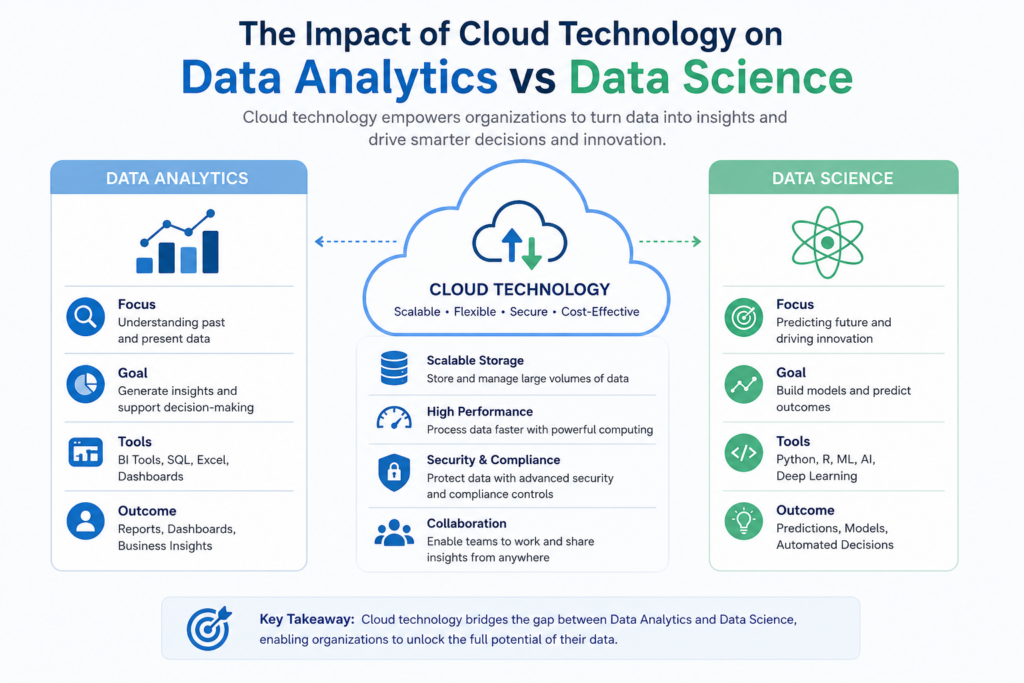
Cloud technology has transformed how organizations collect, store, process, and analyze data. Businesses no longer rely solely on on-premise infrastructure to manage large volumes of information. Instead, cloud platforms provide scalable, flexible, and cost-effective solutions that enable faster decision-making and innovation.
As companies continue their digital transformation journeys, cloud computing is reshaping both analytics and data-driven research. Understanding the impact of cloud technology on Data Analytics vs Data Science helps organizations choose the right strategies, tools, and talent to maximize business value.

What Is Cloud Technology?
Cloud technology refers to the delivery of computing services including storage, databases, networking, software, analytics, and processing power through the internet rather than relying solely on on-premises infrastructure. Instead of purchasing and maintaining expensive physical servers and data centers, businesses can access computing resources on demand from cloud service providers. This approach allows organizations to scale their operations quickly, reduce infrastructure costs, and improve overall efficiency.
In today’s data driven environment, cloud technology has become a critical foundation for digital transformation. Organizations of all sizes use cloud platforms to store vast amounts of information, process data in real time, run advanced analytics, and support business applications from virtually anywhere in the world. As the volume of data continues to grow, cloud solutions provide the flexibility and performance needed to manage complex workloads while maintaining high levels of reliability and security.
Cloud technology also enables teams to collaborate more effectively by providing centralized access to data and applications. Employees, analysts, and decision-makers can work with the same information regardless of their location, leading to faster decision-making and improved productivity. This accessibility has become especially important as remote and hybrid work environments continue to expand.
Key Capabilities of Cloud Technology
Modern cloud platforms offer a wide range of features that help organizations manage, analyze, and utilize their data more effectively:
- Scalable Data Storage
- Store structured and unstructured data without worrying about physical storage limitations.
- Increase or decrease storage capacity based on business requirements.
- Support massive datasets generated from business operations, customer interactions, and digital platforms.
- Real-Time Data Processing
- Analyze incoming data as it is generated.
- Enable businesses to respond quickly to changing market conditions.
- Support applications that require immediate insights and rapid decision-making.
- Advanced Analytics Services
- Provide powerful tools for data visualization, reporting, and business intelligence.
- Help organizations uncover trends, patterns, and opportunities hidden within large datasets.
- Support both descriptive and predictive analytical processes.
- Artificial Intelligence and Machine Learning Tools
- Allow businesses to build intelligent applications without investing heavily in infrastructure.
- Automate repetitive processes and improve operational efficiency.
- Generate predictive insights that support strategic planning and decision-making.
- Enhanced Collaboration Across Teams
- Enable multiple users to access and work with the same datasets simultaneously.
- Improve communication between departments and stakeholders.
- Support global teams through centralized cloud-based platforms.
- Improved Data Security and Disaster Recovery
- Offer advanced security measures such as encryption, access controls, and continuous monitoring.
- Protect critical business information from cyber threats and data loss.
- Ensure business continuity through automated backup and recovery solutions.
Why Cloud Technology Is Important for Modern Businesses
The growing adoption of cloud technology is driven by its ability to deliver flexibility, scalability, and cost efficiency. Traditional infrastructure often requires significant upfront investments and ongoing maintenance costs. In contrast, cloud services typically operate on a pay-as-you-go model, allowing businesses to pay only for the resources they use.
Some of the major business benefits include:
- Reduced operational and infrastructure expenses
- Faster deployment of applications and services
- Greater business agility and scalability
- Improved accessibility and remote collaboration
- Enhanced innovation through AI and advanced analytics
- Better performance and system reliability
- Stronger data protection and compliance support
- Data privacy and compliance requirements
- Cloud security management
- Vendor lock-in concerns
- Integration with legacy systems
- Rising costs from inefficient resource usage

How Cloud Technology Enhances Data Analytics
Cloud technology has transformed the way organizations perform data analytics by providing scalable infrastructure, faster processing capabilities, and easy access to advanced analytical tools. Traditional analytics systems often required significant investments in hardware and maintenance, whereas cloud-based platforms allow businesses to analyze large volumes of data efficiently and cost-effectively. As organizations generate more data than ever before, cloud computing has become an essential component of modern analytics strategies.
Major Benefits of Cloud-Based Data Analytics
Faster Data Processing
One of the most significant advantages of cloud technology is its ability to process massive datasets at high speed. Cloud platforms utilize distributed computing resources that can handle complex analytical workloads without performance bottlenecks.
Key advantages include:
- Rapid analysis of large and complex datasets
- Reduced time required to generate reports and insights
- Support for real-time and near-real-time analytics
- Improved operational efficiency across departments
By accelerating data processing, organizations can identify trends, opportunities, and risks much faster than with traditional infrastructure.
Improved Accessibility
Cloud-based analytics solutions provide users with access to data, dashboards, and reports from virtually any location with an internet connection. This accessibility has become increasingly valuable in today’s remote and hybrid work environments.
Key advantages include:
- Access to analytics platforms from any device
- Better collaboration among distributed teams
- Centralized data availability across departments
- Faster sharing of insights and reports
With cloud technology, decision-makers can stay informed and act quickly regardless of where they are located.
Cost Efficiency
Building and maintaining on-premises analytics infrastructure can be expensive. Cloud technology eliminates many of these costs by offering flexible, usage-based pricing models that align with business needs.
Key advantages include:
- Lower upfront infrastructure investments
- Reduced maintenance and hardware expenses
- Pay-as-you-go resource utilization
- Better allocation of IT budgets
This cost-effective approach enables businesses of all sizes to leverage advanced analytics capabilities without significant financial barriers.
Real Time Decision Making
Modern cloud platforms support continuous data collection and processing, enabling organizations to monitor business performance as events occur. This capability allows companies to react quickly to changing conditions and emerging opportunities.
Key advantages include:
- Live monitoring of business metrics
- Immediate visibility into operational performance
- Faster response to customer behavior changes
- Improved agility in competitive markets
Real time analytics helps organizations make informed decisions based on the most current information available.
Enhanced Data Integration
Cloud platforms can easily connect with multiple data sources, including databases, applications, IoT devices, and third-party systems. This integration creates a unified view of organizational data.
Key advantages include:
- Consolidation of data from various sources
- Improved data consistency and accuracy
- Simplified data management processes
- Better cross functional analysis
By integrating diverse datasets, businesses gain a more comprehensive understanding of their operations and customers.
How Cloud Technology Transforms Data Science
Cloud technology has fundamentally changed the field of data science by providing scalable computing resources, advanced machine learning tools, and collaborative development environments. Data scientists no longer need to rely solely on expensive local hardware to build and deploy sophisticated models. Instead, cloud platforms provide the flexibility and computational power required to manage increasingly complex data science projects.
Key Impacts of Cloud Technology on Data Science
Scalable Machine Learning
Training machine learning models often requires substantial computing power, particularly when working with large datasets or deep learning algorithms. Cloud environments provide access to scalable resources that can be adjusted based on project requirements.
Key advantages include:
- Access to high-performance GPUs and CPUs
- Ability to train models on massive datasets
- Faster processing of machine learning workloads
- Flexible scaling based on computational needs
This scalability enables organizations to develop more advanced predictive and AI-driven solutions.
Faster Experimentation
Data science involves continuous testing, validation, and optimization of models. Cloud technology allows data scientists to run multiple experiments simultaneously, significantly accelerating development cycles.
Key advantages include:
- Parallel model training and testing
- Faster evaluation of algorithms
- Reduced development and deployment timelines
- Improved productivity for data science teams
The ability to experiment rapidly helps organizations bring innovative solutions to market more quickly.
Advanced AI Integration
Many cloud providers offer built-in artificial intelligence and machine learning services that simplify the creation and deployment of intelligent applications. These tools reduce the complexity of implementing advanced AI capabilities.
Key advantages include:
- Pre-built machine learning frameworks
- Automated model development tools
- Natural language processing services
- Computer vision and predictive analytics capabilities
These services allow businesses to adopt AI technologies without requiring extensive infrastructure investments.
Collaboration and Automation
Modern data science projects often involve collaboration among data scientists, data engineers, analysts, and business stakeholders. Cloud platforms create centralized environments where teams can work together efficiently while automating repetitive tasks.
Key advantages include:
- Shared development and analytics environments
- Improved communication across teams
- Automated data preparation workflows
- Streamlined model deployment and monitoring
Enhanced collaboration improves project outcomes and ensures better alignment between technical and business objectives.
Improved Model Deployment and Management
Cloud technology simplifies the process of deploying machine learning models into production environments. Organizations can monitor performance, update models, and scale applications with minimal operational complexity.
Key advantages include:
- Faster model deployment cycles
- Continuous performance monitoring
- Automated updates and maintenance
- Greater reliability and scalability
This helps organizations maximize the value of their data science initiatives while maintaining operational efficiency.
Conclusion
Cloud technology has fundamentally changed how businesses manage and utilize data. By providing scalable infrastructure, real-time processing, advanced AI tools, and cost-effective resources, cloud platforms empower organizations to unlock deeper insights and drive innovation.
The evolving relationship between Data Analytics vs Data Science demonstrates how cloud computing is creating new opportunities for data professionals and businesses alike. Organizations that embrace cloud-driven data strategies will be better positioned to improve decision-making, enhance operational efficiency, and achieve long-term growth in an increasingly data-centric world.
Frequently Asked Questions
Answer:
Cloud technology enables businesses to process, store, and analyze large volumes of data without investing heavily in physical infrastructure. It provides real-time access to data, faster processing speeds, and scalable resources that help organizations generate insights more efficiently and support better decision-making.
Answer:
Cloud computing provides data scientists with powerful computing resources, machine learning platforms, and scalable storage solutions. This allows teams to train complex models, analyze massive datasets, and deploy AI applications more quickly while reducing operational costs.
Answer:
Cloud technology has enhanced both fields by providing shared access to advanced tools, automation, and scalable infrastructure. While analytics focuses on understanding business performance, data science uses cloud-powered AI and machine learning to develop predictive and intelligent solutions.
Answer:
Cloud-based solutions offer flexibility, scalability, cost savings, and improved collaboration. Organizations can access data from anywhere, scale resources based on demand, and leverage advanced analytics and AI capabilities without maintaining extensive on-premise systems.
Answer:
Emerging trends include AI-driven analytics, automated machine learning, real-time data processing, edge computing, and multi-cloud environments. These innovations will help businesses gain faster insights, improve operational efficiency, and create more data-driven strategies in the future.