
Python Data Analysis Helps in Predictive Analytics
How Python Data Analysis Helps in Predictive Analytics and Reporting
Businesses today rely heavily on data to make better decisions, improve performance, and understand future trends. One of the most powerful technologies used for this purpose is Python Data Analysis. From identifying customer behavior to generating business reports, Python has become an essential tool for predictive analytics and reporting across industries.
Python offers powerful libraries, simple syntax, and flexible tools that help analysts process large datasets quickly and accurately. Whether companies want to predict sales, analyze customer preferences, or create visual reports, Python provides reliable solutions for modern data-driven environments.

What is Predictive Analytics?
Predictive analytics is the process of using historical data, statistical methods, and machine learning techniques to predict future outcomes. Businesses use predictive analytics to make informed decisions and reduce risks.
Examples include:
- Predicting future sales
- Detecting fraud activities
- Forecasting customer demand
- Identifying market trends
- Improving inventory management
With the help of Python Data Analysis, organizations can build predictive models that deliver accurate insights from complex datasets.
Why Python is Popular for Data Analysis
Python has become one of the most widely used programming languages for analytics because it is easy to learn, flexible, and highly efficient for handling data-related tasks. Businesses, researchers, and data analysts use Python for reporting, visualization, automation, and predictive analytics because it simplifies complex data operations.
Simple and Beginner-Friendly Syntax
One of the biggest reasons behind Python’s popularity is its clean and readable syntax. Beginners can learn Python quickly, while professionals can build advanced analytical projects with less coding effort.
Key advantages include:
- Easy-to-understand code structure
- Faster learning process for beginners
- Reduced coding complexity
- Improved productivity for analysts and developers
Powerful Data Libraries
Python offers a wide range of powerful libraries that make data analysis faster and more efficient. These libraries help with data cleaning, mathematical calculations, visualization, and machine learning.
Some of the most popular Python libraries include:
- Pandas – Used for data manipulation and cleaning
- NumPy – Handles numerical and mathematical operations
- Matplotlib – Creates charts and graphs
- Scikit-learn – Supports machine learning and predictive analytics
- Seaborn – Helps create advanced statistical visualizations
These tools save time and allow analysts to focus more on insights and decision-making.
Faster Data Processing
Python can process large amounts of structured and unstructured data efficiently. This makes it highly useful for businesses dealing with massive datasets and real-time analytics.
Benefits of faster processing include:
- Quick data cleaning and transformation
- Automated repetitive tasks
- Faster report generation
- Improved business decision-making
Strong Data Visualization Capabilities
Data visualization is an important part of analytics because it helps present information in a clear and understandable format. Python provides powerful visualization tools that help analysts identify patterns, trends, and relationships in data.
Python supports visualizations such as:
- Bar charts
- Line graphs
- Pie charts
- Heatmaps
- Scatter plots
- Interactive dashboards
- Excellent Support for Machine Learning
Python is also widely used in artificial intelligence and predictive analytics projects. Its machine learning libraries help businesses create forecasting models, recommendation systems, and automated analytics solutions.
Common machine learning applications include:
- Customer behavior analysis
- Sales forecasting
- Fraud detection
- Predictive reporting
- Business trend analysis
Large Community and Open Source Support
Python has a massive global community that continuously develops new tools, tutorials, and resources. Since Python is open source, businesses and learners can use it without expensive licensing costs.
Major advantages include:
- Free to use
- Large collection of learning resources
- Strong developer support
- Continuous updates and improvements
Because of its simplicity, speed, and powerful analytical capabilities, Python continues to dominate the field of data analysis and predictive analytics
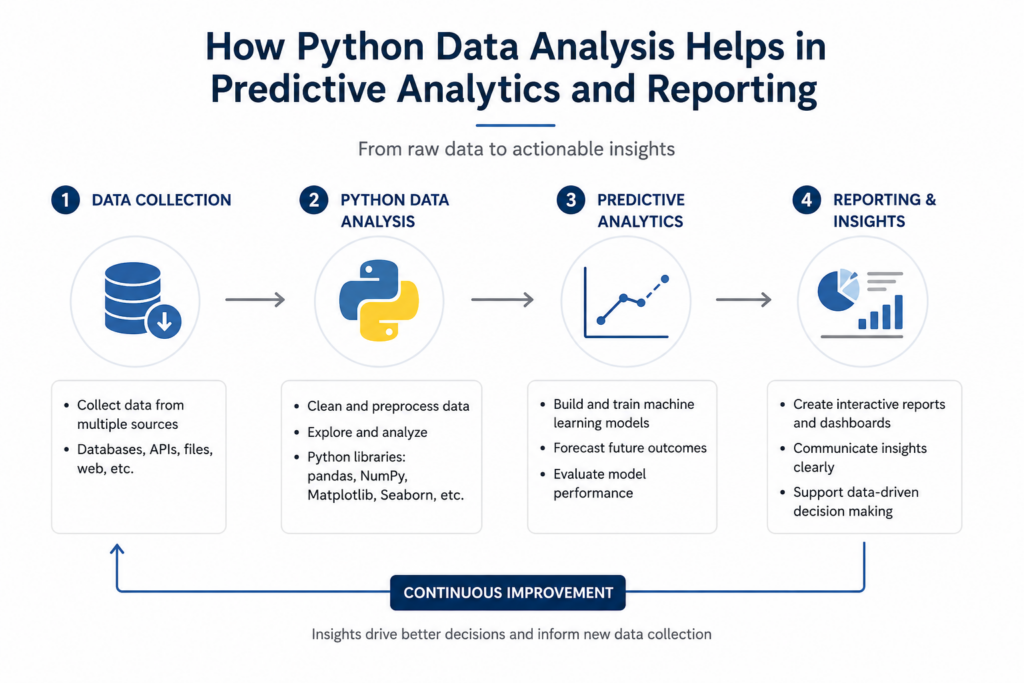
- Better sales forecasting
- Customer behavior analysis
- Improved business decision-making
- Faster data processing and analysis

Role of Python Data Analysis in Predictive Analytics
Predictive analytics depends heavily on accurate data preparation, processing, and forecasting. Python plays a major role in predictive analytics because it helps analysts manage large datasets, automate workflows, and build intelligent prediction models efficiently. Its powerful libraries and machine learning capabilities make it one of the most preferred tools for modern data analysis.
Data Collection and Cleaning
Before prediction begins, raw data must be collected, cleaned, and organized properly. Poor-quality data can lead to inaccurate predictions, which is why data preparation is one of the most important steps in predictive analytics.
Python helps analysts:
- Remove duplicate records
- Fix missing or incorrect values
- Standardize data formats
- Organize structured and unstructured datasets
- Automate repetitive data-cleaning tasks
Libraries like Pandas and NumPy make the entire data preparation process faster and more accurate.
Pattern Recognition
One of the biggest strengths of Python Data Analysis is its ability to identify hidden patterns and trends inside historical data. Businesses use these insights to better understand customer behavior, market trends, and operational performance.
Python can help identify:
- Customer purchasing habits
- Seasonal business trends
- Website traffic patterns
- Sales performance changes
- Marketing campaign effectiveness
These insights help organizations make smarter business decisions and improve future planning.
Machine Learning Integration
Python is widely used in machine learning because it supports advanced predictive models and intelligent algorithms. Analysts can train machine learning systems using historical data to forecast future outcomes with better accuracy.
Python supports predictive tasks such as:
- Sales forecasting
- Customer churn prediction
- Fraud detection
- Product recommendations
- Risk analysis
Popular libraries like Scikit-learn, TensorFlow, and Keras help developers build and train machine learning models efficiently.
Real Time Forecasting
Modern businesses often require real-time analytics to respond quickly to changing market conditions. Python Data Analysis helps companies generate real-time predictions using continuously updated datasets.
Real time forecasting can help businesses:
- Predict future sales performance
- Monitor customer engagement
- Analyze live marketing results
- Track operational efficiency
- Improve inventory management
This allows companies to react faster, reduce risks, and improve overall business performance.
Automation and Efficiency
Python also improves predictive analytics by automating many time-consuming processes. Analysts can build automated workflows that continuously collect, process, and analyze data without manual intervention.
Benefits of automation include:
- Faster reporting
- Reduced human errors
- Improved productivity
- Consistent data processing
- Better scalability for large projects
- Better Decision Making
By combining data analysis, visualization, and predictive modeling, Python helps businesses make data-driven decisions with greater confidence. Organizations can use predictive insights to improve strategies, optimize operations, and increase profitability.
Because of its flexibility, machine learning support, and advanced analytical capabilities, Python has become a powerful tool for predictive analytics across multiple industries.
Importance of Reporting in Business Analytics
In business analytics, reporting is essential because it converts raw numbers and complex datasets into useful business insights. Without proper reporting, companies may struggle to understand performance trends, customer behavior, or operational efficiency. Reporting helps organizations present information in a structured and easy-to-understand format so managers and teams can make informed decisions quickly.
Python has become a popular tool for business reporting because it allows analysts to automate reports, create interactive dashboards, and generate visual data summaries with high accuracy. Modern businesses rely on reporting systems to monitor growth, improve planning, and identify opportunities for improvement.
Why Reporting Matters in Business Analytics
Effective reporting helps organizations stay informed about their daily operations and long-term performance. It provides a clear overview of what is working well and what areas require attention.
Some major benefits of reporting include:
- Better understanding of business performance
- Easier monitoring of company goals and KPIs
- Faster identification of business challenges
- Improved strategic planning
- More accurate decision making
Turning Data into Visual Insights
Large datasets are often difficult to understand in raw form. Reporting solves this problem by presenting information through charts, dashboards, and visual summaries. Python makes this process easier with advanced visualization libraries that help analysts create professional reports.
Businesses commonly use visual reports such as:
- Sales performance dashboards
- Customer engagement charts
- Revenue growth reports
- Marketing analytics summaries
- Financial performance graphs
Visual reporting allows decision makers to understand complex information more quickly and clearly.
Role of Python in Automated Reporting
Manual reporting can take a lot of time and may lead to errors. Python helps automate the reporting process, allowing businesses to generate accurate reports with minimal manual effort.
With Python, analysts can:
- Automatically collect and organize data
- Generate scheduled reports
- Update dashboards in real time
- Reduce repetitive reporting tasks
- Improve reporting consistency and accuracy
This automation helps businesses save time and improve operational efficiency.
Supporting Business Decision Making
Reporting is one of the most important tools for decision-making in modern organizations. Business leaders use reports to analyze market trends, customer preferences, and operational performance before making strategic decisions.
Accurate reporting helps companies:
- Improve productivity
- Optimize business operations
- Track financial performance
- Analyze customer behavior
- Plan future growth strategies
When combined with Python Data Analysis, reporting becomes faster, smarter, and more reliable for organizations of all sizes.
Identifying Trends and Performance Gaps
Regular reporting helps businesses discover patterns, trends, and performance gaps that may not be visible otherwise. Companies can use these insights to improve efficiency and solve operational problems early.
Reporting can reveal:
- Declining sales trends
- Poor performing campaigns
- Inventory issues
- Customer retention problems
- Changes in market demand
By identifying these areas quickly, businesses can take corrective actions and improve overall performance.
Because of its flexibility, automation capabilities, and strong visualization tools, Python continues to play a major role in modern business reporting and analytics.
How Python Improves Data Reporting
Python helps businesses create accurate and visually appealing reports using advanced data visualization and automation tools. It simplifies complex business data and makes reporting faster and more efficient.
Data Visualization
Python libraries like Matplotlib and Seaborn help analysts create professional charts and dashboards for better data understanding.
Common visualizations include:
- Bar charts
- Pie charts
- Heatmaps
- Trend graphs
- Interactive dashboards
These visuals make reports easier to understand for teams and management.
Automated Reports
Python can automate repetitive reporting tasks, reducing manual effort and improving productivity. Businesses can generate reports quickly using real-time data updates.
Benefits include:
- Faster report generation
- Improved accuracy
- Reduced human errors
- Better workflow efficiency
Better Decision Making
Reports generated through Python Data Analysis help companies make informed business decisions based on real insights instead of assumptions.
Python reporting helps businesses:
- Track business performance
- Monitor customer behavior
- Analyze market trends
- Improve strategic planning
Industries Using Python Predictive Analytics
Many industries use Python predictive analytics because it helps analyze data, forecast trends, and improve business efficiency.
Healthcare
Hospitals use predictive analytics to:
- Forecast patient risks
- Improve treatment planning
- Analyze medical data
Finance
Financial companies use Python for:
- Fraud detection
- Risk assessment
- Market trend prediction
Retail
Retail businesses use predictive analytics to:
- Analyze customer behavior
- Forecast product demand
- Improve inventory management
Marketing
Marketing teams use Python to:
- Improve campaign performance
- Target the right audience
- Analyze customer engagement data
Future of Python in Data Analytics
The demand for data driven decision making continues to grow rapidly. As artificial intelligence and machine learning become more common, Python will remain a leading technology for analytics and reporting.
Businesses now prefer professionals with Python analytics skills because they can handle data efficiently and generate meaningful insights for growth.
Conclusion
Python has transformed the way businesses perform predictive analytics and reporting. Its powerful libraries, automation capabilities, and machine learning support make it one of the best tools for modern analytics.
From data cleaning to forecasting and report generation, Python Data Analysis helps organizations improve accuracy, save time, and make smarter business decisions. As industries continue to depend on data insights, Python will remain a valuable solution for predictive analytics and professional reporting.
Frequently Asked Questions
Answer:
Python is widely used for predictive analytics because it offers powerful libraries like Pandas, NumPy, and Scikit-learn that simplify data processing and machine learning. Its simple syntax also makes it easier for beginners and professionals to analyze large datasets efficiently. Businesses prefer Python because it supports automation, accuracy, and faster model development.
Answer:
Python helps in data reporting by automating report generation and creating visual dashboards using libraries like Matplotlib and Seaborn. Analysts can easily transform raw data into charts, graphs, and summaries that improve understanding. This saves time and helps organizations make data-driven decisions more effectively.
Answer:
Many industries use Python data analysis, including healthcare, finance, retail, marketing, and e-commerce. Companies use it to predict customer behavior, detect fraud, forecast sales, and improve operational efficiency. Its flexibility makes it suitable for almost every data-driven industry.
Answer:
Yes, Python is considered one of the best programming languages for beginners in data analytics. It has a simple and readable syntax, along with a large community and learning resources. Beginners can quickly learn data cleaning, visualization, and predictive analytics using Python tools and libraries.
Answer:
Python improves predictive analytics and reporting by providing faster data processing, automation, and accurate forecasting capabilities. It helps businesses identify trends, generate reports, and visualize data more clearly. These features support better decision-making and overall business growth.