
Understanding the 4 Types of Data Analytics
Understanding the 4 Types of Data Analytics
In today’s data driven business environment, organizations rely on data to make informed decisions, improve efficiency, and identify new growth opportunities. From small businesses to large enterprises, analyzing data has become an essential part of strategic planning. Understanding the Types of Data Analytics helps businesses transform raw information into actionable insights that support better decision making.
Data analytics is generally divided into four major categories, each serving a different purpose in the decision making process. Together, these analytical approaches help organizations understand past performance, evaluate current situations, predict future outcomes, and recommend optimal actions.

What Is Data Analytics?
In a world where businesses generate vast amounts of information every day, the ability to make sense of that information has become increasingly important. Data analytics is the discipline that focuses on examining data to identify trends, patterns, relationships, and insights that can support better business outcomes.
Organizations collect data from numerous sources, including customer purchases, website activity, social media interactions, surveys, business applications, and operational processes. However, raw data on its own has limited value. The real advantage comes from analyzing that information and turning it into actionable intelligence that can guide decision-making.
Data analytics helps businesses answer critical questions such as:
- What is driving sales growth?
- Which products are performing best?
- Why are customers leaving?
- How can operational costs be reduced?
- What trends are likely to impact future performance?
By addressing these questions, organizations can make more confident decisions based on evidence rather than assumptions. This approach allows companies to improve efficiency, enhance customer satisfaction, strengthen competitive advantage, and uncover opportunities for innovation.
Modern analytics combines statistical techniques, business intelligence tools, data visualization, and predictive models to extract meaningful insights from large datasets. As technology continues to evolve, businesses are increasingly integrating analytics into everyday operations to improve performance and achieve strategic objectives.
Some of the most common applications of data analytics include:
- Monitoring business performance through dashboards and reports
- Understanding customer behavior and purchasing patterns
- Optimizing marketing campaigns and advertising efforts
- Forecasting future demand and market trends
- Improving supply chain and inventory management
- Detecting risks, anomalies, and fraudulent activities
- Supporting digital transformation and innovation initiatives
The growing importance of data driven decision making has made analytics a core component of modern business strategy. Companies that effectively leverage data are often better positioned to respond to market changes, identify growth opportunities, and maintain long term success.
To make data analysis more effective and structured, professionals generally rely on four distinct analytical approaches. These approaches, commonly known as the Types of Data Analytics, help organizations understand past performance, diagnose issues, anticipate future outcomes, and recommend actions that can drive better business results. Each type serves a unique purpose and contributes to a more complete understanding of business data.
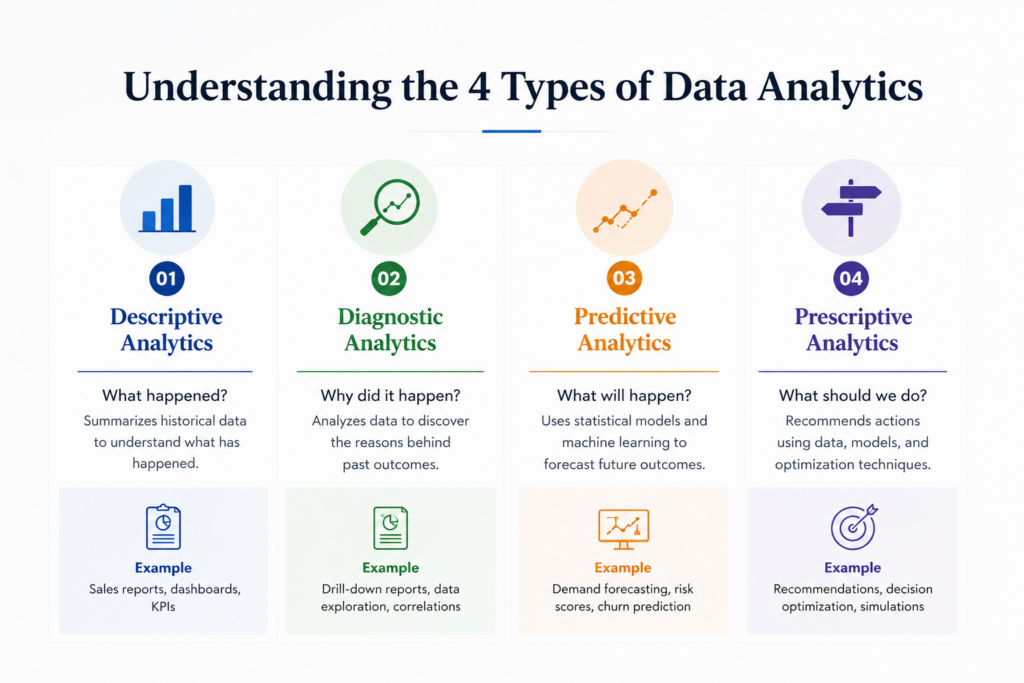

4 Types of Data Analytics
Understanding the different types of analytics is essential for organizations that want to make better use of their data. Each analytical approach serves a unique purpose, helping businesses move from understanding past performance to making informed decisions about the future. Together, these methods create a complete framework for data-driven decision-making and continuous business improvement.
1. Descriptive Analytics: Understanding What Happened
Descriptive analytics is the most fundamental and widely used form of data analysis. It focuses on examining historical data to provide insights into past performance and business activities. This type of analytics helps organizations understand what has already occurred by transforming raw data into meaningful reports, dashboards, summaries, and visualizations.
The primary objective of descriptive analytics is to answer a simple but important question:
“What happened?”
Businesses use descriptive analytics to track key performance indicators (KPIs), monitor operational activities, and evaluate overall business performance. It provides a clear snapshot of business operations and helps decision makers identify trends, patterns, and changes over time.
Common Applications
- Sales performance reports
- Website traffic analysis
- Financial reporting and revenue tracking
- Customer behavior monitoring
- Social media performance measurement
- Inventory and supply chain reporting
- Operational performance dashboards
- Benefits of Descriptive Analytics
- Provides a clear understanding of historical performance
- Helps identify business trends and recurring patterns
- Supports regular reporting and performance monitoring
- Enables organizations to measure business growth
- Simplifies large volumes of data into understandable insights
- Creates a strong foundation for advanced analytics
Organizations often use business intelligence platforms, data visualization tools, charts, graphs, and dashboards to present descriptive insights in an easy to understand format. Although it does not explain why something happened, it is the first step in the analytical process and provides the information needed for deeper investigation.
2. Diagnostic Analytics: Understanding Why It Happened
While descriptive analytics explains what happened, diagnostic analytics focuses on uncovering the reasons behind specific outcomes. It involves examining data in greater detail to identify relationships, patterns, and contributing factors that influenced business results.
Diagnostic analytics answers the question:
“Why did it happen?”
This approach is particularly valuable when organizations experience unexpected changes, such as declining sales, increasing operational costs, or reduced customer engagement. By investigating the root causes of these issues, businesses can make more informed decisions and implement effective solutions.
Diagnostic analytics often relies on techniques such as data mining, correlation analysis, drill-down analysis, and root cause investigation to uncover meaningful insights.
Common Applications
- Investigating sales declines
- Understanding customer churn
- Identifying operational inefficiencies
- Root cause analysis of business problems
- Marketing campaign performance evaluation
- Product performance assessment
- Customer satisfaction analysis
- Benefits of Diagnostic Analytics
- Reveals hidden relationships within datasets
- Identifies factors affecting business performance
- Supports effective problem-solving initiatives
- Improves decision-making accuracy
- Helps organizations learn from past experiences
- Enables continuous process improvement
Among the various Types of Data Analytics, diagnostic analytics is particularly valuable because it helps organizations move beyond reporting and gain a deeper understanding of business challenges. This knowledge allows companies to make targeted improvements and avoid repeating past mistakes.
3. Predictive Analytics: Understanding What May Happen
Predictive analytics focuses on forecasting future outcomes by analyzing historical data, identifying trends, and applying statistical models or machine learning algorithms. Rather than simply reviewing past events, this approach helps organizations estimate what is likely to happen in the future.
Predictive analytics answers the question:
“What is likely to happen next?”
Businesses increasingly rely on predictive models to anticipate customer behavior, market trends, operational risks, and future demand. These forecasts help organizations prepare for upcoming opportunities and challenges before they occur.
The effectiveness of predictive analytics depends on the quality of available data and the accuracy of the models used. As more data becomes available, predictive models can often become more reliable and insightful.
Common Applications
- Sales forecasting
- Demand prediction
- Customer behavior forecasting
- Risk assessment and management
- Inventory planning
- Financial forecasting
- Fraud detection
- Market trend prediction
- Benefits of Predictive Analytics
- Improves strategic business planning
- Helps organizations manage risks proactively
- Supports data-driven forecasting
- Enhances resource allocation and budgeting
- Improves customer retention strategies
- Enables faster responses to market changes
Predictive analytics allows businesses to shift from reactive decision-making to proactive planning. Instead of waiting for events to occur, organizations can anticipate future scenarios and develop strategies that improve long-term performance and competitiveness.
4. Prescriptive Analytics: Understanding What Should Be Done
Prescriptive analytics is the most advanced stage of the analytics process. It not only predicts potential outcomes but also recommends the best actions to achieve desired business objectives. By combining predictive insights with optimization techniques, business rules, and artificial intelligence, prescriptive analytics helps organizations determine the most effective course of action.
Prescriptive analytics answers the question:
“What should we do?”
This approach is designed to support complex decision-making by evaluating multiple possible scenarios and identifying the actions most likely to produce favorable results. It helps organizations maximize efficiency, improve profitability, and optimize business processes.
As businesses continue to adopt artificial intelligence and automation technologies, prescriptive analytics is becoming increasingly important for strategic planning and operational excellence.
Common Applications
- Supply chain optimization
- Dynamic pricing strategies
- Resource allocation planning
- Personalized customer recommendations
- Financial planning and budgeting
- Workforce scheduling
- Logistics and route optimization
- Business process automation
- Benefits of Prescriptive Analytics
- Supports intelligent and data-driven decisions
- Optimizes business operations and workflows
- Improves overall organizational efficiency
- Reduces costs and operational risks
- Enhances productivity and performance
- Maximizes business outcomes and profitability
Among all Types of Data Analytics, prescriptive analytics provides the highest level of decision support because it goes beyond prediction and actively recommends actions. This enables organizations to make faster, smarter, and more effective business decisions based on data-driven insights.
How the Four Analytics Types Work Together
While each of the four analytics methods serves a different purpose, they are most effective when used together as part of a complete data driven decision making process. Rather than operating independently, organizations typically apply them in sequence to gain deeper insights and make more informed business decisions.
The analytics journey often begins with Descriptive Analytics, which focuses on reviewing historical data to understand past performance. It provides a clear picture of what has already occurred by analyzing reports, dashboards, key performance indicators (KPIs), and historical trends. Businesses use descriptive analytics to identify patterns, monitor performance, and establish a baseline for future analysis.
Once organizations understand what happened, they move to Diagnostic Analytics to determine the reasons behind specific outcomes. This stage involves exploring data in greater detail to identify relationships, correlations, and root causes. Diagnostic analytics helps answer questions such as why sales increased, why customer retention declined, or why operational costs changed over time.
After understanding past events and their causes, businesses can leverage Predictive Analytics to anticipate future outcomes. By using statistical models, machine learning algorithms, and historical datasets, predictive analytics helps organizations forecast trends, customer behavior, market demand, and potential risks. This enables decision-makers to prepare for future opportunities and challenges before they occur.
The final stage is Prescriptive Analytics, which takes predictive insights one step further by recommending the best course of action. Prescriptive analytics evaluates multiple possible scenarios and suggests strategies that are most likely to achieve desired results. It supports decision-makers by providing actionable recommendations based on data-driven analysis.
The Analytics Progression
The four stages can be summarized as follows:
- Descriptive Analytics – Explains what happened.
- Diagnostic Analytics – Explains why it happened.
- Predictive Analytics – Forecasts what may happen next.
- Prescriptive Analytics – Recommends what actions should be taken.
Real-World Example
Consider an e-commerce company experiencing a decline in monthly sales:
- Descriptive Analytics identifies that sales dropped by 15% during the previous quarter.
- Diagnostic Analytics reveals that website traffic decreased due to lower search engine visibility.
- Predictive Analytics forecasts that sales may continue to decline if traffic trends remain unchanged.
- Prescriptive Analytics recommends investing in SEO improvements, targeted marketing campaigns, and customer retention initiatives to reverse the trend.
By following this structured approach, businesses gain a complete understanding of their data and can make proactive decisions rather than simply reacting to problems after they occur.
Why Integration Matters
Organizations that combine all four analytics types gain a significant competitive advantage. Instead of relying solely on historical reporting, they can uncover hidden insights, anticipate future developments, and implement strategies that improve performance across departments.
Benefits of integrating all four analytics approaches include:
- Faster and more informed decision-making
- Improved business forecasting accuracy
- Better risk management and mitigation
- Enhanced customer experience and personalization
- Increased operational efficiency
- Stronger strategic planning capabilities
- Greater ability to identify growth opportunities
When combined, the 4 Types of Data Analytics create a comprehensive framework that transforms raw data into meaningful business intelligence. This integrated approach allows organizations to move beyond basic reporting and embrace advanced, data-driven decision-making that supports long-term growth and innovation.
Conclusion
Understanding the Types of Data Analytics is essential for organizations seeking to make informed decisions and stay competitive in a rapidly changing business environment. Descriptive analytics helps explain past performance, diagnostic analytics identifies underlying causes, predictive analytics forecasts future possibilities, and prescriptive analytics recommends optimal actions.
By combining these four analytical approaches, businesses can transform data into valuable insights, improve operational efficiency, and support long-term growth through evidence-based decision-making.
Frequently Asked Questions
Answer:
The four main types of data analytics are Descriptive Analytics, Diagnostic Analytics, Predictive Analytics, and Prescriptive Analytics. Each type serves a unique purpose, from understanding historical performance to recommending future actions. Together, they help organizations make smarter, data-driven decisions and improve business outcomes.
Answer:
The different types of data analytics help businesses understand past performance, identify the causes of specific outcomes, predict future trends, and determine the best course of action. By using these analytical approaches, organizations can reduce risks, improve efficiency, and make more informed strategic decisions.
Answer:
Predictive analytics focuses on forecasting future events based on historical data and statistical models. Prescriptive analytics goes a step further by recommending actions that can help achieve desired results. While predictive analytics answers “What may happen?”, prescriptive analytics answers “What should be done?”
Answer:
Descriptive analytics is the most widely used type because it provides a clear summary of historical data and business performance. Organizations frequently use reports, dashboards, and visualizations to track key metrics. It also serves as the foundation for more advanced analytics methods.
Answer:
Yes, many organizations use all four types of data analytics as part of a complete data strategy. Descriptive analytics explains what happened, diagnostic analytics identifies why it happened, predictive analytics forecasts future possibilities, and prescriptive analytics recommends the best actions. Combining these approaches creates a more comprehensive decision-making framework.