
What is Natural Language Processing (NLP)
How Machines Understand Human Language?
Natural Language Processing (NLP) is one of the most exciting areas of Artificial Intelligence and Data Science. Every day, people interact with technology using language, through search engines, chatbots, virtual assistants, emails, social media, and AI tools.
However, computers do not naturally understand human language the way people do. Human communication contains context, grammar, emotions, slang, abbreviations, and multiple meanings for the same word. This complexity makes language difficult for machines to process.

What Is Natural Language Processing?
Natural Language Processing is a branch of Artificial Intelligence that focuses on helping computers understand and work with human language.
It combines concepts from:
- Artificial Intelligence
- Machine Learning
- Linguistics
- Data Science
The goal is to transform unstructured text and speech into information that computers can analyze and use.
In simple terms, NLP allows machines to read, listen, understand, and respond to human language.
Why Is NLP Important?
Organizations generate and collect enormous amounts of text data every day.
Examples include:
- Customer reviews
- Emails
- Social media posts
- Support tickets
- Product feedback
- Chat conversations
Analyzing this information manually is often impossible.
NLP helps organizations process large volumes of language data and uncover valuable insights quickly.
Benefits of NLP:
- Faster text analysis
- Improved customer experience
- Automated communication
- Better decision making
- Enhanced business intelligence
As businesses become increasingly data driven, NLP has become an essential technology across industries.
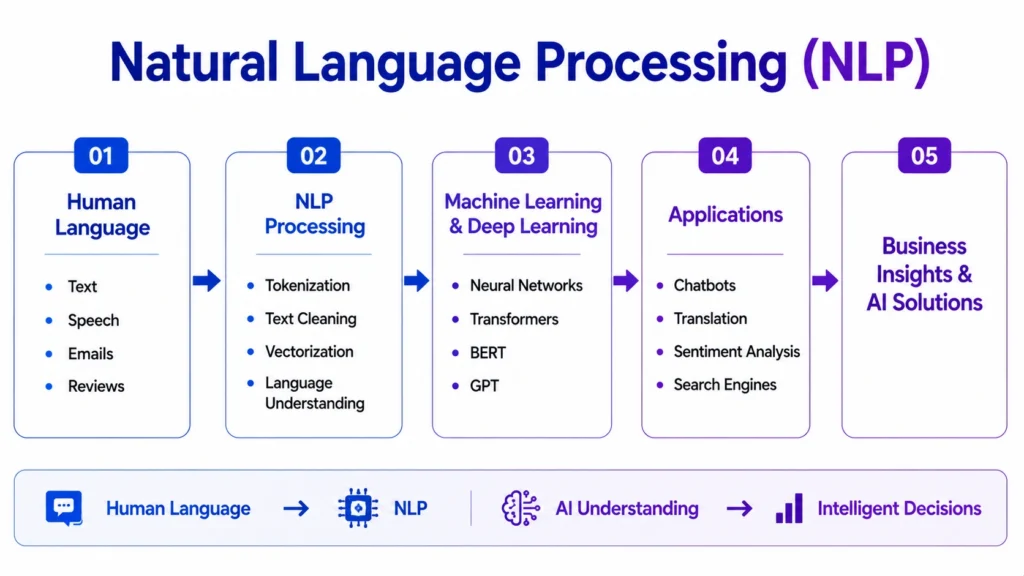
How Does NLP Work?
Before machines can understand language, the text must be converted into a format that computers can process.
A typical NLP workflow includes several stages.
1. Text Collection
The process begins by gathering text from sources such as:
- Documents
- Websites
- Social media
- Customer feedback
- Emails
2. Text Preprocessing
Raw text often contains unnecessary information.
Preprocessing may include:
- Removing punctuation
- Converting text to lowercase
- Removing stop words
- Correcting spelling errors
This improves data quality before analysis.
3. Tokenization
Text is divided into smaller units called tokens.
For example: “Data Science is powerful”
becomes
- Data
- Science
- is
- powerful
4. Feature Extraction
Text is transformed into numerical representations that machine learning models can understand.
5. Model Training
Machine learning or deep learning models learn patterns from the processed text data.
6. Prediction and Analysis
The trained model performs tasks such as classification, translation, recommendation, or text generation.
Common NLP Techniques
Several techniques help computers understand language effectively.
1. Text Classification
Categorizing text into predefined groups.
Examples:
- Spam Detection
- Sentiment Analysis
- Topic Classification
2. Sentiment Analysis
Determining whether text expresses positive, negative, or neutral sentiment.
Examples:
- Product Reviews
- Social Media Comments
- Customer Feedback
3. Named Entity Recognition (NER)
Identifying important entities within text.
Examples:
- Names
- Organizations
- Locations
- Dates
4. Language Translation
Converting text from one language to another.
Examples:
- English to Hindi
- English to French
5. Text Summarization
Generating concise summaries from lengthy documents.
Examples:
- News Articles
- Research Papers
- Business Reports
NLP Applications in Everyday Life
Many people use NLP powered technologies without realizing it.
- Search Engines: Search engines use NLP to understand user queries and deliver relevant results.
- Chatbots: Customer support chatbots rely on NLP to understand questions and provide responses.
- Virtual Assistants: Digital assistants process voice commands using NLP techniques.
- Email Filtering: Spam detection systems classify unwanted emails automatically.
- Language Translation Tools: Translation platforms use NLP to convert text across languages.
- Generative AI: Modern AI systems generate human like text using advanced NLP models.
NLP and Machine Learning
Machine Learning plays a significant role in modern NLP systems.
- Traditional rule based approaches often struggled with language complexity.
- Machine Learning allows NLP systems to learn patterns directly from data.
Common machine learning tasks in NLP include:
- Sentiment Analysis
- Text Classification
- Spam Detection
- Recommendation Systems
As datasets grow larger, machine learning helps improve language understanding and prediction accuracy.
NLP and Deep Learning
Deep Learning has significantly advanced the capabilities of NLP.
Deep learning models can identify complex relationships within language that traditional methods often miss.
Popular deep learning approaches include:
- Neural Networks
- Recurrent Neural Networks (RNNs)
- Long Short Term Memory
- Networks (LSTMs)
- Transformer Models
These technologies power many modern AI applications.
The Rise of Transformers, BERT, and GPT
One of the biggest breakthroughs in NLP has been the introduction of Transformer architectures.
Transformers enable models to process large amounts of text efficiently while understanding context more effectively.
Popular transformer based models include:
BERT: Designed to understand language context and meaning.
Commonly used for:
- Search
- Question Answering
- Text Classification
GPT: Designed to generate human-like text.
Commonly used for:
- Content Creation
- Chatbots
- Generative AI Applications
These models have transformed how businesses use AI driven language technologies.
Skills Required for NLP
Professionals working with NLP often develop expertise in:
- Python
- Machine Learning
- Deep Learning
- Data Science
- Linguistics Concepts
- Text Analytics
Knowledge of modern NLP frameworks and transformer models is increasingly valuable in today’s AI driven job market.
Conclusion….
Natural Language Processing has transformed how machines interact with human language. From search engines and chatbots to translation systems and Generative AI applications, NLP enables computers to understand and process language at a scale that would be impossible manually.
As organizations continue adopting AI powered solutions, the importance of NLP continues to grow.
Understanding its concepts, techniques, and real world applications provides a strong foundation for anyone interested in Data Science, Machine Learning, Artificial Intelligence, or Generative AI.
Learn NLP, Deep Learning, and Generative AI with Career247
Modern AI systems rely heavily on Natural Language Processing to understand and generate human language.
Career247’s Data Science and Machine Learning with GenAI Certification Powered by IBM introduces learners to NLP concepts such as text preprocessing, vectorization, word embeddings, sequence models, transformer architectures, and hands-on applications using modern language models.
Through practical projects including sentiment analysis and AI powered text applications, learners gain exposure to the skills increasingly demanded in today’s Data Science and AI roles.

Frequently Asked Questions
Answer:
Natural Language Processing is a branch of Artificial Intelligence that enables computers to understand, interpret, and generate human language.
Answer:
Yes. NLP is a specialized field within Artificial Intelligence that focuses on language understanding and communication.
Answer:
Examples include chatbots, language translation tools, sentiment analysis systems, virtual assistants, and spam filters.
Answer:
Common skills include Python, Machine Learning, Deep Learning, Data Science, and text analytics.
Answer:
Generative AI systems use NLP techniques to understand prompts, process language, and generate human like responses.