
Introduction to Machine Learning using Python
Machine Learning using Python in Data Analytics
Introduction to Machine Learning using Python in Data Analytics is a crucial step for anyone looking to understand how data driven systems make predictions and automate decision making. Machine learning enables systems to learn from data and improve performance without explicit programming.
In modern data analytics, it is widely used for forecasting, classification, and pattern detection using tools like Python, SQL, and visualization platforms. This is why machine learning concepts are now an integral part of any data analytics course, especially for those exploring how to become data analyst or upskill through structured learning paths.

What is Machine Learning in Data Analytics?
Machine Learning (ML) is a subset of artificial intelligence that allows systems to learn from data and make predictions.
In data analytics, Machine learning helps in identify hidden patterns, predict future outcomes and automate decision making
Real Life Examples of Machine Learning....
Why Use Python for Machine Learning?
Python has become the most popular language for machine learning due to several key advantages:
Setting Up Python Environment for Machine Learning
Before diving into ML, you need to set up your Python environment. Here’s a step by step guide:
1. Install Python:
- Download the latest version of Python from the official website python.org.
- During installation, check the box to add Python to your system’s PATH.
2. Install Package Management Tools:
- Use pip, Python’s default package manager, to install libraries. Run the command:
pip install --upgrade pip
3. Set Up Virtual Environments (Optional but Recommended):
- Virtual environments isolate your projects and ensure compatibility. Create one with:
pip install virtualenv
virtualenv env_name
source env_name/bin/activate       #For Linux/Mac
env_name\Scripts\activate          #For Windows
4. Install Essential Python Libraries for Machine Learning:
- Install the following libraries:
pip install numpy pandas matplotlib scikit-learn
- For advanced ML projects, you may also need:
pip install tensorflow keras

Implementing Your First Machine Learning Model
Let’s create a simple model to predict house prices using Scikit learn.
Example Code:
import numpy as np
import pandas as pd
from sklearn.model_selection import train_test_split
from sklearn.linear_model import LinearRegression
from sklearn.metrics import mean_squared_error

# Sample dataset
data = {
    'Square_Feet': [1500, 2000, 2500, 3000, 3500],
    'Price': [300000, 400000, 500000, 600000, 700000]
}
df = pd.DataFrame(data)

# Splitting data into features and target
X = df[['Square_Feet']]
y = df['Price']

# Train-test split
X_train, X_test, y_train, y_test = train_test_split(X, y, test_size=0.2, random_state=42)

# Model training
model = LinearRegression()
model.fit(X_train, y_train)

# Predictions
predictions = model.predict(X_test)

# Evaluation
mse = mean_squared_error(y_test, predictions)
print("Mean Squared Error:", mse)
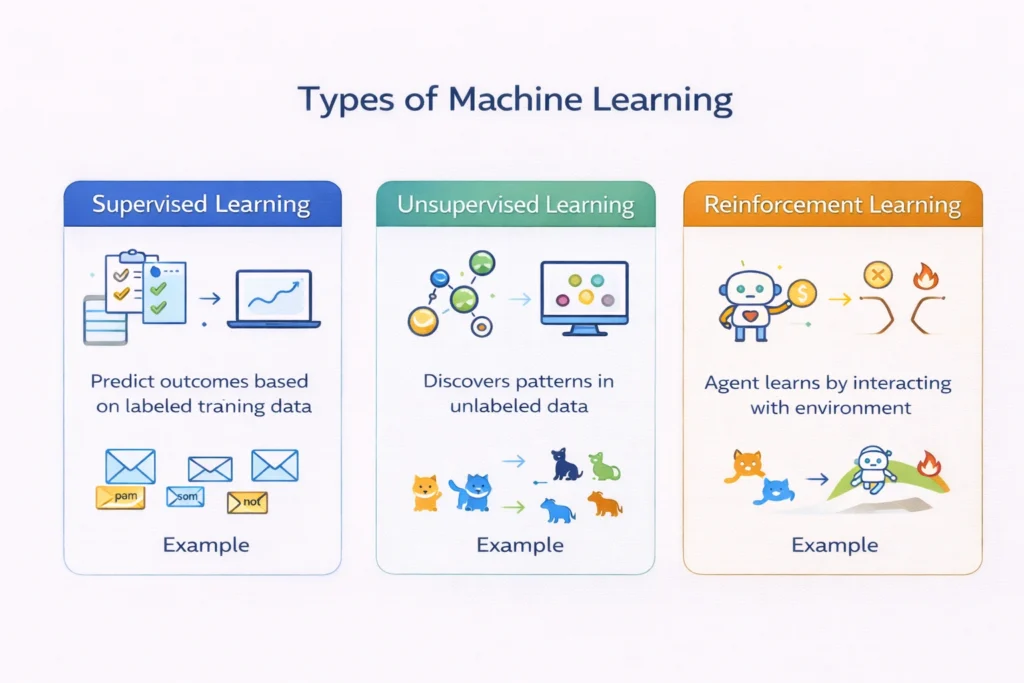
Types of Machine Learning
1. Supervised Learning
- Uses labeled data
- Learns input output mapping
Examples:
- Spam detection
- Sales prediction
2. Unsupervised Learning
- Uses unlabeled data
- Finds patterns automatically
Examples:
- Customer segmentation
- Clustering
3. Reinforcement Learning
- Learns through rewards and penalties
Examples:
- Game AI
- Robotics
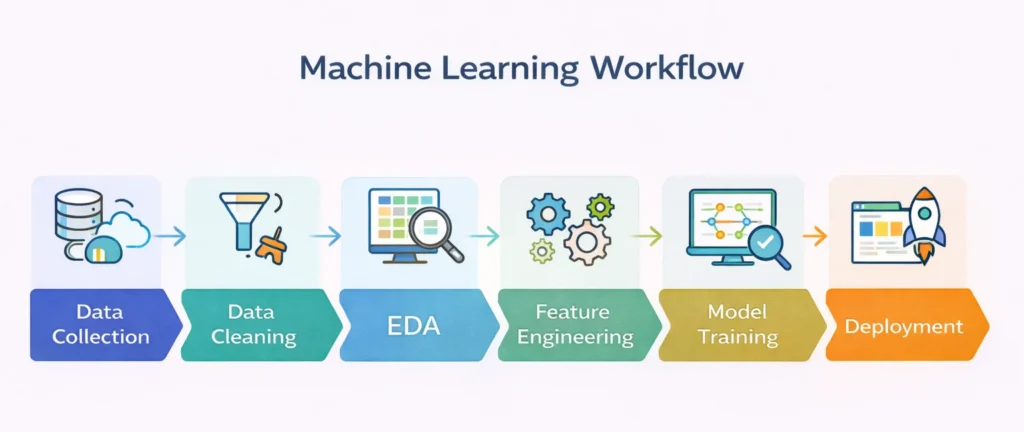
Machine Learning Workflow in Data Analytics
Step 1: Data Collection:
Gather data from sources like databases, APIs, or files.
Step 2: Data Cleaning
Handle missing values and remove inconsistencies.
Step 3: Exploratory Data Analysis (EDA)
Understand patterns and relationships in data.
Step 4: Feature Engineering
Select and transform important variables.
Step 5: Model Building
Train machine learning models.
Step 6: Model Evaluation
Check accuracy using metrics.
Step 7: Deployment
Use model in real world applications.
Common Machine Learning Algorithms
- Linear Regression: Used for prediction and works on continuous data.
- Logistic Regression: Used for classification problems
- Decision Trees: Tree based decision making
- K-Means Clustering: Groups similar data points
The Conclusion is….
Understanding Introduction to Machine Learning using Python in Data Analytics provides a strong foundation for building intelligent systems and making data driven decisions.
- From data preprocessing to model deployment, machine learning plays a critical role in modern analytics workflows.
- As industries increasingly rely on data, learning machine learning has become essential for career growth.
- Many learners start with a structured data analyst course online with certificate or explore best data analytics courses to gain hands on experience, understand real world applications, and build job ready skills in analytics and machine learning.
For those looking for a guided and practical learning approach, platforms like Career247 offer structured data analytics programs designed to help beginners and professionals build real world skills effectively.
Frequently Asked Questions
Answer:
Python is widely used because of its simplicity, powerful libraries like Scikit-learn, and strong support for data analysis and visualization.
Answer:
Machine learning helps analyze data, find patterns, and make predictions using algorithms.
Answer:
Supervised, unsupervised, and reinforcement learning.
Answer:
It depends on your background, but beginners can learn basics in 3–6 months.
Answer:
Basic machine learning knowledge is highly beneficial for advanced analytics roles.
Answer:
Python, R, SQL, and tools like TensorFlow and Scikit learn.