
Introduction to Statistics in Data Analytics
Introduction to Statistics in Data Analytics
Statistics in Data Analytics is the foundation for extracting meaningful insights from data and making data driven decisions. It involves collecting, analyzing, interpreting, and presenting data using mathematical techniques and probability concepts.
Statistics is a key part of data analytics, used in tools like Python, SQL, Excel, Power BI, and Tableau to find trends, make predictions, and test assumptions. It helps turn raw data into useful insights for decision making. That’s why statistics is an important topic in any data analytics course and a must learn skill for anyone who wants to become a data analyst.

Using Statistics in Data Analytics
Statistics in data analytics refers to the systematic process of working with data to uncover useful information. It enables analysts to summarize large datasets, identify patterns, and draw conclusions.
It includes:
- Data collection
- Data organization
- Data analysis
- Data interpretation
Using statistical techniques, analysts can convert raw data into structured insights that support decision making.
Why Statistics is Important for a Data Analyst Career
Statistics is a fundamental skill for building a successful career in data analytics, as it helps analysts understand patterns, trends, and relationships within data.
- Whether learned through a data analysis course or practical experience, it is essential for making accurate, data driven decisions.
- In real world projects, statistics is widely used in data cleaning, exploratory data analysis (EDA), hypothesis testing, and predictive modeling to extract meaningful insights.
- It is also a key component of most data analyst certification and data analytics certification programs, making it crucial for becoming job ready and advancing in the field.
Types of Statistics in Data Analytics
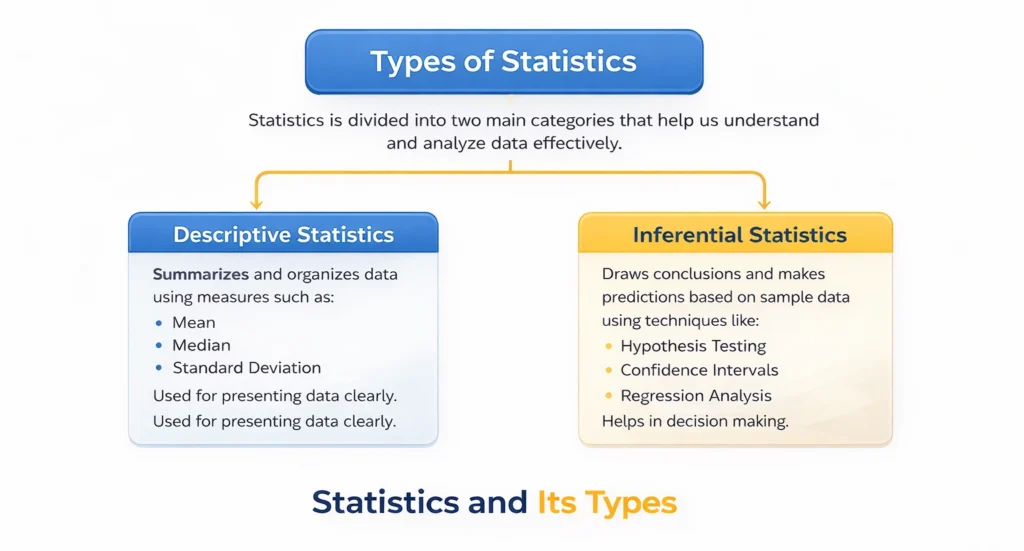
Statistics is broadly divided into two main categories:
1. Descriptive Statistics
Descriptive statistics focuses on summarizing and describing data.
Important techniques include:
- Mean (average)
- Median (middle value)
- Mode (most frequent value)
- Standard deviation
- Variance
Example: Analyzing average monthly sales of a company.
2. Inferential Statistics
Inferential statistics uses sample data to make predictions or generalizations about a population.
Important concepts include:
- Hypothesis testing
- Confidence intervals
- Regression analysis
- Probability distributions
Example: Predicting future sales based on past trends.
Descriptive Statistics in Data Analytics
Descriptive statistics helps in summarizing large datasets into simpler forms, often using:
Inferential Statistics in Data Analytics
Inferential statistics uses sample data to infer conclusions about a larger population. Some common techniques include:

Hypothesis Testing in Data Analytics
Hypothesis testing is a statistical method used to evaluate assumptions or claims about a population. It involves:
- Null Hypothesis (H₀): A statement of no effect or no difference, assumed true until evidence suggests otherwise.
- Alternative Hypothesis (H₁): A statement indicating the presence of an effect or difference.
- Significance Level (α): The probability threshold to reject the null hypothesis, often set at 0.05.
- P-value: The probability of observing results as extreme as those in the sample if the null hypothesis is true. A lower p-value indicates stronger evidence against the null hypothesis.
Data in Statistics
Data is the backbone of statistics and can be classified into two main types:
- Quantitative Data: Numerical data that can be measured, such as sales figures, temperatures, or test scores.
- Qualitative Data: Categorical data that describes attributes or characteristics, such as customer feedback, colors, or types of products.
Understanding the type of data is crucial for selecting the appropriate statistical methods and tools for analysis.
Representation of Data
Data representation plays a crucial role in understanding statistical information. Common methods include:
- Tables: Organizing data in rows and columns for clarity.
- Charts and Graphs: Visual representations such as bar charts, pie charts, line graphs, and scatter plots.
- Frequency Distributions: Summarizing data into intervals or groups to show the frequency of occurrences.
- Box Plots: Displaying the distribution of data based on a five-number summary (minimum, first quartile, median, third quartile, maximum).
Models of Statistics in Data Analytics
Statistical models are mathematical frameworks used to represent real world processes. This involves common models like:
Process in Data Analysis
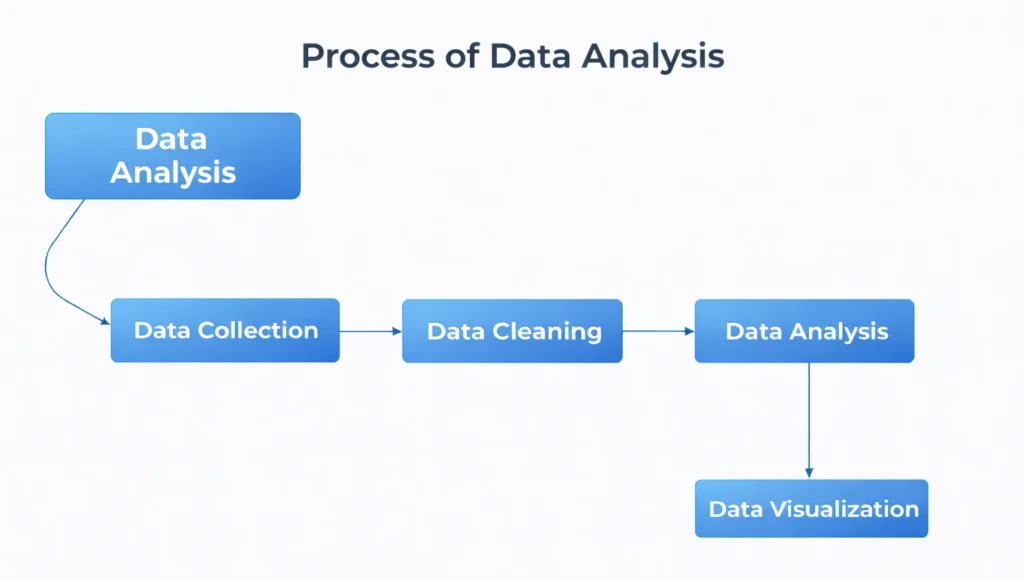
Data analysis involves processing and examining data to uncover patterns and insights. The main steps include:
- Data Collection: Gathering relevant data from reliable sources.
- Data Cleaning: Identifying and correcting errors or inconsistencies in the data.
- Data Analysis: Applying statistical tools and techniques to interpret the data.
- Data Visualization: Presenting results in charts, graphs, or dashboards for clear communication.
Types of Data Analysis

Coefficient of Variation in Data Analytics
The coefficient of variation (CV) measures the relative variability of data compared to its mean. It is calculated as:
Applications of Statistics in Data Analytics
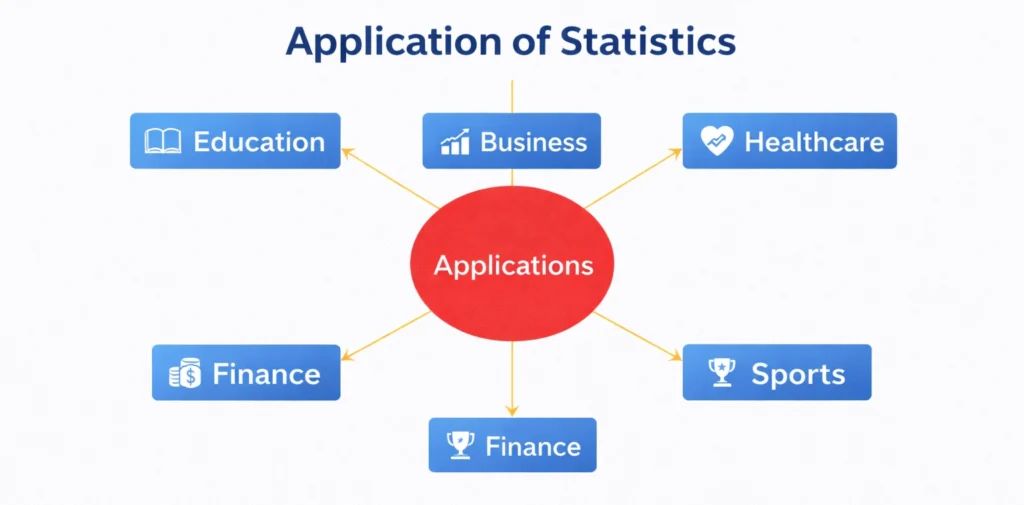
Statistics has a wide range of applications, including:
- Business: Market analysis, forecasting, quality control, and customer segmentation.
- Healthcare: Analyzing treatment effectiveness, predicting disease outbreaks, and patient monitoring.
- Education: Assessing student performance, designing educational programs, and analyzing survey data.
- Finance: Risk assessment, portfolio management, and fraud detection.
- Sports: Evaluating player performance, predicting game outcomes, and analyzing team strategies.
1. Business Statistics
Business statistics focuses on applying statistical methods to solve business problems. Key areas include:
- Demand Forecasting: Predicting future product demand based on historical data.
- Inventory Management: Optimizing stock levels to minimize costs and meet customer demand.
- Financial Analysis: Analyzing financial data to assess profitability and investment risks.
- Customer Behavior Analysis: Understanding customer preferences and improving marketing strategies.
2. Scope of Statistics
The scope of statistics extends to almost every field, including:
- Social Sciences: Analyzing survey data, public opinion, and social trends.
- Natural Sciences: Conducting experiments and interpreting results.
- Engineering: Quality control and reliability testing.
- Public Policy: Designing and evaluating programs based on statistical evidence.
- Sports and Entertainment: Performance analysis and audience measurement.
3. Limitations of Statistics
While powerful, statistics has its limitations:
- Data Dependence: Conclusions are only as accurate as the quality of the data collected.
- Misinterpretation: Incorrect use of statistical methods can lead to false conclusions or misleading results.
- Complexity: Advanced techniques may require specialized knowledge to apply and interpret correctly.
- Assumptions: Many statistical methods rely on assumptions that may not always hold true in real-world scenarios.
Problems Related to Statistics in Data Analytics
Problem 1:
Calculate the mean of the dataset: [5, 10, 15, 20, 25].
Solution: The mean of a dataset is calculated using the formula:
Mean = ∑all data points/number of data points
In this case, the dataset is: [5, 10, 15, 20, 25].
Sum of the data points: 5 + 10 + 15 + 20 + 25 = 75
Number of data points = 5.
Now, calculating the mean:
Mean = 75/5 = 15
Answer: The mean is 15.
Problem 2:
If the standard deviation of a dataset is 4 and the mean is 20, what is the coefficient of variation
Solution: The coefficient of variation (CV) is calculated using the formula:
Coefficient of Variation = (Standard Deviation/Mean) × 100
Given:
Standard deviation = 4
Mean = 20
Now, calculating the coefficient of variation:
CV = (4/20) × 100
= 0.2 × 100
= 20%
Answer: The coefficient of variation is 20%.
Final Thoughts....
In conclusion, statistics is key to data analytics, helping us understand data, spot trends, and make better decisions. By understanding basic concepts like mean and probability, we can analyze data more effectively and make informed choices.
Unlock your Statistics potential with Career247 ! Dive into our expertly designed course and master Statistics today. Click now to get started!
Frequently Asked Questions
Answer:
Statistics in data analytics is the process of collecting, analyzing, and interpreting data using mathematical techniques to extract meaningful insights and support decision-making.
Answer:
Statistics is important because it helps summarize data, identify trends, and make predictions. It ensures accurate and reliable data analysis for better decision-making.
Answer:
The two main types are descriptive statistics, which summarizes data, and inferential statistics, which makes predictions based on sample data.
Answer:
Statistics is used in business forecasting, healthcare analysis, financial modeling, and marketing optimization to improve decision making and performance.
Answer:
Common tools include Python, SQL, Excel, Power BI, and Tableau, which help analyze and visualize data effectively.
Answer:
Yes, statistics is a fundamental skill required for data analytics as it helps understand data patterns, perform analysis, and build predictive models.