
Exploratory Data Analysis in Data Analytics
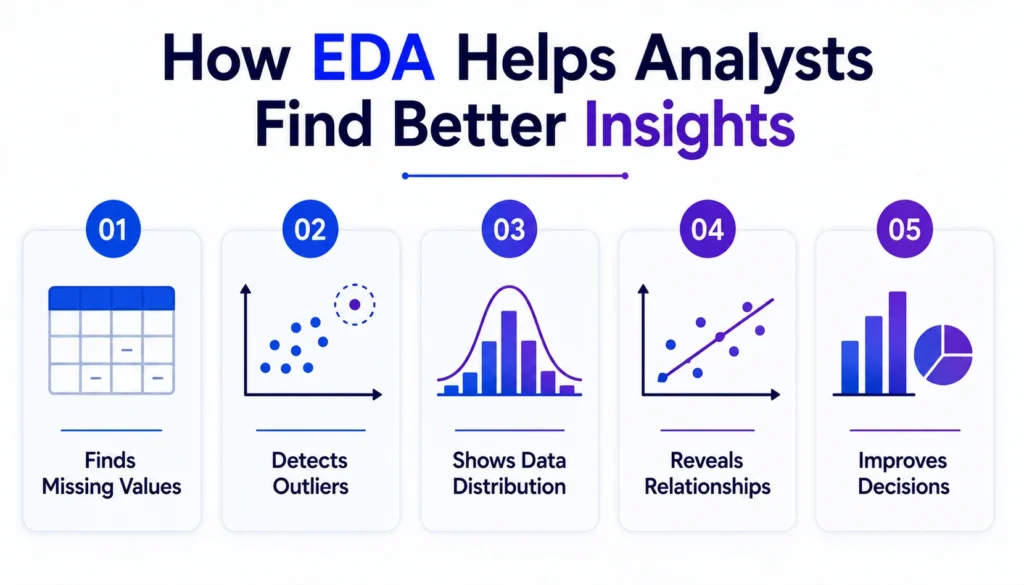
How EDA Helps Analysts Find Better Insights
Exploratory data analysis is one of the most important steps in the data analytics workflow because it helps analysts understand the dataset before making conclusions, building dashboards, or applying machine learning models. EDA is used to explore data, detect patterns, identify missing values, find outliers, understand relationships, and generate useful business questions.

What is Exploratory Data Analysis?
Exploratory Data Analysis, commonly known as EDA, is the process of investigating a dataset to understand its structure, quality, patterns, and possible insights.
EDA is usually performed before deep analysis, dashboard creation, or machine learning. It helps analysts understand:
- What columns are available
- What type of data is present
- Whether values are missing
- Whether outliers exist
- How variables are distributed
- How features are related
- What business questions can be answered
For example, if a company has sales data, EDA can help identify which region has the highest sales, which product category is underperforming, whether discounts affect profit, and whether sales have seasonal patterns.
Why EDA is Important in Data Analytics
EDA is important because raw data rarely tells the full story directly. Before creating any final report or dashboard, analysts need to check whether the data is clean, reliable, and meaningful.
1. Helps Understand the Dataset
EDA gives a clear overview of the dataset. Analysts can check the number of rows, columns, data types, unique values, and overall structure.
This helps avoid confusion before starting analysis.
2. Helps Find Missing Values
Missing values can affect analysis and dashboards. EDA helps identify where data is missing and how serious the issue is.
For example, if customer age is missing in 40% of records, any age based analysis may become unreliable.
3. Helps Detect Outliers
Outliers are unusual values that are very different from normal data points. EDA helps identify whether outliers are valid, incorrect, or business critical.
Example: A very high transaction value may be a premium purchase, data entry error, or fraud signal.
4. Helps Identify Patterns and Trends
EDA helps analysts find useful patterns such as sales growth, seasonal demand, customer behavior changes, or product performance trends.
These patterns can later become business insights.
5. Helps Build Better Dashboards and Models
EDA helps analysts choose the right metrics, charts, filters, and features. This improves the quality of dashboards, reports, and machine learning models.
EDA in Python
Python is widely used for exploratory data analysis because it provides powerful libraries for cleaning, summarizing, and visualizing data.
Common Python libraries for EDA include:
- Pandas for data cleaning and manipulation
- NumPy for numerical calculations
- Matplotlib for basic charts
- Seaborn for statistical visualizations
- Plotly for interactive charts
Example EDA workflow in Python:
import pandas as pd

df = pd.read_csv("sales_data.csv")

print(df.head())
print(df.info())
print(df.describe())
print(df.isnull().sum())
print(df.duplicated().sum())
This basic code helps analysts check the structure, summary, missing values, and duplicate records in a dataset.

EDA Process: Step by Step
A good exploratory data analysis process follows a structured approach.
1. Understand the Business Problem
Before analyzing data, understand the business goal.
Examples:
- Why are sales decreasing?
- Which customers are more profitable?
- Which campaign performed better?
- Are there fraud patterns in transactions?
A clear business question gives direction to the analysis.
2. Understand the Dataset
Check the dataset structure.
Important checks include:
- Number of rows and columns
- Column names
- Data types
- Unique values
- Duplicate records
- Basic summary
This step helps analysts understand what kind of data they are working with.
3. Clean the Data
Data cleaning is a major part of EDA.
Common cleaning tasks include:
- Handling missing values
- Removing duplicates
- Correcting data types
- Standardizing date formats
- Fixing inconsistent category names
Clean data leads to more reliable insights.
4. Perform Descriptive Statistics
Descriptive statistics help summarize data.
Common measures include:
- Mean, Median and Mode
- Minimum and maximum
- Standard deviation
- Percentiles
These values help analysts understand the central tendency, spread, and variation in the dataset.
5. Analyze Data Distribution
Distribution analysis shows how values are spread.
Common visuals include:
- Histograms
- Box plots
- Density plots
- Bar charts
For example, income data may be right skewed because a few customers earn much more than others.
6. Detect Outliers
Outliers should be checked carefully because they can affect averages, charts, and models.
Common outlier detection methods include:
- Box plot
- IQR method
- Z score
- Percentile based checks
Outliers should not always be removed. First, analysts should understand whether they are errors or meaningful business events.
7. Find Relationships Between Variables
EDA helps identify how variables are connected.
Examples:
- Discount vs profit
- Marketing spend vs revenue
- Customer age vs purchase amount
- Website traffic vs conversions
Common techniques include:
- Correlation analysis
- Scatter plots
- Group wise comparison
- Heatmaps
This step helps analysts discover deeper insights.
8. Generate Insights and Questions
EDA does not always give final answers. Sometimes, it gives better questions.
For example:
- Why does profit drop when discount increases?
- Why does one region have high sales but low profit?
- Why are repeat customers declining?
- Why is one product category more seasonal?
These questions help guide deeper analysis.
EDA in Business Analytics
Exploratory data analysis is not only technical. It is also useful for business decision making.
For example, in a retail business, EDA can help identify:
- Best selling products
- Low profit categories
- Seasonal sales trends
- High value customer segments
- Discount impact on profit
- Regional performance differences
In marketing, EDA can help understand:
- Campaign performance
- Customer response rate
- Conversion trends
- Audience segments
- Channel wise ROI
This makes EDA a practical skill for data analysts, business analysts, and BI professionals.
Common Exploratory Data Analysis Techniques
1. Univariate Analysis
Univariate analysis studies one variable at a time.
Example: Analyzing sales distribution, customer age, order quantity, or product category count.
Useful charts are Histogram, Bar chart and Box plot.
2. Bivariate Analysis
Bivariate analysis studies the relationship between two variables.
Example: Checking how discount affects profit or how customer age affects purchase value.
Useful charts are Scatter plot, Line chart and Grouped bar chart.
3. Multivariate Analysis
Multivariate analysis studies more than two variables together.
Example: Analyzing sales, profit, discount, region, and product category together.
Useful visuals:
- Heatmaps and Pair plots
- Pivot tables
- Dashboard views
4. Correlation Analysis
Correlation analysis checks whether two numerical variables move together.
Example: If marketing spend increases and revenue also increases, there may be a positive correlation.
Important note: correlation does not always mean causation.
5. Outlier Analysis
Outlier analysis helps detect unusual data points.
This is useful in:
- Fraud detection
- Insurance analytics
- Financial analysis
- Transaction monitoring
- Data quality checks
How EDA Helps Analysts Find Better Insights
EDA helps analysts move from raw data to meaningful insights by improving clarity.
- It Shows What Matters: EDA helps identify the most important variables, trends, and business patterns.
- Reduces Wrong Assumptions: Instead of assuming why something happened, analysts can check actual data patterns.
- It Improves Data Quality: Missing values, duplicate records, and inconsistent formats can be detected early.
- Supports Better Visualization: EDA helps analysts choose the right charts and dashboard structure.
- It Improves Machine Learning Results: Good EDA helps identify useful features, outliers, data imbalance, and model risks.
Learn EDA with Data Analytics and GenAI
If you want to learn exploratory data analysis in a practical way, Career247’s Data Analytics with GenAI Course can help you build a structured foundation. The course covers statistics, Excel, SQL, Python, Tableau, dashboards, real world projects, and GenAI supported analytics workflows.
EDA becomes more powerful when you know how to clean data, ask the right questions, visualize patterns, and validate insights. Career247’s practical project based approach helps learners understand these skills in a job ready way.
So the conclusion is….
Exploratory data analysis is one of the most valuable steps in data analytics because it helps analysts understand data before making decisions. It improves data quality, reveals patterns, detects outliers, and supports better dashboards, reports, and machine learning models.
EDA also helps analysts ask better questions. Instead of jumping directly to conclusions, analysts can explore the data, validate assumptions, and find insights that are useful for business decisions.
For anyone learning data analytics, EDA is a must have skill because it connects statistics, data cleaning, visualization, and business thinking into one practical workflow.

Frequently Asked Questions
Answer:
Exploratory data analysis is the process of examining a dataset to understand its structure, quality, patterns, outliers, relationships, and possible insights before final analysis or modeling.
Answer:
EDA is important because it helps analysts understand data quality, detect missing values, find outliers, identify trends, and create better dashboards or models.
Answer:
Common EDA techniques include descriptive statistics, univariate analysis, bivariate analysis, multivariate analysis, correlation analysis, distribution analysis, and outlier detection.
Answer:
EDA in Python is done using libraries like Pandas, NumPy, Matplotlib, Seaborn, and Plotly to clean, summarize, visualize, and explore datasets.
Answer:
Yes, EDA is very useful before machine learning because it helps identify missing values, outliers, feature relationships, data imbalance, and patterns that affect model performance.