
Different Types of Errors
Different Types of Errors in Data Analytics
In the world of data analytics, accuracy is everything. Even small mistakes can lead to incorrect insights, poor decisions, and business losses. Understanding the different types of errors in data analytics helps analysts improve data quality, build reliable models, and make better predictions.
In this guide, we’ll explore the major error types, their causes, and how to minimize them.
- Errors in data analytics occur when there is a difference between the actual value and the observed or predicted value.
- The most common types include measurement errors, sampling errors, processing errors, and model errors.
- Reducing errors improves decision-making, prediction accuracy, and business outcomes.

What Are Errors in Data Analytics?
In data analytics, errors refer to the differences, inconsistencies, or deviations between the expected (true) values and the values that are actually observed or recorded. These discrepancies can reduce the reliability, accuracy, and overall quality of insights derived from data.
Errors are a natural part of working with data and can arise at any stage of the analytics pipeline, including data collection, data entry, data processing, modeling, and even during interpretation. If not identified and handled properly, errors can lead to misleading conclusions, poor decision-making, and ineffective business strategies.
At a fundamental level, errors measure how far an observed result is from the true value. This is commonly expressed as:
- Error=Actual Value−Observed Value
This formula highlights the core idea: the larger the difference, the greater the error, and the less accurate the data or model.
- It helps improve data quality and integrity
- It ensures more accurate predictions and insights
- It reduces the risk of incorrect business decisions
- It enables better model evaluation and optimization
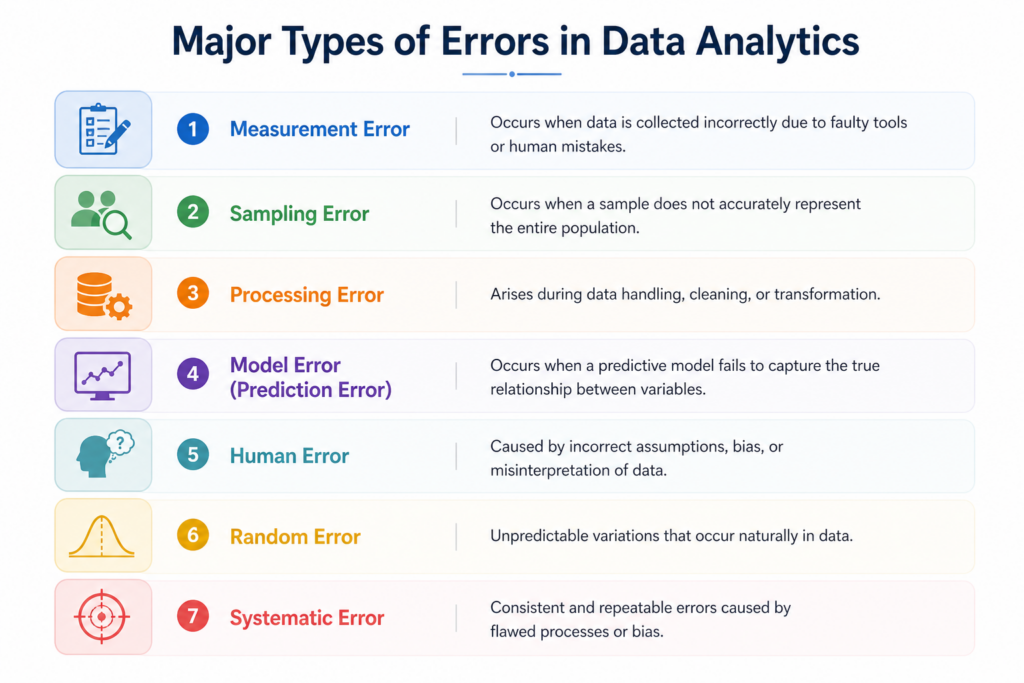
Major Types of Errors in Data Analytics
1. Measurement Error
Measurement errors happen when data is collected incorrectly due to faulty tools or human mistakes.
Examples:
- Incorrect survey responses
- Sensor malfunction
- Manual data entry errors
Impact:
Leads to inaccurate datasets and flawed insights.
2. Sampling Error
Sampling error occurs when a sample does not accurately represent the entire population.
Examples:
- Surveying only a specific group
- Small sample size
- Biased sample selection
Impact:
Results may not generalize to the full population.
3. Processing Error
Processing errors arise during data handling, cleaning, or transformation.
Examples:
- Incorrect data formatting
- Coding mistakes
- Missing value mismanagement
Impact:
Corrupts datasets and leads to incorrect analysis.
4. Model Error (Prediction Error)
Model error occurs when a predictive model fails to capture the true relationship between variables.
Examples:
- Overfitting
- Underfitting
- Poor feature selection
Impact:
Reduces prediction accuracy and model performance.
5. Human Error
Human errors are caused by incorrect assumptions, bias, or misinterpretation of data.
Examples:
- Misreading charts
- Wrong data assumptions
- Logical errors in analysis
Impact:
Leads to flawed decision-making.
6. Random Error
Random errors are unpredictable variations that occur naturally in data.
Examples:
- Fluctuations in measurements
- Environmental changes
Impact:
Introduces noise but can be reduced using statistical techniques.
7. Systematic Error
Systematic errors are consistent and repeatable errors caused by flawed processes or bias.
Examples:
- Biased survey questions
- Faulty measurement instruments
Impact:
Leads to consistently incorrect results.


Types of Errors in Statistical Modeling
In statistical modeling and machine learning, understanding different types of errors is essential for building models that perform well not just on training data, but also on unseen data. Among the most important error types are bias error and variance error two concepts that directly impact a model’s accuracy and generalization ability.
Bias Error
Bias error occurs when a model makes overly simplified assumptions about the data. This usually happens when the model is too basic to capture the underlying patterns in the dataset.
- Leads to underfitting (model fails to learn relationships properly)
- Common in simple models like linear regression applied to complex data
- Produces consistently inaccurate predictions
Example:
If you try to fit a straight line to data that actually follows a curve, your model will miss important patterns, resulting in high bias.
Variance Error
Variance error occurs when a model becomes too sensitive to small fluctuations or noise in the training data. This typically happens when the model is overly complex.
- Leads to overfitting (model memorizes data instead of learning patterns)
- Performs well on training data but poorly on new data
- Captures noise as if it were meaningful information
Example:
A highly complex model might perfectly fit training data points but fail when new data is introduced.
Conceptual Visualization
Error=Bias 2+Variance+Irreducible Error
This equation shows that the total model error is a combination of:
- Bias (error from wrong assumptions)
- Variance (error from sensitivity to data)
- Irreducible error (noise that cannot be eliminated)
- Use clean and validated data
- Increase sample size
- Apply data preprocessing techniques
- Validate models using cross-validation
- Automate processes to reduce human error
Summary
Errors are an inevitable part of data analytics, but understanding their types and causes helps minimize their impact. From measurement and sampling errors to model and human errors, each type affects analysis differently. By applying best practices, analysts can significantly improve accuracy and reliability.
Frequently Asked Questions
Answer:
The most common types of errors in data analytics include measurement errors, sampling errors, processing errors, and modeling errors. These errors can occur at different stages of the data lifecycle. Each type affects data accuracy and insights in unique ways. Identifying them early helps improve the reliability of analysis.
Answer:
Measurement error occurs when the data collected is inaccurate due to faulty instruments, incorrect inputs, or human mistakes. For example, wrong survey responses or sensor failures can cause this error. It directly impacts data quality and leads to misleading conclusions. Proper validation methods can help reduce it.
Answer:
Sampling error happens when a selected sample does not properly represent the entire population. This often occurs due to small sample sizes or biased selection methods. As a result, the analysis may not reflect real-world trends. Using larger and more diverse samples can minimize this error.
Answer:
Processing errors occur during data handling, such as data entry, coding, or transformation mistakes. These errors can happen when merging datasets or applying incorrect formulas. They may distort results and reduce analysis accuracy. Automated tools and data cleaning techniques help prevent such issues.
Answer:
Bias error occurs when a model is too simple and fails to capture underlying patterns, while variance error happens when a model is too complex and overfits the data. Both errors affect model performance in different ways. Balancing bias and variance is crucial for building accurate predictive models.
Answer:
Errors can be reduced by implementing proper data validation, using reliable data sources, and applying consistent data cleaning methods. Regular audits and automated tools also help identify inconsistencies. Additionally, choosing the right model and sampling techniques improves overall accuracy. A structured approach ensures better decision-making.