
What is Deep Learning
How Machines Learn Complex Patterns
Deep Learning has become one of the most influential technologies in modern Artificial Intelligence. From facial recognition and self driving cars to virtual assistants and Generative AI tools, deep learning powers many of the intelligent systems we use every day.
While traditional machine learning models can identify patterns in structured data, deep learning takes this capability a step further. It enables computers to learn highly complex patterns from massive amounts of data, making it possible to solve problems that were once considered impossible for machines.

What Is Deep Learning?
Deep Learning is a subset of Machine Learning that uses artificial neural networks to learn patterns from data.
The term “deep” refers to the multiple layers within a neural network that allow the system to learn increasingly complex features from data.
Instead of manually defining rules, deep learning models automatically learn relationships and patterns through training.
In simple terms:
- Machine Learning teaches computers to learn from data.
- Deep Learning teaches computers to learn complex patterns from large amounts of data using neural networks.
Why Is Deep Learning Important?
Many real world problems involve enormous amounts of unstructured data such as:
- Images
- Videos
- Audio
- Text
- Social Media Content
Traditional machine learning algorithms often struggle with such data because feature extraction can be difficult.
Deep learning automatically discovers important patterns without extensive manual intervention.
Benefits of Deep Learning….
- Handles large datasets effectively
- Learns complex relationships automatically
- Improves prediction accuracy
- Supports advanced AI applications
- Works well with text, images, and speech data
These capabilities have made deep learning a key technology in modern AI systems.
How Deep Learning Works
Deep learning models are built using structures called neural networks.
These networks are inspired by the way neurons communicate within the human brain.
A neural network typically consists of:
1. Input Layer: Receives the raw data.
Examples:
- Customer data
- Images
- Text
- Audio
- Hidden Layers
Process information and identify patterns.
The more hidden layers a network contains, the deeper the model becomes.
2. Output Layer: Produces the final prediction or classification.
Examples:
- Spam or Not Spam
- Fraud or Legitimate Transaction
- Positive or Negative Review
Understanding Neural Networks
Neural networks are the foundation of deep learning.
- Each artificial neuron receives input values, performs calculations, and passes information to the next layer.
- Over time, the network learns which patterns are important for making accurate predictions.
This process allows neural networks to improve their performance through training.
From Perceptrons to Multi Layer Perceptrons (MLPs)
The journey of deep learning began with the perceptron.
1. Perceptron: A perceptron is the simplest type of artificial neuron.
- It makes decisions based on input values and predefined weights.
- While useful, a single perceptron can solve only simple problems.
2. Multi Layer Perceptron (MLP): To solve more complex problems, multiple layers of neurons are connected together.
- This creates a Multi Layer Perceptron.
- MLPs can identify more sophisticated relationships and form the basis of many deep learning architectures.
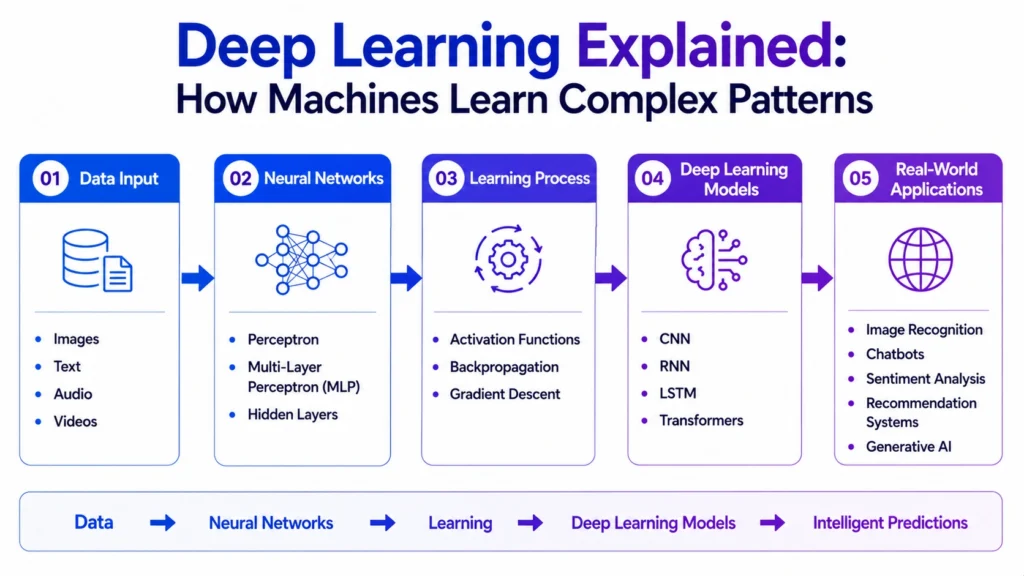
Activation Functions: Helping Neural Networks Learn
Neural networks require activation functions to determine how information flows through the network.
Without activation functions, neural networks would behave like simple mathematical equations.
Popular activation functions include:
Often used in binary classification problems.
Useful for certain deep learning applications.
Activation functions help neural networks learn non-linear patterns found in real world data.

Backpropagation and Gradient Descent
Training a neural network requires continuous improvement.
Two important concepts make this possible.
- Backpropagation: Backpropagation measures prediction errors and sends feedback through the network.
- The model learns which connections need adjustment.
- Gradient Descent: Gradient Descent is an optimization technique used to reduce prediction errors.
- It updates network parameters gradually to improve model accuracy.
Together, these techniques enable deep learning models to learn from data effectively.
Deep Learning vs Machine Learning
| Aspect | Machine Learning | Deep Learning |
|---|---|---|
| Data Requirement | Moderate | Large |
| Feature Engineering | Often Manual | Mostly Automatic |
| Complexity | Lower | Higher |
| Training Time | Faster | Longer |
| Hardware Requirement | Moderate | Higher |
| Best For | Structured Data | Large and Unstructured Data |
Deep learning is a specialized branch of machine learning designed for more complex learning tasks.
Popular Deep Learning Frameworks
Modern deep learning development relies on specialized frameworks.
- TensorFlow: One of the most widely used deep learning frameworks.
- Provides tools for building and deploying neural networks.
- Keras: A user friendly API built on top of TensorFlow.
- Popular among beginners and professionals alike.
These frameworks simplify the process of creating and training deep learning models.
Real World Applications of Deep Learning
1. Image Recognition
Used in:
- Medical Imaging
- Facial Recognition
- Security Systems
2. Natural Language Processing
Used in:
- Chatbots
- Translation Systems
- Sentiment Analysis
3. Recommendation Systems
Used by:
- Streaming Platforms
- E Commerce Companies
- Social Media Applications
4. Autonomous Vehicles
Deep learning helps vehicles recognize roads, obstacles, and traffic conditions.
5. Generative AI
Modern AI tools use deep learning to generate:
- Text
- Images
- Audio
- Code
Deep Learning and Computer Vision
One of the most important applications of deep learning is Computer Vision.
Computer Vision enables machines to interpret visual information from images and videos.
A specialized deep learning architecture called a Convolutional Neural Network (CNN) is commonly used for image related tasks.
Examples include:
- Object Detection
- Image Classification
- Medical Diagnosis
- Facial Recognition
Conclusion is….
Deep Learning has transformed the capabilities of Artificial Intelligence by enabling machines to learn complex patterns from massive amounts of data.
Through neural networks, activation functions, backpropagation, and advanced architectures, deep learning powers many of the intelligent technologies shaping today’s digital world.
As AI adoption continues to accelerate, understanding deep learning fundamentals provides a strong foundation for careers in Data Science, Machine Learning, Computer Vision, NLP, and Generative AI.
Learn Deep Learning and AI with Career247
Career247’s Data Science and Machine Learning with GenAI Certification Powered by IBM introduces learners to neural networks, activation functions, backpropagation, TensorFlow, Keras, Computer Vision, CNNs, NLP, transformers, and Generative AI concepts.
Through practical projects and hands on learning, learners gain exposure to the technologies that power modern AI systems and real world business applications.

Frequently Asked Questions
Answer:
Deep Learning is a subset of Machine Learning that uses neural networks with multiple layers to learn complex patterns from data.
Answer:
Yes. Deep Learning is a branch of Machine Learning, which itself is a subset of Artificial Intelligence.
Answer:
Neural networks are computational models inspired by the human brain that help machines learn patterns and make predictions.
Answer:
Machine Learning often requires manual feature engineering, while Deep Learning automatically learns features from large datasets.
Answer:
Deep Learning is used in image recognition, natural language processing, recommendation systems, autonomous vehicles, and Generative AI applications.