
Data Warehousing for Data Analytics
Why Businesses Store Data Before Analysis
Data Warehousing for Data Analytics plays a crucial role in helping organizations transform raw data into meaningful business insights. Every day, companies generate enormous amounts of information from websites, mobile apps, CRM systems, payment platforms, marketing campaigns, and operational systems. However, this data is often scattered across multiple locations.

What is a Data Warehouse?
A data warehouse is a centralized system designed to store large volumes of structured business data for analysis and reporting.
Unlike operational databases that handle daily transactions, a data warehouse is optimized for analytics.
Its primary purpose is to help organizations answer business questions such as:
- How have sales changed over time?
- Which products generate the highest revenue?
- What customer segments are most profitable?
- Which marketing campaigns deliver the best ROI?
Instead of searching across multiple systems, analysts can access a single source of truth.
Why Businesses Need Data Warehouses
Modern organizations often operate dozens of software systems.
Examples include:
- CRM Platforms
- ERP Systems
- Financial Applications
- E-Commerce Platforms
- Marketing Tools
- Customer Support Systems
Each system stores valuable information, but analyzing them separately creates challenges.
A data warehouse solves this problem by bringing data together in one place.
Key benefits include:
- Centralized data storage
- Faster reporting
- Improved data consistency
- Better dashboard performance
- Historical trend analysis
- Enhanced decision making
For large organizations, a data warehouse becomes the foundation of business intelligence.
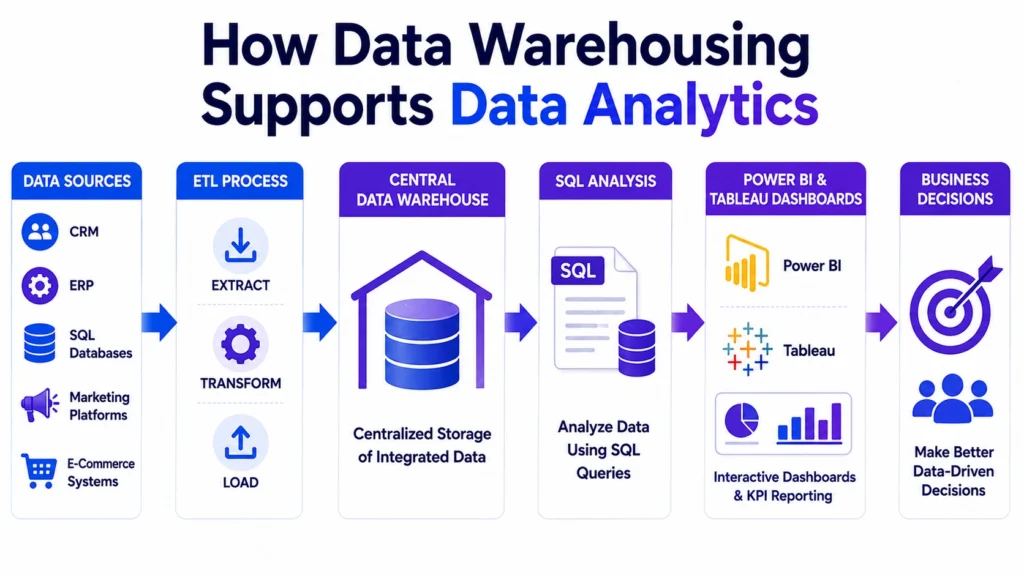
How Data Warehousing Works
A data warehouse does not collect data automatically. Before data enters the warehouse, it typically passes through an ETL process.
The workflow looks like this:
Step 1: Data Collection
Data is extracted from:
- SQL Databases
- Excel Files
- CRM Systems
- ERP Applications
- Cloud Platforms
- Marketing Tools
Step 2: Data Transformation
The extracted data is:
- Cleaned
- Standardized
- Validated
- Aggregated
Step 3: Data Loading
Prepared data is loaded into the data warehouse.
Step 4: Analysis and Reporting
Analysts use:
- SQL
- Power BI
- Tableau
- Excel
to generate insights and dashboards.
Data Warehouse vs Database
Many beginners confuse databases and data warehouses. While they both store data, they serve different purposes.
| Feature | Database | Data Warehouse |
|---|---|---|
| Purpose | Daily Operations | Analytics & Reporting |
| Data Type | Current Transactions | Historical Data |
| Performance Focus | Fast Updates | Fast Analysis |
| Users | Applications | Analysts & Decision Makers |
| Examples | MySQL, PostgreSQL | Snowflake, Redshift, BigQuery |
A database helps run the business. A data warehouse helps understand the business.
Main Components of a Data Warehouse
1. Data Sources
The systems where business data originates. Examples:
- CRM
- ERP
- Sales Systems
- Websites
- Marketing Platforms
2. ETL Layer
Responsible for:
- Extracting data
- Cleaning data
- Transforming data
- Loading data
This ensures information remains accurate and consistent.
3. Data Warehouse Storage
The central repository where prepared data is stored. Popular platforms include:
- Snowflake
- Amazon Redshift
- Google BigQuery
- Azure Synapse Analytics
4. Business Intelligence Layer
Visualization and reporting tools connect to the warehouse.
Examples:
- Power BI
- Tableau
- Looker
- Excel
This is where dashboards and reports are created.

Real World Example of Data Warehousing
Consider a large retail company.
Data comes from:
- Physical Stores
- Online Website
- Mobile Application
- Customer Loyalty Program
- Marketing Platforms
Without a warehouse, analysts would need to query multiple systems separately.
With a data warehouse:
- All customer data is centralized.
- Sales information is standardized.
- Marketing metrics are integrated.
- Historical trends are preserved.
The result is faster reporting and more reliable decision making.
Data Warehousing and Business Intelligence
Business intelligence tools rely heavily on data warehouses.
A dashboard showing:
- Revenue
- Customer Growth
- Conversion Rates
- Marketing ROI
- Inventory Performance
often pulls information directly from a warehouse.
This relationship explains why data warehousing is considered a foundational element of modern business intelligence.
Common Benefits of Data Warehousing
- Faster Reporting: Analysts can access centralized information without querying multiple systems.
- Improved Data Quality: ETL processes help eliminate inconsistencies.
- Better Historical Analysis: Organizations can track trends across months and years.
- Scalable Analytics: Warehouses can store massive amounts of information efficiently.
- Stronger Decision Making: Reliable data leads to more confident business decisions.
Why Data Analysts Should Understand Data Warehousing
Not every analyst will design a data warehouse, but understanding the concept provides several advantages.
It helps analysts:
- Understand data pipelines
- Work effectively with data engineers
- Build better dashboards
- Write efficient SQL queries
- Improve reporting accuracy
As analytics teams continue to grow, knowledge of data warehousing has become increasingly valuable across Data Analyst, Business Analyst, and Business Intelligence roles.
Conclusion is….
Data warehouses have become a cornerstone of modern analytics. By bringing information from multiple systems into a centralized environment, organizations can analyze data more efficiently, create reliable dashboards, and make better business decisions.
For aspiring analysts, understanding data warehousing helps connect the dots between data collection, ETL processes, SQL analysis, business intelligence, and dashboard reporting. It provides a broader view of how analytics systems operate within real world organizations.
Build Job Ready Data Analytics Skills with Career247
Modern analytics professionals are expected to understand the complete data journey, from data collection and storage to analysis and visualization.
Career247’s Data Analytics with GenAI Course helps learners build practical skills in SQL, Statistics, Python, Power BI, Tableau, Data Visualization, Dashboard Design, ETL concepts, and business analytics projects.
By working on real world scenarios, learners gain exposure to the tools and workflows used by modern analytics teams to transform data into business value.
Frequently Asked Questions
Answer:
Data warehousing is the process of collecting, storing, and organizing business data in a centralized repository for reporting, analysis, and business intelligence.
Answer:
Databases support day to day business operations, while data warehouses are designed specifically for analytics and historical reporting.
Answer:
Businesses use data warehouses to combine information from multiple systems, improve reporting, and support data driven decision making.
Answer:
Yes. SQL is commonly used to access, analyze, and retrieve information stored in data warehouses.
Answer:
A strong starting point is learning SQL, ETL processes, dashboard development, and business intelligence concepts.