
Future of Data Analyst Jobs
Will AI Replace Data Analysts?
Future of data analyst jobs is one of the biggest questions for learners entering data analytics today. With AI tools now writing SQL queries, generating Python code, summarizing dashboards, and creating reports, many beginners wonder: will AI replace data analysts?
The simple answer is: AI will replace some repetitive tasks, but it is unlikely to replace skilled data analysts completely. The role is changing. Future data analysts will need to use AI tools, validate outputs, understand business problems, and turn data into decisions.

Future of Data Analytics Jobs with AI
AI can automate many basic analytics tasks, but data analysis is not only about generating charts or writing code. A data analyst needs to understand business context, ask the right questions, clean messy data, validate results, and explain insights clearly.
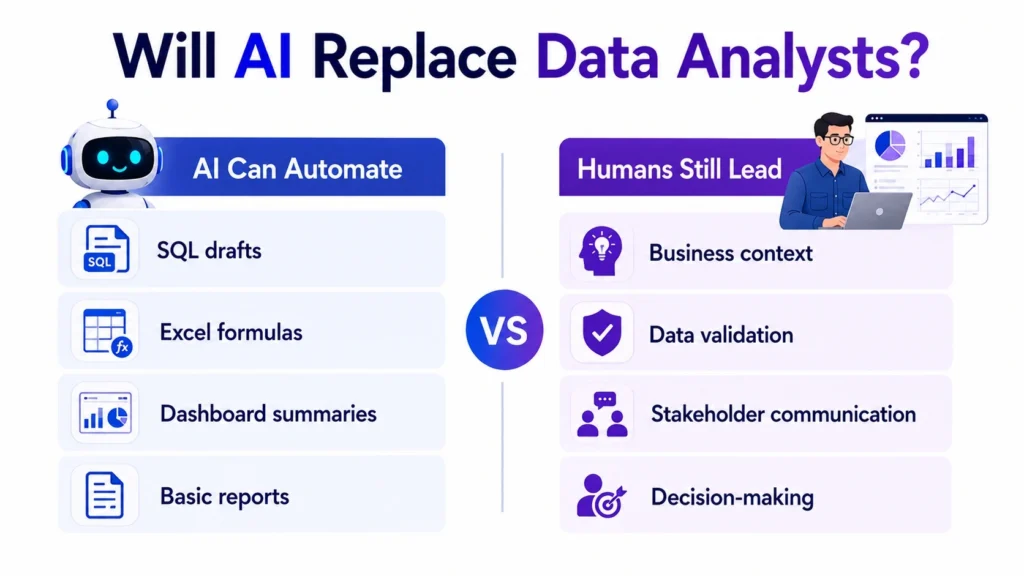
AI can help with:
- Writing SQL queries
- Creating Excel formulas
- Generating Python code
- Summarizing dashboards
- Suggesting charts
- Finding basic trends
- Drafting reports
But AI still struggles with:
- Understanding company specific context
- Knowing which KPI matters most
- Validating messy data properly
- Explaining business trade offs
- Handling stakeholder requirements
- Making ethical and practical decisions
So, AI will not remove the need for data analysts. It will raise the expectations from data analysts.
How AI is Changing Data Analyst Jobs
AI is shifting the data analyst role from manual reporting to smarter decision support. Earlier, analysts spent more time preparing data and creating repeated reports. Now, AI can speed up these tasks.
A modern analyst may use AI to:
- Generate first drafts of SQL queries
- Debug Python code
- Create dashboard summaries
- Explore possible insights
- Build faster reports
- Explain data patterns in simple language
What Tasks are Most Likely to be Automated?
AI is most likely to automate repetitive and rule based tasks.
Tasks AI can automate faster:
- Basic reporting
- Simple dashboard summaries
- Repeated SQL queries
- Excel formula generation
- Data formatting support
- Code explanation
- First draft analysis notes
Tasks still needing human analysts:
- Defining the business problem
- Choosing the right metrics
- Checking data quality
- Validating AI generated output
- Explaining insights to stakeholders
- Making recommendations
- Connecting analysis with business action
In short, AI may reduce low value manual work, but it increases the value of analysts who can think critically.
Why Data Analysts Will Still Be Needed
Data analysts will still be needed because businesses do not just need data output; they need reliable insights and decisions.
- Business Context Matters: AI may generate a chart, but it may not know why sales dropped, whether the data is incomplete, or which business factor is most important.
- Data Quality Needs Human Judgment: Real world data has missing values, duplicates, wrong formats, and unclear definitions. Analysts decide how to clean and interpret it.
- AI Output Needs Validation: AI can produce wrong SQL, misleading summaries, or incorrect assumptions. Data analysts must verify results before business teams use them.
- Stakeholder Communication is Human Led: Business teams need clear explanations, not just technical outputs. Analysts translate data into simple business language.
- Decision Making Needs Accountability: Companies need people who can take responsibility for insights, recommendations, and business impact.

Data Analyst Skills Needed in the AI Era
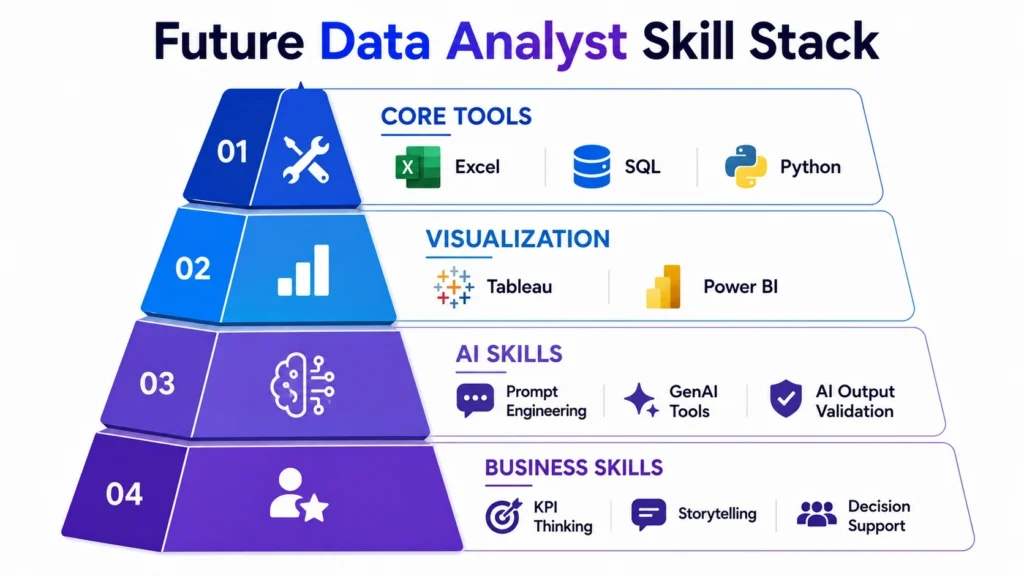
To stay relevant, data analysts should build a mix of technical, analytical, business, and AI skills.
Technical Skills:
- Excel
- SQL and Python
- Tableau or Power BI
- Statistics
- Data cleaning
- Dashboard Creation
AI and GenAI Skills:
- Prompt engineering
- AI assisted SQL
- AI assisted Python
- Dashboard summarization
- AI output validation
- Responsible AI usage
Business Skills:
- KPI understanding
- Problem solving
- Stakeholder communication
- Data storytelling
- Decision making support
Data Analyst vs AI Powered Data Analyst
| Area | Traditional Data Analyst | AI-Powered Data Analyst |
|---|---|---|
| SQL | Writes queries manually | Uses AI drafts, then validates logic |
| Python | Writes and debugs code manually | Uses AI for support and reviews output |
| Dashboards | Builds reports manually | Uses AI summaries and faster insights |
| Reporting | Writes everything from scratch | Uses AI drafts and edits for business clarity |
| Main Value | Tool execution | Business thinking + AI validation |
How Beginners Can Prepare for Future Data Analyst Jobs
Beginners should not panic about AI. They should prepare smartly.
A practical roadmap:
- Learn Excel for basic analysis and reporting.
- Learn SQL for database querying.
- Learn Python for data cleaning and automation.
- Learn Tableau or Power BI for dashboards.
- Learn statistics and business KPIs.
- Practice prompt engineering for analytics.
- Build real world projects.
- Learn how to validate AI generated output.
- Improve communication and storytelling skills.
This approach helps beginners become AI ready instead of AI dependent.
So the conclusion is that….
AI will change data analyst jobs, but it will not remove the need for skilled analysts.
- Repetitive tasks like basic reporting, formula writing, query drafting, and dashboard summarization may become faster with AI.
- However, business understanding, data validation, communication, and decision making will remain human led.
- The future data analyst will be someone who understands data deeply and uses AI as a productivity tool.
For learners, the best strategy is clear: build strong analytics fundamentals, learn GenAI supported workflows, work on real projects, and develop business communication skills.
For beginners who want a structured path, Career247’s Data Analytics with GenAI Course can help build these future ready skills through Excel, SQL, Python, Tableau, dashboards, real world projects, GenAI workflows, and prompt engineering.
This makes it a practical choice for learners who want to become confident, job ready, and AI ready data analysts.
Frequently Asked Questions
Answer:
AI may automate repetitive tasks, but it is unlikely to fully replace skilled data analysts. Analysts are still needed for business understanding, data validation, decision making, and insight communication.
Answer:
The future of data analyst jobs will be more AI assisted. Analysts will spend less time on repetitive reporting and more time on business interpretation, validation, and decision support.
Answer:
Yes, data analytics is still a strong career path. AI is increasing the need for analysts who can combine data skills, business thinking, and AI supported workflows.
Answer:
Data analysts should learn Excel, SQL, Python, Tableau or Power BI, statistics, prompt engineering, data storytelling, and AI output validation.
Answer:
Yes, beginners can still become data analysts. The best approach is to build strong fundamentals first and then learn how to use GenAI tools responsibly.
Answer:
An AI powered data analyst is someone who uses AI tools to speed up tasks like SQL, Python, reporting, and dashboard summaries while still validating results and making business recommendations.