
LLMs in Data Science
How Large Language Models Are Transforming Data Science and AI
LLMs in Data Science are rapidly changing how organizations analyze data, build AI applications, automate workflows, and generate business insights. Over the past few years, Large Language Models (LLMs) such as GPT, BERT, Gemini, Llama, and Claude have become some of the most significant advancements in Artificial Intelligence. They can understand natural language, generate human like text, write code, summarize documents, answer questions, and even assist with data analysis.
For Data Scientists, LLMs are much more than conversational AI tools. They are becoming intelligent assistants that help automate repetitive tasks, accelerate Machine Learning workflows, analyze unstructured data, and improve decision making. As businesses increasingly adopt Generative AI, understanding how LLMs work has become an important skill for aspiring Data Scientists.
What Are Large Language Models (LLMs)?
Large Language Models (LLMs) are advanced Artificial Intelligence models trained on enormous volumes of text data to understand, generate, and process human language.
Unlike traditional Machine Learning models that are built for a single task, LLMs can perform many different language related tasks using a single foundation model.
These tasks include:
- Answering questions
- Summarizing documents
- Translating languages
- Writing code
- Sentiment analysis
- Text classification
- Information extraction
- Content generation
LLMs combine advances in:
- Deep Learning
- Natural Language Processing (NLP)
- Neural Networks
- Transformer Architecture
Why LLMs Are Important in Data Science
Traditional Data Science focused mainly on structured data stored in spreadsheets and databases.
However, businesses now generate enormous amounts of unstructured data, including:
- Emails
- Customer reviews
- Social media posts
- Chat conversations
- Reports
- Research papers
- Support tickets
LLMs help Data Scientists understand and analyze this information at scale. This enables organizations to extract insights that were previously difficult or time-consuming to obtain.
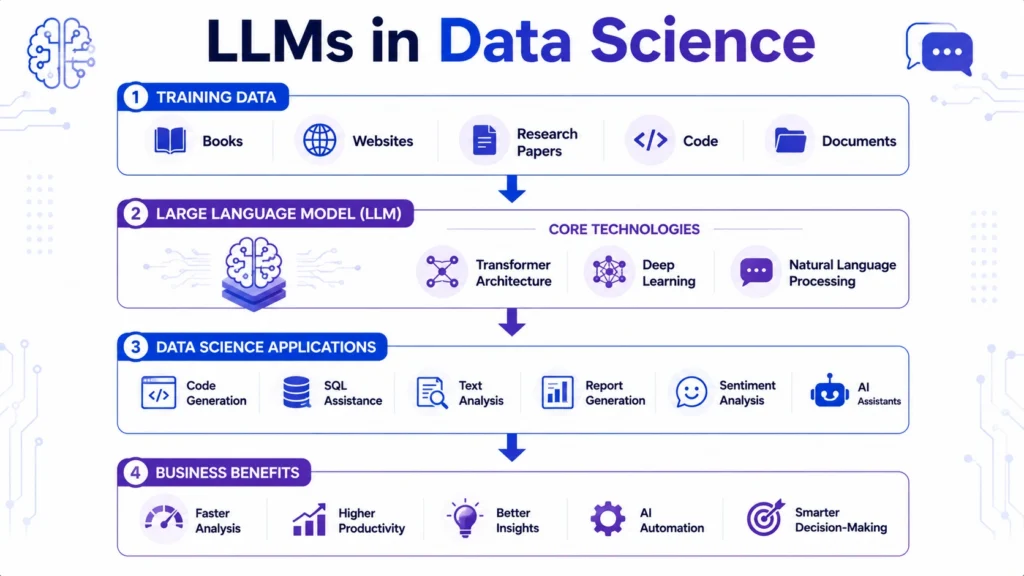
How Do Large Language Models Work?
Although the mathematics behind LLMs is complex, the overall workflow is easier to understand.
Step 1: Massive Data Collection
LLMs learn from billions of words collected from:
- Books
- Articles
- Websites
- Research papers
- Documentation
- Public datasets
Step 2: Transformer Architecture
Unlike older NLP models, modern LLMs use the Transformer architecture.
Transformers help models understand relationships between words, even when they appear far apart in a sentence.
This significantly improves language understanding.
Step 3: Training
During training, the model repeatedly predicts missing or next words in text.
Over time, it learns:
- Grammar
- Context
- Language patterns
- Reasoning structures
- Relationships between concepts
Step 4: Fine Tuning
Organizations often customize foundation models using domain specific datasets.
For example:
- Healthcare
- Banking
- Legal
- Customer support
- Finance
This improves performance for specialized business applications.
Popular Large Language Models
Several LLMs are widely used across industries.
- GPT: Developed for conversational AI, coding assistance, reasoning, and content generation.
- BERT: Designed primarily for understanding language and search related tasks. Widely used in NLP applications.
- Llama: An open weight family of LLMs that supports research and enterprise AI development.
- Claude: Designed for conversational reasoning, summarization, and enterprise workflows.
- Gemini: A multimodal AI model capable of understanding text, images, and other data types.
Applications of LLMs in Data Science
1. Text Analysis
LLMs can automatically analyze:
- Customer feedback
- Product reviews
- Survey responses
- Support tickets
This helps businesses understand customer sentiment and emerging trends.
2. Code Generation
Modern LLMs can generate:
- Python scripts
- SQL queries
- Data cleaning code
- Visualization code
This improves productivity during Data Science projects.
3. Report Generation
LLMs can automatically create:
- Executive summaries
- Business reports
- Dashboard explanations
- Analytical insights
This reduces manual reporting effort.
4. Natural Language Interfaces
Instead of writing complex SQL queries, users can ask questions such as:
“Show sales trends for the last six months.”
The LLM converts natural language into executable queries.
5. AI Assistants
Many organizations now build AI assistants that help employees:
- Search company knowledge
- Analyze documents
- Answer business questions
- Retrieve information quickly
These assistants are powered by LLMs.
Benefits of LLMs in Data Science
Large Language Models offer several advantages.
- Faster Analysis: They automate repetitive language related tasks.
- Improved Productivity: Data Scientists spend less time writing boilerplate code and documentation.
- Better Decision Making: LLMs summarize large volumes of information quickly.
- Scalability: They can process thousands of documents efficiently.
- Enhanced Accessibility: Business users can interact with data using natural language instead of technical queries.
Limitations of LLMs
Despite their capabilities, LLMs have limitations.
- Hallucinations: Models may generate incorrect or fabricated information.
- Outdated Knowledge: Some models may not include recent events unless connected to external data sources.
- Privacy Concerns: Organizations must protect sensitive business information when using AI systems.
- Human Verification: Outputs should always be reviewed before making business decisions.
LLMs vs Traditional Machine Learning
| Aspect | Traditional ML | Large Language Models |
|---|---|---|
| Primary Data | Structured | Mostly Unstructured |
| Tasks | Specific | Multiple language tasks |
| Training | Task-specific | General-purpose foundation model |
| Flexibility | Limited | Highly versatile |
| User Interaction | Technical | Natural language |
Rather than replacing Machine Learning, LLMs complement existing Data Science workflows.
Skills Needed to Work with LLMs in Data Science
As LLM adoption grows, Data Scientists should develop expertise in:
- Python and SQL
- Machine Learning
- Deep Learning
- Natural Language Processing
- Prompt Engineering
- Vector Databases
- API Integration
- Generative AI
These skills enable professionals to build intelligent AI powered applications.
The conclusion is….
LLMs in Data Science are transforming how organizations analyze information, build AI solutions, and automate business processes. By combining Deep Learning, Natural Language Processing, and Transformer based architectures, Large Language Models enable Data Scientists to work more efficiently with unstructured data and create intelligent applications that were once difficult to build.
As Generative AI adoption continues to accelerate, understanding LLMs is becoming an increasingly valuable skill for aspiring Data Scientists. Professionals who combine traditional Data Science knowledge with expertise in Large Language Models will be well prepared for the next generation of AI driven careers.
Master Generative AI and LLMs with Career247
Modern Data Science goes beyond traditional Machine Learning.
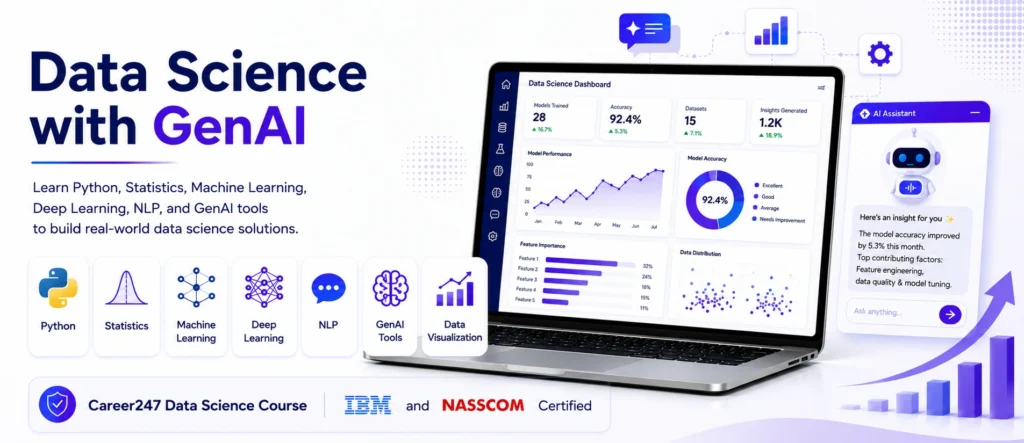
Career247’s Data Science and Machine Learning with GenAI Certification Powered by IBM equips learners with industry relevant skills in Python, SQL, Machine Learning, Deep Learning, Natural Language Processing, and Generative AI.
Frequently Asked Questions
Answer:
LLMs in Data Science are Large Language Models that help analyze unstructured data, generate code, summarize information, automate workflows, and support AI powered analytics.
Answer:
They enable Data Scientists to process large volumes of text, automate repetitive tasks, improve productivity, and build intelligent AI applications.
Answer:
No. LLMs complement traditional Machine Learning by handling language based tasks while conventional ML remains essential for many predictive modeling applications.
Answer:
Python, Machine Learning, NLP, Deep Learning, Prompt Engineering, API integration, and Generative AI fundamentals are among the most valuable skills.
Answer:
Healthcare, banking, retail, education, legal services, customer support, marketing, software development, and many other industries use LLM powered solutions.