
How to Become a Data Scientist With No Experience
Is It Possible to Become a Data Scientist Without Experience?
One of the most common questions aspiring professionals ask is: Can I become a Data Scientist with no experience?
The answer is yes, but it requires a structured approach.
Data Science has become one of the most sought after career fields because organizations increasingly rely on data to solve business problems, predict future outcomes, automate decisions, and create AI powered products. From healthcare and finance to e commerce and technology, companies are investing heavily in data driven solutions.

What Does a Data Scientist Actually Do?
Before learning the tools, it is important to understand the role itself.
A Data Scientist uses data, statistics, machine learning, and artificial intelligence to solve complex business problems and generate insights.
Common responsibilities include:
- Collecting and preparing data
- Analyzing patterns and trends
- Building predictive models
- Creating machine learning solutions
- Communicating findings to stakeholders
- Supporting business decision making
For example, a Data Scientist might help an e-commerce company predict product demand, detect fraudulent transactions, recommend products, or improve customer retention.
The good news is that you do not need years of industry experience to start learning Data Science.
Many successful Data Scientists began as students, fresh graduates, career switchers, or professionals from non technical backgrounds.
Is It Possible to Become a Data Scientist Without Experience?
Yes.
Most entry level candidates do not have years of industry experience.
Employers often evaluate candidates based on:
- Technical skills
- Project experience
- Problem solving ability
- Portfolio quality
- Business understanding
- Communication skills
This means you can build credibility through projects and practical learning even before getting your first Data Science job.

Guide to become Data Scientist without experience
Step 1: Learn the Fundamentals of Data Science
Before diving into coding or machine learning, understand the overall Data Science workflow.
Main concepts include:
- Data Collection
- Data Cleaning
- Exploratory Data Analysis
- Statistics
- Machine Learning
- Data Visualization
- Model Evaluation
- Business Problem Solving
Understanding how these pieces fit together will make your learning journey much easier.
Step 2: Learn Python
Python is one of the most widely used programming languages in Data Science.
Its simplicity and extensive ecosystem make it ideal for beginners.
Important Python topics include:
- Variables and Data Types
- Loops
- Functions
- Lists and Dictionaries
- File Handling
- Object Oriented Programming Basics
Once comfortable with Python fundamentals, move to Data Science libraries.
Step 3: Learn SQL
Data Scientists often work with large datasets stored in databases.
SQL helps retrieve, filter, and analyze data efficiently.
Main SQL concepts include:
- SELECT Statements
- WHERE Clauses
- GROUP BY
- ORDER BY
- Joins
- Aggregate Functions
- Subqueries
Step 4: Build a Strong Statistics Foundation
You don’t need to become a mathematician, but a basic understanding of statistics is extremely helpful.
Important topics include:
- Mean, Median and Mode
- Standard Deviation
- Correlation
- Hypothesis Testing
- Probability and Sampling
Statistics helps Data Scientists understand patterns and validate conclusions.
Step 5: Learn Data Visualization
Data Scientists must communicate findings effectively.
Visualization tools help convert complex data into understandable insights.
Common tools include:
- Matplotlib
- Seaborn
- Tableau
- Power BI
Visualization is often the bridge between technical analysis and business decision making.
Step 6: Understand Machine Learning
Machine Learning is one of the most exciting parts of Data Science.
It enables systems to learn from data and make predictions without being explicitly programmed.
Learn practical applications of:
- Supervised Learning
- Unsupervised Learning
- Reinforcement Learning
Step 7: Learn Deep Learning and Neural Networks
Deep Learning powers many modern AI applications.
Important concepts include:
- Neural Networks
- Perceptrons
- Multi Layer Perceptrons
- Activation Functions
- Backpropagation
- Gradient Descent
Deep Learning is used in:
- Image Recognition
- Speech Processing
- Natural Language Processing
- Generative AI
Understanding these concepts opens the door to advanced AI applications.
Step 8: Explore Natural Language Processing (NLP)
NLP enables computers to understand and process human language.
Applications include:
- Chatbots
- Sentiment Analysis
- Language Translation
- Resume Screening
- Content Classification
NLP has become increasingly important with the growth of Generative AI.
Step 9: Learn Generative AI
Generative AI is transforming how Data Scientists work.
Tools such as ChatGPT and other Large Language Models help professionals:
- Generate code
- Automate documentation
- Explore datasets
- Create reports
- Improve productivity
Step 10: Build Real World Data Science Projects
Projects are often the most important part of your learning journey.
They demonstrate practical skills and help build confidence.
Step 11: Build a Data Science Portfolio
Your portfolio is proof of your skills.
A strong portfolio should include:
- Project descriptions
- Business objectives
- Data sources
- Methodology
- Results
- Visualizations
- GitHub repositories
A well organized portfolio can significantly strengthen job applications.
Step 12: Develop Business Understanding
Many beginners focus only on coding.
However, successful Data Scientists understand business problems.
Ask questions such as:
- Why are customers leaving?
- How can revenue be increased?
- What drives customer behavior?
- How can risks be reduced?
Business thinking helps transform technical work into valuable business outcomes.
Common Mistakes Beginners Make
- Learning Algorithms Without Understanding Data: Data preparation is often more important than model complexity.
- Ignoring SQL: SQL remains one of the most essential Data Science skills.
- Skipping Projects: Projects are critical for demonstrating practical ability.
- Focusing Only on Certificates: Skills and portfolio quality often matter more than certificates alone.
- Avoiding Statistics: Statistics is fundamental to effective Data Science.
Simple Data Science Roadmap
Month 1:
- Python Fundamentals
- Data Science Basics
Month 2:
- SQL
- Data Cleaning and Data Manipulation
Month 3:
- Statistics and Data Visualization
Month 4:
- Machine Learning Fundamentals
Month 5:
- Deep Learning and NLP
Month 6:
- Generative AI
- Portfolio Projects
Month 7:
- GitHub Portfolio
- Resume Building
Month 8:
- Interview Preparation
- Job Applications
Consistency and hands on practice are more important than completing everything quickly.
So the conclusion is….
Becoming a Data Scientist without experience may seem challenging at first, but it is entirely achievable with the right roadmap.
By learning Python, SQL, Statistics, Machine Learning, Deep Learning, NLP, and Generative AI while building practical projects, you can develop the skills employers look for in modern Data Science roles.
Rather than focusing on the lack of experience, focus on creating evidence of your abilities through projects, portfolios, and continuous learning. The combination of technical expertise, business understanding, and hands on practice can help you build a strong foundation for a successful Data Science career.
Build Industry Ready Data Science Skills with Career247
Structured learning path can make the transition into Data Science significantly easier.
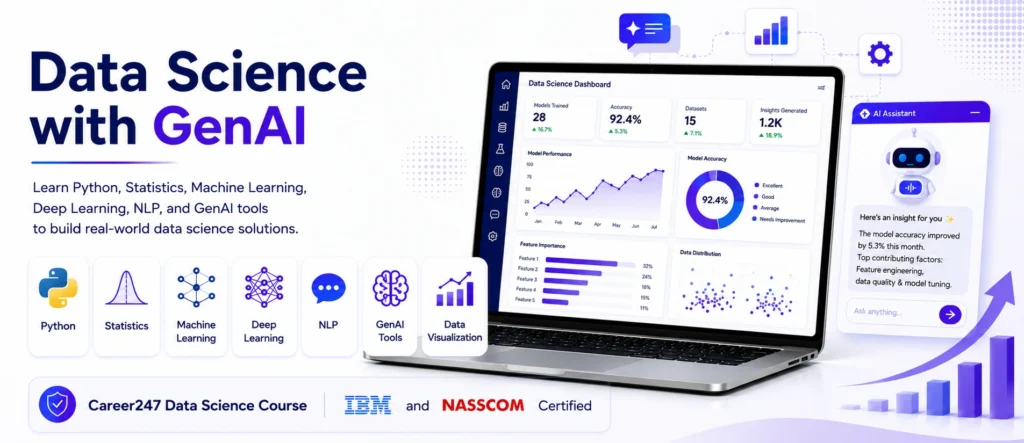
Career247’s Data Science and Machine Learning with GenAI Certification Powered by IBM helps learners develop practical expertise in Python, SQL, Statistics, Machine Learning, Deep Learning, Natural Language Processing, and Generative AI.
Through hands on projects such as Fraud Detection, Customer Churn Prediction, Demand Forecasting, Resume Screening using NLP, and Sentiment Analysis, learners gain real world experience with the tools and techniques used by modern Data Scientists. The program combines strong theoretical foundations with practical application to help learners prepare for the evolving world of AI and Data Science.
Frequently Asked Questions
Answer:
Yes. Many professionals enter Data Science through projects, portfolios, and structured learning paths.
Answer:
No. People from various educational backgrounds successfully transition into Data Science.
Answer:
The timeline varies, but many learners build foundational skills within several months of focused study and project work.
Answer:
Python is one of the most widely used programming languages in Data Science and is highly recommended.
Answer:
Yes. Entry level opportunities exist for candidates who demonstrate practical skills through projects and portfolios.