
Best Practices for Implementing AI and Data Science in Organizations
Best Practices for Implementing AI and Data Science in Organizations
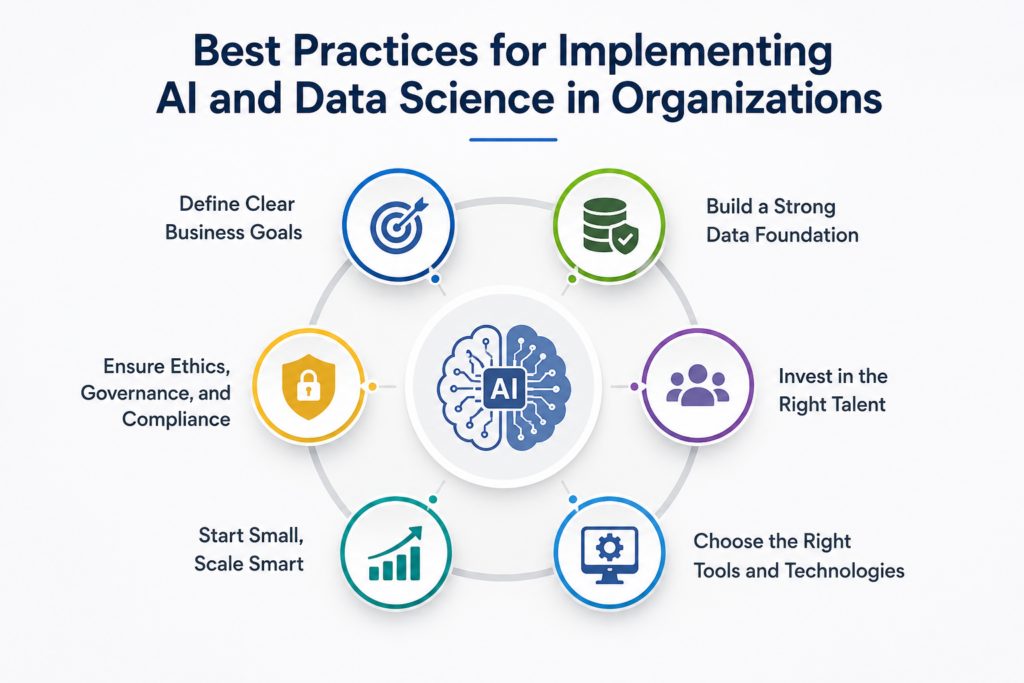
As businesses increasingly embrace digital transformation, the successful implementation of AI and Data Science has become a strategic priority. Organizations across industries are leveraging intelligent technologies to improve decision-making, automate operations, enhance customer experiences, and gain competitive advantages. However, achieving meaningful results requires more than simply adopting new tools. Companies must follow structured approaches and proven best practices to maximize the value of their investments.
Organizations that develop a clear strategy and focus on long-term goals are more likely to achieve successful outcomes from their AI and analytics initiatives.

Start with Clear Business Objectives
One of the most common mistakes organizations make is adopting technology without defining a clear purpose. Before implementing any solution, businesses should identify specific challenges they want to solve and the outcomes they expect to achieve.
Examples of common objectives include:
- Improving customer retention
- Reducing operational costs
- Enhancing productivity
- Detecting fraud and risks
- Optimizing supply chains
- Increasing revenue opportunities
A clear objective helps ensure that AI and Data Science projects remain aligned with business priorities.
Build a Strong Data Foundation
The success of any analytics or artificial intelligence initiative depends on the quality of the underlying data. Poor-quality data can lead to inaccurate insights, unreliable predictions, and ineffective decision-making. Organizations that invest in strong data management practices are better positioned to gain meaningful business insights and maximize the value of their technology investments.
A well structured data foundation also helps teams work more efficiently by reducing errors, improving collaboration, and ensuring that information is available when needed. Before implementing advanced AI or analytics solutions, businesses should establish clear processes for collecting, storing, and managing data.
Organizations should focus on:
Data Accuracy
Ensuring information is complete, consistent, and up to date.
Accurate data is essential for generating reliable reports, forecasts, and business recommendations. Even the most advanced AI systems can produce misleading results if they are trained on incorrect or outdated information. Regular data validation and quality checks help organizations maintain confidence in their insights.
Key practices include:
- Removing duplicate and outdated records.
- Verifying data sources regularly.
- Establishing data quality standards across departments.
Data Accessibility
Providing authorized teams with easy access to relevant datasets.
Data should be available to employees and decision makers when they need it. Limited access can slow down operations and prevent teams from making timely decisions. Organizations should implement centralized data platforms that allow secure and efficient information sharing.
Benefits of improved accessibility include:
- Faster decision-making processes.
- Better collaboration between departments.
- Increased productivity through self-service analytics.
Data Integration
Combining information from multiple systems to create a unified view of business operations.
Many organizations store data across various platforms such as CRM systems, marketing tools, financial software, and operational databases. Integrating these sources provides a complete picture of business performance and helps uncover valuable patterns that might otherwise remain hidden.
Effective data integration can help organizations:
- Eliminate information silos.
- Improve reporting accuracy.
- Gain deeper insights into customer behavior and business processes.
Data Security
Protecting sensitive information from unauthorized access and cyber threats.
As organizations collect increasing amounts of data, security becomes a critical priority. Strong security measures help protect customer information, maintain regulatory compliance, and preserve business reputation. A proactive approach to cybersecurity reduces the risk of costly data breaches.
Important security measures include:
- Implementing role-based access controls.
- Encrypting sensitive data during storage and transfer.
- Conducting regular security audits and employee training.
A strong data foundation increases the effectiveness of all future AI-driven initiatives. By prioritizing data accuracy, accessibility, integration, and security, organizations can create a reliable environment for analytics, machine learning, and intelligent decision-making. This foundation enables businesses to innovate with confidence while achieving long-term operational success.

Develop a Cross Functional Team
Successful implementation requires collaboration between multiple departments rather than relying solely on technical teams.
An effective project team may include:
- Data Scientists
- Business Analysts
- IT Professionals
- Department Managers
- Security Specialists
- Executive Stakeholders
When business and technical experts work together, organizations can create solutions that deliver measurable value and align with operational goals.
Begin with Small, Scalable Projects
Many organizations attempt large-scale deployments immediately, which can increase costs and complexity. A more effective approach is to start with pilot projects that address specific business problems.
Benefits of small scale implementation include:
- Faster results
- Lower risk
- Easier performance measurement
- Better stakeholder support
- Improved learning opportunities
Once successful outcomes are achieved, organizations can gradually expand their AI and Data Science initiatives across other departments.
Focus on Employee Training and Adoption
Technology alone cannot drive transformation. Employees must understand how to use new tools effectively and incorporate them into their daily workflows.
Training programs should cover:
- Data literacy
- Analytics interpretation
- AI-assisted decision-making
- Technology best practices
- Ethical use of intelligent systems
Organizations that invest in workforce development often experience higher adoption rates and stronger project outcomes.
Establish Strong Data Governance Policies
As organizations collect and process larger volumes of information, proper governance becomes increasingly important. Clear policies help ensure compliance, security, and responsible data usage.
Key governance practices include:
- Defining data ownership
- Setting access controls
- Maintaining compliance standards
- Monitoring data quality
- Establishing audit processes
Strong governance frameworks help organizations build trust while minimizing risks.
Prioritize Ethical and Responsible AI
Modern businesses must ensure that intelligent systems are transparent, fair, and accountable. Ethical implementation helps organizations avoid bias, maintain customer trust, and comply with emerging regulations.
Important considerations include:
- Algorithm transparency
- Bias detection and mitigation
- Responsible data collection
- Privacy protection
- Human oversight of automated decisions
Responsible use of AI and Data Science supports sustainable growth and long-term credibility.
Invest in Scalable Technology Infrastructure
As projects grow, organizations need technology platforms capable of handling increasing data volumes and computational demands.
Essential infrastructure components may include:
- Cloud computing platforms
- Data warehouses
- Analytics tools
- Machine learning frameworks
- Cybersecurity solutions
Scalable infrastructure ensures that organizations can continue expanding their capabilities without major disruptions.
Measure Performance Continuously
Implementation should not end once a system is deployed. Continuous monitoring helps organizations evaluate effectiveness and identify opportunities for improvement.
Common performance metrics include:
- Return on investment (ROI)
- Operational efficiency improvements
- Customer satisfaction scores
- Prediction accuracy
- Revenue growth
- Cost reductions
Regular evaluation allows organizations to refine strategies and maximize long-term value.
Encourage a Data Driven Culture
The most successful organizations create a culture where decisions are supported by evidence rather than assumptions. Encouraging employees to use analytics in their daily work helps maximize the impact of technology investments.
A data-driven culture promotes:
- Better collaboration
- Improved decision-making
- Greater innovation
- Increased accountability
- Faster problem-solving
This cultural shift is often as important as the technology itself.
Common Challenges to Avoid
While implementing intelligent technologies offers many benefits, organizations should be aware of potential obstacles.
Common challenges include:
- Poor data quality
- Lack of leadership support
- Insufficient employee training
- Unrealistic expectations
- Weak governance policies
- Inadequate infrastructure
Addressing these challenges early can significantly improve project success rates.
Conclusion
Implementing AI and Data Science successfully requires careful planning, quality data, skilled teams, and a commitment to continuous improvement.
Organizations that focus on clear objectives, responsible practices, employee training, and scalable infrastructure are better positioned to achieve meaningful business outcomes. By following these best practices, companies can unlock the full potential of intelligent technologies and build a stronger foundation for future growth.
Frequently Asked Questions
Answer:
A clear strategy ensures that projects align with business goals, deliver measurable results, and provide long-term value.
Answer:
High-quality data improves accuracy, reliability, and the effectiveness of analytics and machine learning models.
Answer:
Pilot projects reduce risk, allow teams to learn from experience, and demonstrate value before larger investments are made.
Answer:
Organizations should establish ethical guidelines, monitor bias, protect privacy, and maintain human oversight of automated decisions.
Answer:
Common challenges include poor data quality, lack of skilled talent, inadequate infrastructure, and resistance to organizational change.