
Data Analytics Challenges
Common Challenges in Data Analytics and Their Solutions
Modern businesses rely heavily on data to make smarter decisions, improve customer experiences, and increase profits. From small startups to large enterprises, organizations collect huge amounts of information every day. However, managing and analyzing this data is not always easy. Many companies face multiple challenges that affect the accuracy, speed, and quality of insights.
Understanding these issues is important for businesses that want to improve their decision-making process. In this article, we will discuss the most common challenges in data analytics and practical solutions to overcome them.

Why Businesses Face Data Analytics Challenges
Today, businesses collect huge amounts of data from websites, mobile apps, customer transactions, social media platforms, and cloud systems. While this information helps companies make better decisions, managing and analyzing large datasets can become difficult without the right tools and strategies.
Many organizations face data analytics challenges because data keeps growing rapidly and comes from multiple sources. If these issues are not handled properly, businesses may struggle to generate accurate insights and improve performance.
Some common reasons behind analytics problems include:
- Poor data quality and duplicate records
- Lack of skilled data analytics professionals
- Data security and privacy concerns
- Slow data processing systems
- Difficulty integrating multiple data sources
- High infrastructure and maintenance costs
For example, inaccurate data can lead to wrong business decisions, while slow analytics systems can delay important reports and insights. Similarly, managing customer data securely has become a major challenge due to increasing cyber threats and privacy regulations.
To overcome these problems, businesses are investing in cloud technology, automation tools, data security solutions, and employee training. With the right analytics strategy, companies can improve efficiency, make smarter decisions, and gain a competitive advantage in the market.
- Investing in modern analytics tools
- Improving data security systems
- Training employees regularly
- Using cloud-based infrastructure
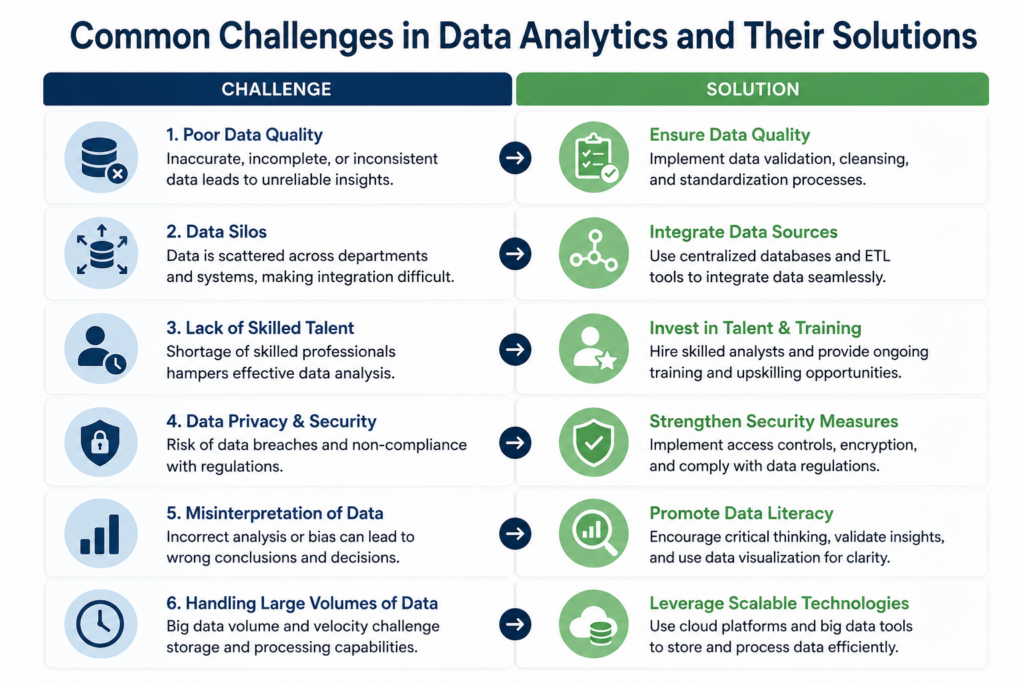

Major Data Analytics Challenges and Their Solutions
1. Poor Data Quality
One of the biggest challenges in data analytics is poor-quality data. Incorrect, incomplete, or duplicate information can lead to inaccurate reports and wrong business decisions. When businesses rely on low-quality data, their analytics results become unreliable and may affect overall business growth.
Many companies collect data from multiple platforms, making it difficult to maintain consistency and accuracy. Even small data errors can create major reporting problems over time.
Common examples include:
- Missing customer details
- Duplicate records
- Incorrect sales data
- Outdated information
Solution
Businesses should use proper data cleaning and validation processes to improve accuracy. Automated tools can also help remove duplicate entries and maintain consistent data.
Regular monitoring and auditing of datasets help organizations identify errors before they impact analytics reports. Maintaining high-quality data improves overall business performance and decision-making.
Best Practices
- Regularly audit datasets
- Use automated validation tools
- Standardize data entry methods
- Remove outdated information
Clean and accurate data improves reporting and analytics performance.
2. Difficulty Managing Large Volumes of Data
Modern businesses generate massive amounts of data every day. Traditional systems often struggle to process and store large datasets efficiently. As data volume grows, businesses may experience slower performance and difficulty accessing important insights quickly.
Managing large datasets manually becomes time-consuming and expensive. Without scalable infrastructure, businesses may face operational inefficiencies and delayed analytics.
This can cause:
- Slow reporting
- Delayed analytics
- Storage limitations
- System performance issues
Solution
Cloud based analytics platforms help businesses manage large datasets more efficiently. They offer scalable storage, faster processing, and real time analytics capabilities.
Cloud technology also reduces the need for expensive physical infrastructure and allows businesses to scale resources according to their requirements. This improves flexibility and operational efficiency.
Benefits of Cloud Analytics
- Faster processing speed
- Flexible storage capacity
- Real time insights
- Lower infrastructure costs
Cloud technology helps organizations handle growing data more effectively.
3. Data Security and Privacy Concerns
Businesses store sensitive customer and financial information, making data security a major concern. Cyberattacks and data breaches can damage both reputation and customer trust. Protecting business data has become more important as organizations increasingly depend on digital systems.
Many industries must also follow strict privacy regulations to ensure customer information remains secure. Weak security practices can lead to financial losses and legal penalties.
Common risks include:
- Unauthorized access
- Weak passwords
- Malware attacks
- Poor encryption systems
Solution
Organizations should implement strong cybersecurity measures and data protection policies.
Businesses should also train employees about cybersecurity best practices because human errors are one of the leading causes of security breaches. Regular system updates and monitoring improve overall protection.
Important Security Measures
- Use data encryption
- Enable multi-factor authentication
- Restrict unauthorized access
- Conduct regular security audits
Strong security practices help protect valuable business data.
4. Lack of Skilled Data Professionals
Many companies struggle to hire experienced data analysts and analytics experts. Without skilled professionals, understanding complex datasets becomes difficult. Businesses may fail to identify useful insights or interpret reports correctly.
The growing demand for analytics professionals has created a skill gap in many industries. Organizations often face challenges in managing advanced analytics tools effectively.
This often leads to:
- Poor data interpretation
- Inaccurate forecasting
- Weak reporting strategies
- Limited business insights
Solution
Businesses should invest in employee training and modern analytics tools that simplify data analysis.
Providing regular learning opportunities helps employees stay updated with the latest analytics technologies and industry trends. User-friendly tools can also reduce the complexity of analytics processes.
Important Analytics Skills
- Data visualization
- Statistical analysis
- SQL and database management
- Business intelligence tools
Skilled professionals help companies make smarter business decisions.
5. Integrating Data from Multiple Sources
Businesses collect data from websites, mobile apps, CRM systems, social media platforms, and cloud databases. Combining all this information into one system can be challenging. Different systems often store data in different formats, making integration difficult.
Without proper integration, businesses may struggle to get a complete view of customer behavior and operational performance. This can reduce analytics efficiency and reporting accuracy.
Solution
Centralized data integration platforms help businesses connect multiple data sources into a single dashboard.
Integrated systems improve collaboration between departments and make data easier to access and analyze. Automation tools also simplify the integration process and reduce manual work.
Advantages of Data Integration
- Better reporting accuracy
- Faster access to insights
- Improved decision-making
- Simplified analytics workflow
Integrated systems make data analytics more efficient and organized.
6. Slow Decision-Making Due to Delayed Insights
Many organizations still rely on outdated reporting systems that take too much time to generate insights. Delayed analytics can affect business performance and customer experience. In fast-moving industries, slow decisions can lead to missed opportunities and reduced competitiveness.
Businesses today require real-time information to respond quickly to customer needs and market changes. Traditional reporting methods are often unable to provide instant insights.
Solution
Real-time analytics tools help businesses analyze live data instantly and respond quickly to changing market conditions.
These tools allow organizations to monitor performance continuously and identify problems before they become serious. Faster access to insights improves overall operational efficiency.
Benefits of Real-Time Analytics
- Faster decision-making
- Instant performance tracking
- Better customer experience
- Quick trend detection
Real time insights help businesses stay competitive and improve operational efficiency.
Conclusion
Data analytics helps businesses make informed decisions, improve operational efficiency, and increase business growth. However, organizations often face challenges such as poor data quality, security concerns, lack of skilled professionals, and difficulty managing large datasets.
By adopting modern technologies, cloud platforms, and strong data management practices, businesses can overcome these problems effectively. Companies that invest in advanced analytics solutions will gain better insights and stay ahead in the competitive digital market.
Frequently Asked Questions
Answer:
The biggest challenges in data analytics include poor data quality, managing large datasets, data security risks, lack of skilled professionals, and integrating data from multiple sources. These issues can reduce the accuracy of insights and slow down business decision-making. Companies must use modern analytics tools and proper data management strategies to overcome these problems.
Answer:
Businesses can improve data quality by regularly cleaning datasets, removing duplicate records, and using automated validation tools. Standardizing data entry methods also helps maintain accuracy across systems. High-quality data leads to better reporting, improved forecasting, and more reliable business insights.
Answer:
Data security is important because businesses often store sensitive customer and financial information in analytics systems. Weak security can lead to data breaches, cyberattacks, and loss of customer trust. Companies should use encryption, strong passwords, multi-factor authentication, and regular security monitoring to protect their data.
Answer:
Cloud technology helps businesses store and process large amounts of data efficiently without expensive infrastructure. It provides faster processing speed, real-time analytics, scalability, and easier access to business insights. Cloud-based analytics platforms also support remote collaboration and improve overall operational efficiency.
Answer:
A data analytics professional should have skills in data visualization, statistical analysis, SQL, spreadsheet tools, and business intelligence platforms. Knowledge of cloud computing and machine learning is also becoming important in modern analytics. These skills help analysts convert raw data into meaningful business insights.