
Difference between Data Analytics and Business Analytics
Business Analytics vs Data Analytics
Difference between business analytics and data analytics is one of the most common questions for beginners who want to build a career in analytics. Both fields work with data, both help businesses make better decisions, and both use tools like Excel, SQL, Python, Tableau, and Power BI. However, their focus, job roles, responsibilities, and career paths are slightly different.
Data analytics focuses more on collecting, cleaning, analyzing, and visualizing data to find insights. Business analytics focuses more on using those insights to solve business problems, improve strategies, and support decision making. In simple words, data analytics explains what the data says, while business analytics connects that data with business action.

What is Data Analytics?
Data analytics is the process of collecting, cleaning, analyzing, and interpreting data to identify patterns, trends, and insights.
- It helps organizations understand what is happening in their data and why it is happening.
- A data analyst usually works with raw data and converts it into meaningful reports, dashboards, and insights.
Common tasks in data analytics include:
- Collecting data from different sources
- Cleaning and preparing datasets
- Analyzing trends and patterns
- Creating dashboards and reports
- Using SQL, Excel, Python, Tableau, or Power BI
- Explaining insights to teams
Example:
A company wants to know why website sales dropped last month. A data analyst may analyze website traffic, conversion rate, product performance, customer behavior, and marketing campaign data to find the possible reason.
What is Business Analytics?
Business analytics is the process of using data insights to solve business problems, improve processes, and support strategic decisions.
- It focuses more on business outcomes than only technical analysis.
- A business analyst or business analytics professional works closely with stakeholders, understands business goals, studies data insights, and recommends practical actions.
Common tasks in business analytics include:
- Understanding business problems
- Analyzing performance metrics
- Identifying improvement areas
- Creating business reports
- Supporting strategy and planning
- Recommending actions based on data
Example:
If sales are declining, a business analytics professional may not only analyze the numbers but also recommend changes in pricing, product strategy, marketing campaigns, or customer targeting.
Difference Between Data Analytics and Business Analytics
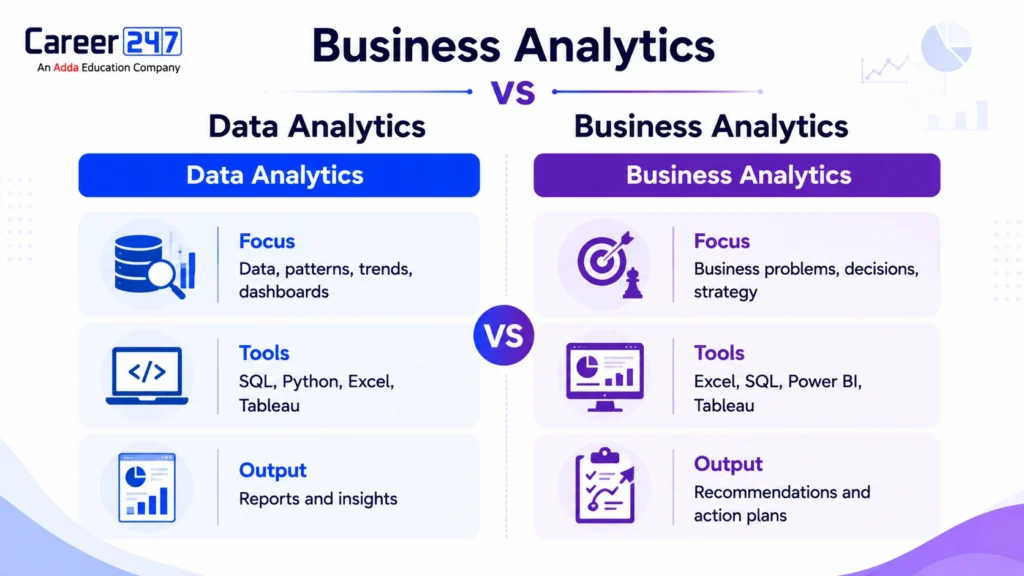
Although both fields are connected, they are not exactly the same. The main difference between business analytics and data analytics lies in their focus.
| Factor | Data Analytics | Business Analytics |
|---|---|---|
| Main Focus | Data, patterns, trends, and insights | Business problems, decisions, and strategy |
| Core Question | What does the data show? | What should the business do with the insight? |
| Work Type | More technical and analytical | More business and decision-oriented |
| Common Tools | SQL, Python, Excel, Tableau, Power BI | Excel, SQL, Tableau, Power BI, business reporting tools |
| Output | Dashboards, reports, data insights | Business recommendations and action plans |
| Best For | People who enjoy data handling and analysis | People who enjoy business problem-solving and strategy |
In short, data analytics is more focused on analyzing data, while business analytics is more focused on applying insights to business decisions.
Business Analytics vs Data Analytics: Simple Example
Let’s understand this with a simple business case…..
A retail company notices that its monthly revenue has dropped.
Data Analytics Role:
A data analyst will check:
- Which product categories declined
- Which region had lower sales
- What happened to customer traffic
- Whether discounts affected profit
- Which customer segments purchased less
The output may be a dashboard showing sales drop by region, category, and customer segment.
Business Analytics Role:
A business analytics professional will use the insights to suggest:
- Which product category needs promotion
- Which region needs sales attention
- Whether pricing should be adjusted
- Which customer segment should be retargeted
- What business action should be taken next
This shows how data analytics finds the insight, while business analytics helps convert that insight into a decision.
Skills Required for Data Analytics
If you want to build a career in data analytics, you should focus on both technical and analytical skills.
Technical Skills:
- Excel and Statistics
- SQL and Python
- Tableau or Power BI
- Data cleaning and Dashboard creation
Analytical Skills:
- Pattern recognition and Logical thinking
- Data interpretation and Problem solving
- Attention to detail
Skills Required for Business Analytics
Business analytics requires a strong mix of business understanding, analytical thinking, and communication skills.
Business Skills:
- Business process understanding
- Requirement gathering
- Problem solving
- KPI tracking
- Stakeholder communication
Analytical Skills:
- Data interpretation
- Dashboard reading
- Trend analysis
- Decision making support
- Reporting
Technical Skills:
- Excel
- SQL basics
- Power BI or Tableau
- Basic statistics
- Business reporting tools
Data Analyst vs Business Analyst
The comparison of data analyst vs business analyst is also important because many beginners get confused between these job roles.
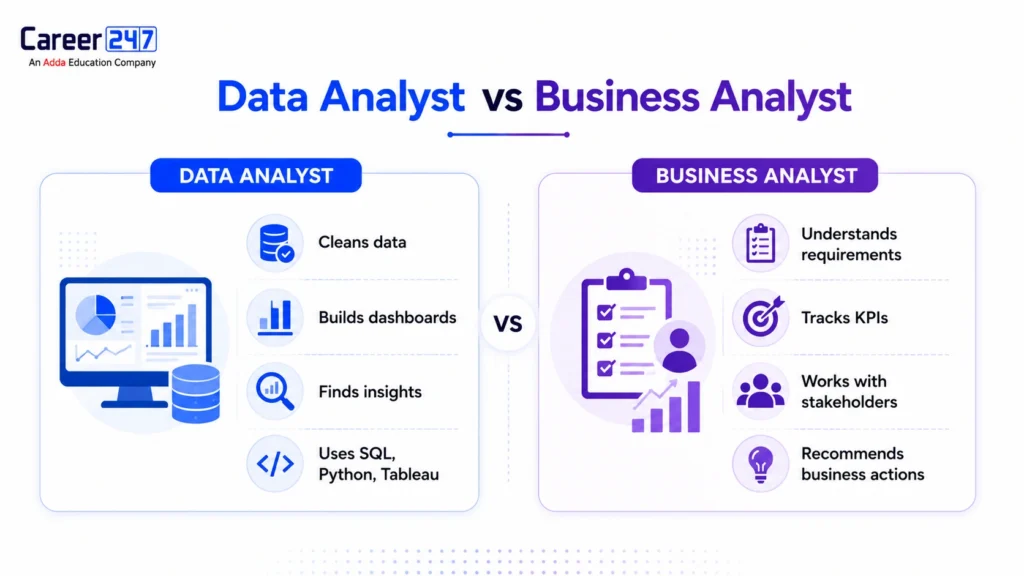
A Data Analyst mainly works with data, tools, reports, and dashboards. A Business Analyst focuses more on business requirements, process improvement, stakeholder communication, and decision support.
| Factor | Data Analyst | Business Analyst |
|---|---|---|
| Main Role | Analyze data and generate insights | Understand business problems and suggest solutions |
| Technical Focus | Higher | Moderate |
| Business Focus | Moderate | Higher |
| Tools | SQL, Excel, Python, Tableau, Power BI | Excel, SQL, Power BI, Jira, documentation tools |
| Main Output | Dashboards, reports, insights | Business requirements, solutions, recommendations |
| Works With | Data teams, product teams, business teams | Stakeholders, management, tech teams, operations |
| Best Fit For | Analytical and tool-focused learners | Business and communication-focused learners |
Career Opportunities in Data Analytics
Data analytics opens opportunities in technical and analytical roles.
Common job roles include:
- Data Analyst
- Junior Data Analyst
- BI Analyst
- Reporting Analyst
- Marketing Analyst
- Product Analyst
- Operations Analyst
- Data Visualization Analyst
These roles are suitable for learners who enjoy working with datasets, dashboards, SQL queries, Python notebooks, and performance metrics.
Career Opportunities in Business Analytics
Business analytics opens opportunities in business focused analytical roles.
Common job roles include:
- Business Analyst
- Business Analytics Associate
- Strategy Analyst
- Operations Analyst
- Product Analyst
- Management Analyst
- Business Intelligence Analyst
- Process Analyst
These roles are suitable for learners who enjoy solving business problems, working with stakeholders, and connecting data insights with business strategy.
Which is Better: Data Analytics or Business Analytics?
There is no single better option. The right choice depends on your interest and career goal.
Choose Data Analytics If:
- You enjoy working with data and tools
- You like SQL, Python, Excel, Tableau, or Power BI
- You want to build dashboards and reports
- You enjoy finding patterns in data
- You prefer analytical and technical work
Choose Business Analytics If:
- You enjoy business strategy and decision making
- You like communicating with teams and stakeholders
- You want to solve business problems
- You are interested in operations, product, finance, or management
- You prefer a mix of data and business communication
If you are still confused, start with data analytics fundamentals. Once your foundation is clear, you can move toward business analytics, BI, product analytics, or advanced analytics based on your interest.
Data Analyst vs Business Analyst Salary
Role | Average Salary | Typical Range | Market Note |
|---|---|---|---|
| Data Analyst | Around ₹6.5 LPA | Roughly ₹2 LPA – ₹14 LPA | More tool/technical focused; SQL, Python, Excel, Power BI/Tableau |
| Business Analyst | Around ₹9 LPA | Roughly ₹3 LPA – ₹18 LPA | More business/process/stakeholder focused; salaries can be higher with domain expertise |
Career247 Courses for Data Analytics and Business Analytics
Since both fields are closely connected, structured learning can help beginners understand the right path. Career247 offers both Data Analytics Course and Business Analytics Course, making it easier for learners to choose based on their career goals.
Career247’s Data Analytics Course is suitable for learners who want to build practical skills in Excel, SQL, Python, Tableau, dashboards, data cleaning, and real world analytics projects.
Career247’s Business Analytics Course is suitable for learners who want to understand business problem solving, reporting, KPI analysis, decision making, and business strategy using data.
For learners who are unsure which path to choose, starting with core analytics concepts and then selecting a specialization can be a smart approach.
So the Conclusion is….
The difference between business analytics and data analytics mainly comes down to focus.
- Data analytics is more about analyzing data, finding trends, and building insights.
- Business analytics is more about using those insights to solve business problems and support decisions.
Both fields are closely connected and both offer strong career opportunities. If you enjoy working deeply with data and tools, data analytics may be the better path. If you enjoy business strategy, stakeholder communication, and decision making, business analytics may be a better fit.
For beginners, the best approach is to understand both fields clearly, learn the common tools, work on real-world projects, and then choose the path that matches your strengths and career goals.
Frequently Asked Questions
Answer:
Data analytics explains what the data shows. Business analytics explains what the business should do based on that data.
Answer:
Both roles are good. A data analyst role is better if you enjoy tools, datasets, dashboards, and analysis. A business analyst role is better if you enjoy business problems, stakeholder communication, and decision-making.
Answer:
Business analytics may be less programming heavy, but it requires strong business understanding and communication. Data analytics may require more technical skills like SQL, Python, and dashboarding.
Answer:
Yes, you can. Many skills overlap, such as Excel, SQL, dashboards, reporting, KPI analysis, and problem solving. With business domain knowledge, data analysts can move into business analytics roles.
Answer:
Choose a data analytics course if you want stronger technical skills in SQL, Python, dashboards, and data analysis. Choose a business analytics course if you want to focus more on business decisions, reporting, KPIs, and strategy.