
Why Learning Data Analytics Is Important for Modern Career Growth
Why Learning Data Analytics Is Important for Modern Career Growth
In today’s digital economy, data has become one of the most valuable business assets. Organizations across industries collect vast amounts of information every day, from customer behavior and sales performance to operational metrics and market trends. However, raw data alone has little value unless it can be analyzed and transformed into meaningful insights.
This growing dependence on data-driven decision-making has increased the demand for professionals who can understand, interpret, and visualize data effectively. As a result, Data Analytics has emerged as one of the most sought-after skills for students, graduates, and working professionals looking to build future-ready careers.

Understanding Data Analytics
Data Analytics is the process of collecting, organizing, analyzing, and interpreting data to uncover meaningful insights that support business decision-making. In today’s digital environment, organizations generate vast amounts of information from customer interactions, websites, applications, sales transactions, and internal operations. Analytics helps transform this raw data into actionable knowledge.
Rather than relying on intuition alone, businesses use data-driven insights to understand market trends, customer preferences, and operational performance. This enables organizations to make informed decisions, reduce risks, and identify opportunities for growth.
Modern analytics combines business expertise with technology, making it one of the most valuable skills in today’s workforce. It is widely used across industries such as healthcare, finance, retail, manufacturing, education, and technology.
Some key functions of Data Analytics include:
- Collecting and organizing large volumes of data
- Identifying patterns, trends, and relationships
- Measuring business performance through key metrics
- Supporting strategic and operational decision-making
- Predicting future outcomes using historical information
- Improving efficiency and productivity across departments
As businesses continue to embrace digital transformation, data analytics has become an essential tool for maintaining competitiveness and driving innovation.
Why Businesses Need Data Analytics
Every business generates data through websites, mobile applications, customer purchases, social media engagement, marketing campaigns, and operational processes. Without proper analysis, this information remains unused and provides little value. Data analytics helps organizations convert data into meaningful insights that can improve decision-making and business performance.
By understanding what the data reveals, companies can better respond to customer needs, optimize resources, and adapt to changing market conditions. Analytics also helps businesses identify potential challenges before they become major problems.
Some of the major benefits of Data Analytics include:
Better Understanding of Customers
Analytics helps organizations gain deeper insights into customer behavior, purchasing patterns, and preferences. This information allows businesses to create personalized experiences and build stronger customer relationships.
Improved Operational Efficiency
Businesses can use analytics to identify bottlenecks, eliminate inefficiencies, and streamline workflows. This often leads to reduced costs, faster processes, and better utilization of resources.
Smarter Business Decisions
Data-driven decisions are typically more reliable than decisions based solely on assumptions. Analytics provides factual information that helps leaders evaluate opportunities and make strategic choices with greater confidence.
Enhanced Marketing Performance
Organizations can measure the effectiveness of marketing campaigns, understand audience engagement, and optimize advertising strategies. This helps improve return on investment and customer acquisition efforts.
Performance Monitoring
Analytics enables businesses to track key performance indicators (KPIs) and evaluate progress toward organizational goals. Regular monitoring helps companies make adjustments when needed and maintain steady growth.
Identifying New Opportunities
Through trend analysis and market research, organizations can discover emerging opportunities, changing consumer demands, and areas for expansion. This allows businesses to stay ahead of competitors and respond proactively to industry changes.
Key reasons companies invest in analytics:
- Increased accuracy in decision-making
- Better customer satisfaction and retention
- More effective marketing and sales strategies
- Improved business forecasting
- Enhanced productivity and efficiency
- Greater competitive advantage
- Support for long-term business growth
As data continues to play a central role in modern business operations, the demand for analytics knowledge is increasing across industries. Organizations are actively seeking professionals who can interpret data, generate insights, and contribute to data-driven decision-making processes.


Key Skills Used in Data Analytics
Building expertise in data analytics requires a combination of technical knowledge, analytical thinking, and business understanding. Professionals use various tools and methodologies to collect, organize, analyze, and interpret data that supports informed decision-making.
As organizations increasingly rely on data-driven strategies, developing these skills can help individuals contribute effectively to business growth and operational improvement.
Some of the most important areas of learning include:
Data Analysis and Interpretation
Data analysts must understand how to examine large datasets and identify meaningful patterns, trends, and relationships. The goal is to transform raw information into actionable insights that support business objectives.
Spreadsheet Analysis
Spreadsheet tools remain widely used for organizing, cleaning, and analyzing data. They help professionals perform calculations, create reports, and manage business information efficiently.
Database Querying
Businesses store large amounts of information in databases. Learning how to retrieve, filter, and manage data using query languages allows professionals to access relevant information quickly and accurately.
Data Visualization
Presenting data in a visual format makes complex information easier to understand. Charts, graphs, dashboards, and reports help stakeholders identify trends and make informed decisions.
Business Problem Solving
Analytics is not only about working with numbers. Professionals must apply critical thinking and analytical skills to solve real-world business challenges, improve processes, and identify opportunities for growth.
Reporting and Communication
The ability to communicate findings clearly is essential in data analytics. Analysts often present insights to managers and stakeholders, helping them understand the results and take appropriate action.
Additional skills that support analytics success include:
- Attention to detail and accuracy
- Critical and logical thinking
- Data organization and management
- Problem-solving abilities
- Business and industry awareness
- Effective communication and presentation skills
A strong combination of these skills enables professionals to turn data into valuable business insights and support better decision-making across organizations.
Career Opportunities in Data Analytics
The growing importance of data has created opportunities for analytics professionals across a wide range of industries. Organizations use data to improve customer experiences, optimize operations, reduce costs, and support strategic planning, increasing the demand for individuals with analytical capabilities.
Analytics skills are valuable in sectors such as finance, healthcare, retail, technology, education, manufacturing, logistics, and consulting. Because data is used in almost every industry, professionals can explore diverse career paths based on their interests and expertise.
Some common career opportunities include:
- Data Analyst – Analyzes data to identify trends, patterns, and business insights.
- Business Analyst – Uses data to improve business processes and support organizational goals.
- Reporting Analyst – Creates reports and dashboards that help track business performance.
- Operations Analyst – Focuses on improving efficiency and optimizing operational processes.
- Business Intelligence Professional – Develops data driven solutions for strategic decision-making.
- Market Research Analyst – Studies market trends, customer behavior, and industry developments.
- Data Visualization Specialist – Designs charts, dashboards, and visual reports that make data easier to understand.
As organizations continue investing in digital transformation and data driven strategies, the demand for analytics professionals is expected to remain strong. The versatility of data analytics makes it a valuable skill set for both technical and non-technical professionals seeking long-term career growth and opportunities across multiple industries.
How Structured Learning Can Help
While many free resources are available online, structured learning programs often provide a more organized approach to understanding analytics concepts.
A guided learning environment can help learners:
- Follow a step-by-step roadmap
- Learn industry-relevant concepts
- Practice with real-world datasets
- Build analytical thinking skills
- Understand commonly used business tools
- Work on practical projects and exercises
For beginners, having a clear learning path can make the process more manageable and focused.
Exploring Professional Data Analytics Training
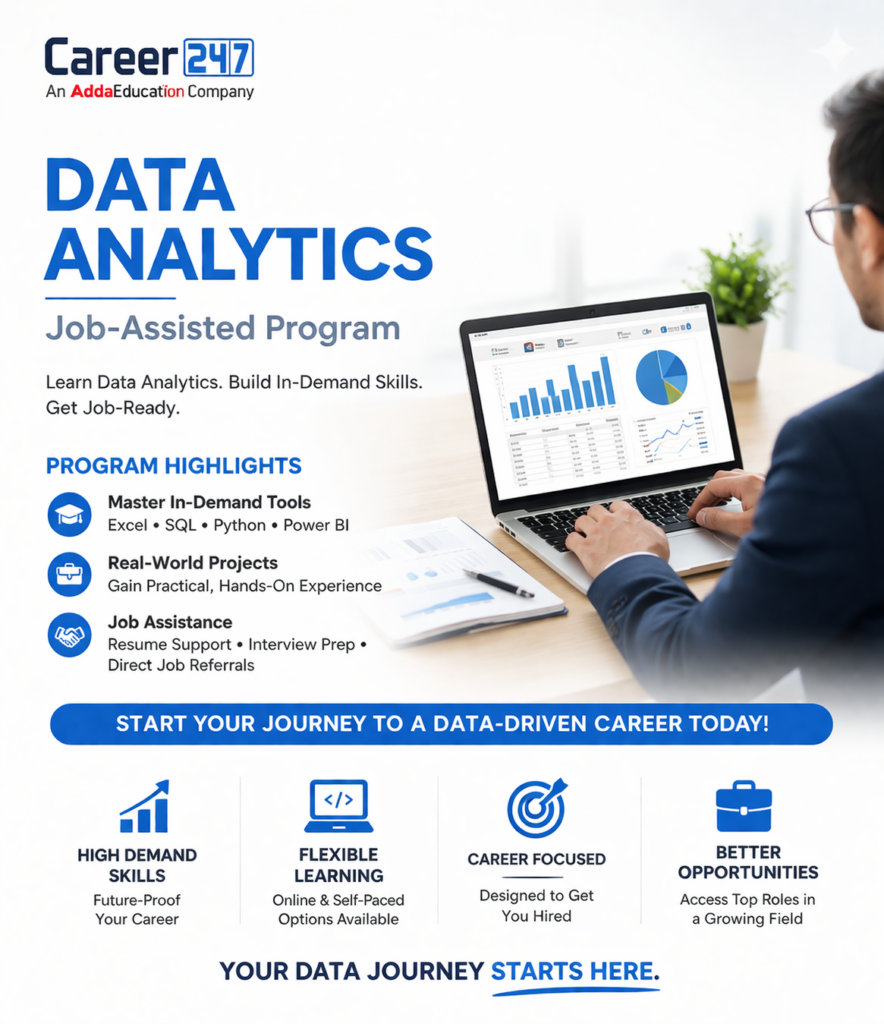
Many learners choose specialized Data Analytics programs to gain practical exposure and develop industry-relevant skills. Programs offered by learning platforms such as Career247 are designed to help individuals understand analytics concepts through structured training, practical exercises, and guided learning experiences. Career247 offers career-focused educational programs aimed at helping learners build relevant skills for modern industries.
When evaluating any analytics program, learners should consider factors such as curriculum structure, learning methodology, practical exposure, mentorship opportunities, and overall alignment with their career goals.
Who Can Learn Data Analytics?
One of the advantages of analytics is that it attracts learners from diverse educational and professional backgrounds.
The field may be suitable for:
- College students
- Recent graduates
- Working professionals
- Career switchers
- Entrepreneurs
- Business professionals
- Technology enthusiasts
A willingness to learn and develop problem-solving skills is often more important than having prior analytics experience.
The Future of Data Analytics
As organizations continue to adopt artificial intelligence, automation, and digital transformation initiatives, data will remain central to decision-making processes.
Businesses increasingly require professionals who can transform information into actionable insights. This trend is expected to keep analytics skills relevant across industries for years to come.
Developing analytical capabilities today can help learners build a strong foundation for future opportunities in a data-driven world.
Final Thoughts
Data Analytics has become an essential skill in the modern workplace. From understanding customer behavior to improving business performance, analytics helps organizations make smarter decisions based on evidence rather than assumptions.
For individuals interested in developing analytical thinking and working with data, structured learning programs can provide a practical pathway to gaining knowledge and experience. By focusing on continuous learning and hands-on practice, aspiring professionals can build valuable skills that are increasingly relevant across industries.
Frequently Asked Questions
Answer:
Data Analytics is the process of examining and interpreting data to identify patterns, trends, and useful insights. Businesses use analytics to make informed decisions, improve efficiency, and better understand customer behavior. As organizations become more data-driven, analytics skills are increasingly valuable across industries.
Answer:
Data Analytics can be learned by students, graduates, working professionals, and career changers from various educational backgrounds. While having basic analytical and problem-solving skills can be helpful, many beginners start learning without prior experience in data-related fields.
Answer:
Professionals in Data Analytics often work with data visualization, spreadsheet analysis, database management, reporting, and business problem-solving techniques. They also learn how to organize, clean, and interpret data to support decision-making processes within organizations.
Answer:
Data Analytics skills can be applied in multiple industries, including healthcare, finance, retail, technology, and marketing. Common career paths include Data Analyst, Business Analyst, Reporting Analyst, Business Intelligence Analyst, and Operations Analyst, among others.
Answer:
A structured learning program can provide a step-by-step approach to understanding key analytics concepts and tools. It often combines theoretical knowledge with practical exercises, helping learners build confidence and develop the skills needed to work with real-world data and business scenarios.