
Why Data Analysts Need GenAI Skills in 2026
Generative AI in Data Analytics
Why Data Analysts Need GenAI Skills in 2026 is no longer just a discussion for technology leaders. It is becoming an important question for students, aspiring analysts, and working professionals who want to stay relevant in a rapidly changing job market.
Data Analytics has traditionally focused on collecting, cleaning, analyzing, and visualizing data to support business decisions. However, the rise of Generative AI (GenAI) is changing how analysts work. Tasks that once required hours of manual effort can now be completed faster with AI powered tools.

What Is GenAI?
Generative AI refers to artificial intelligence systems capable of creating new content based on patterns learned from large amounts of data.
Unlike traditional analytics tools that primarily analyze existing information, GenAI can generate:
- Text
- Reports
- Code
- Queries
- Summaries
- Recommendations
- Business insights
Popular GenAI tools include:
- ChatGPT
- Gemini
- Claude
- Microsoft Copilot
- Perplexity
These tools are increasingly becoming part of everyday workflows across analytics, business intelligence, marketing, and operations.
The Changing Role of Data Analysts
A few years ago, Data Analysts spent a significant portion of their time on repetitive tasks such as:
- Data cleaning
- Spreadsheet management
- SQL query writing
- Report creation
- Dashboard updates
While these responsibilities still exist, organizations now expect analysts to provide deeper insights and faster decision making support.
GenAI is helping bridge this gap by automating routine activities and allowing analysts to focus more on strategy and business impact.
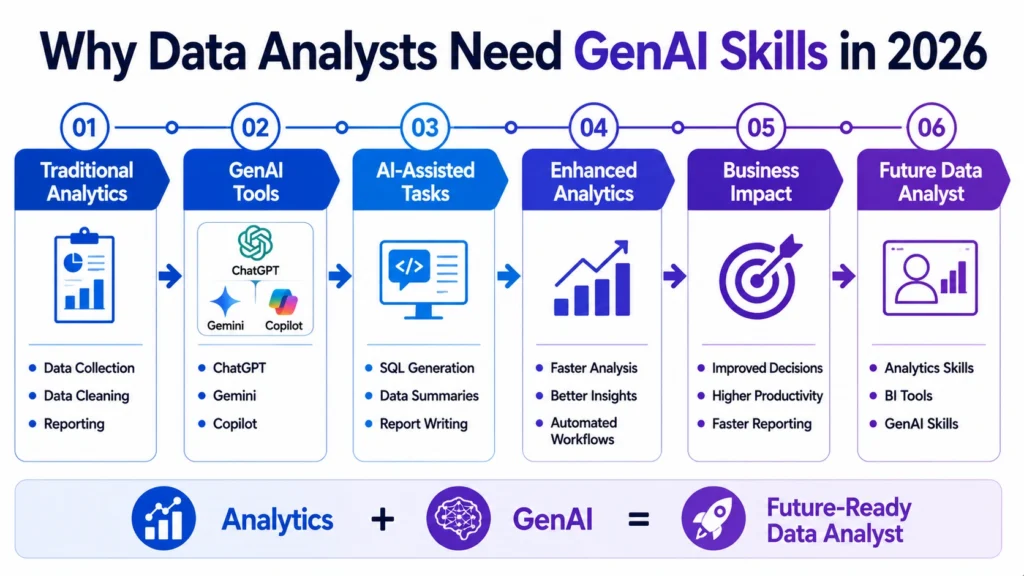
How GenAI Is Transforming Data Analytics
1. Faster Data Cleaning
Data preparation often consumes a large portion of an analyst’s time.
GenAI tools can assist by:
- Identifying missing values
- Suggesting cleaning techniques
- Recommending transformations
- Explaining preprocessing methods
While human validation remains necessary, AI can significantly accelerate the process.
2. AI Assisted SQL Generation
Many analysts work with databases daily.
Instead of manually writing every query, analysts can use GenAI tools to generate SQL statements from simple business questions.
For example: “Show customer acquisition trends for the last six months.”
A GenAI tool can quickly create a starting SQL query that can be refined and validated.
This reduces time spent on routine query development.
3. Smarter Data Exploration
Before presenting findings, analysts must understand the data.
GenAI can help by:
- Explaining trends
- Identifying anomalies
- Suggesting visualizations
- Generating summaries
This enables faster exploratory data analysis and more efficient insight generation.
4. Automated Report Writing
One of the most time consuming tasks in analytics is creating reports for stakeholders.
GenAI can assist with:
- Executive summaries
- KPI explanations
- Trend descriptions
- Business recommendations
This helps analysts communicate findings more effectively.
5. Improved Dashboard Storytelling
Modern businesses want more than charts and numbers. They want answers.
GenAI helps analysts transform dashboard metrics into understandable business narratives.
Instead of simply displaying a sales decline, analysts can explain:
- What happened
- Possible reasons
- Business implications
- Recommended actions
This improves decision making across organizations.
Why Employers Are Looking for GenAI Skills
Organizations are rapidly integrating AI into their workflows.
As a result, employers increasingly value professionals who can combine analytical thinking with AI powered productivity tools.
Data Analysts with GenAI skills can often:
- Work faster
- Automate repetitive tasks
- Generate insights efficiently
- Communicate findings better
- Support business decisions more effectively
The combination of analytics expertise and AI literacy is becoming a competitive advantage.
Many professionals report measurable productivity improvements when AI assists with research, writing, coding, and analytical tasks.
This trend suggests that AI literacy is quickly becoming a workplace expectation rather than a specialized skill.

Essential GenAI Skills for Data Analysts
- Prompt Engineering: Knowing how to ask effective questions is becoming an important professional skill.
- Well crafted prompts often produce better analytical outputs and more accurate results.
- AI Assisted Analytics: Analysts should learn how to use AI for:
- Data exploration
- Query generation
- Reporting
- Visualization recommendations
- Data Validation: AI generated outputs should always be verified.
- Analysts must be able to evaluate results critically and ensure accuracy.
- Business Communication: One of the most valuable uses of GenAI is converting technical findings into business friendly insights.
- Strong communication skills remain essential.
Will GenAI Replace Data Analysts?
This is one of the most common concerns among aspiring professionals.
The answer is no.
GenAI can automate specific tasks, but it cannot replace:
- Business understanding
- Critical thinking
- Contextual judgment
- Problem solving
- Stakeholder communication
Organizations still need professionals who can interpret results, ask meaningful questions, and make informed recommendations.
The future belongs to analysts who know how to work alongside AI rather than compete against it.
What Should Aspiring Data Analysts Learn in 2026?
A modern Data Analyst should understand:
Analytics Foundations:
- Excel and SQL
- Statistics
- Data Cleaning
- Data Visualization
Business Intelligence Tools:
- Power BI
- Tableau
GenAI Skills:
- Prompt Engineering
- ChatGPT
- AI Assisted Reporting
- AI Powered Analytics Workflows
Professionals who combine these skills are likely to be better prepared for the future analytics landscape.
Future of Data Analytics with GenAI
The role of Data Analysts is evolving from report creators to insight generators.
GenAI is helping professionals spend less time on repetitive work and more time solving business problems.
As organizations continue investing in AI powered decision making, the demand for analysts who understand both traditional analytics and Generative AI is expected to grow.
Learning GenAI today is not about replacing analytical skills. It is about enhancing them.
Conclusion….
The analytics industry is entering a new phase where Generative AI is becoming part of everyday workflows. From data cleaning and SQL generation to reporting and storytelling, GenAI is helping Data Analysts work more efficiently and deliver greater business value.
As organizations continue adopting AI powered solutions, professionals who combine analytical expertise with GenAI skills will be better positioned to adapt, innovate, and contribute to data driven decision making. Rather than replacing analysts, GenAI is becoming a powerful tool that enhances productivity and expands what data professionals can achieve.
Learn Data Analytics with GenAI at Career247….
Career247’s Data Analytics with GenAI program helps learners build practical skills in analytics, SQL, Power BI, Tableau, statistics, and AI assisted workflows. Through hands on projects and industry relevant training, learners gain exposure to the tools and techniques increasingly used in modern analytics roles.
Frequently Asked Questions
Answer:
GenAI skills include prompt engineering, AI assisted reporting, automated data exploration, SQL generation, and AI powered business communication.
Answer:
GenAI helps automate repetitive tasks, improve productivity, accelerate analysis, and enhance business reporting.
Answer:
Yes. ChatGPT can assist with SQL generation, report writing, data explanations, analytical brainstorming, and documentation.
Answer:
No. GenAI supports analysts by improving efficiency, but human judgment, business understanding, and decision making remain essential.
Answer:
Popular tools include ChatGPT, Gemini, Claude, Microsoft Copilot, and Perplexity.