
The Role of Big Data Analytics in Artificial Intelligence
The Role of Big Data Analytics in Artificial Intelligence
Artificial intelligence feels almost magical when you watch it work a chatbot that understands context, a recommendation engine that knows what you want before you do, a fraud system that catches a scam in milliseconds. But none of that intelligence comes from nowhere. Behind every smart AI model sits an enormous pile of data, and behind that pile sits big data analytics, quietly doing the heavy lifting.
AI doesn’t learn from thin air. It learns from patterns buried inside massive, messy datasets and finding those patterns is exactly what big data analytics is built to do. Without it, machine learning models would be flying blind, training on incomplete or poorly structured information that leads to weak predictions and unreliable outputs.

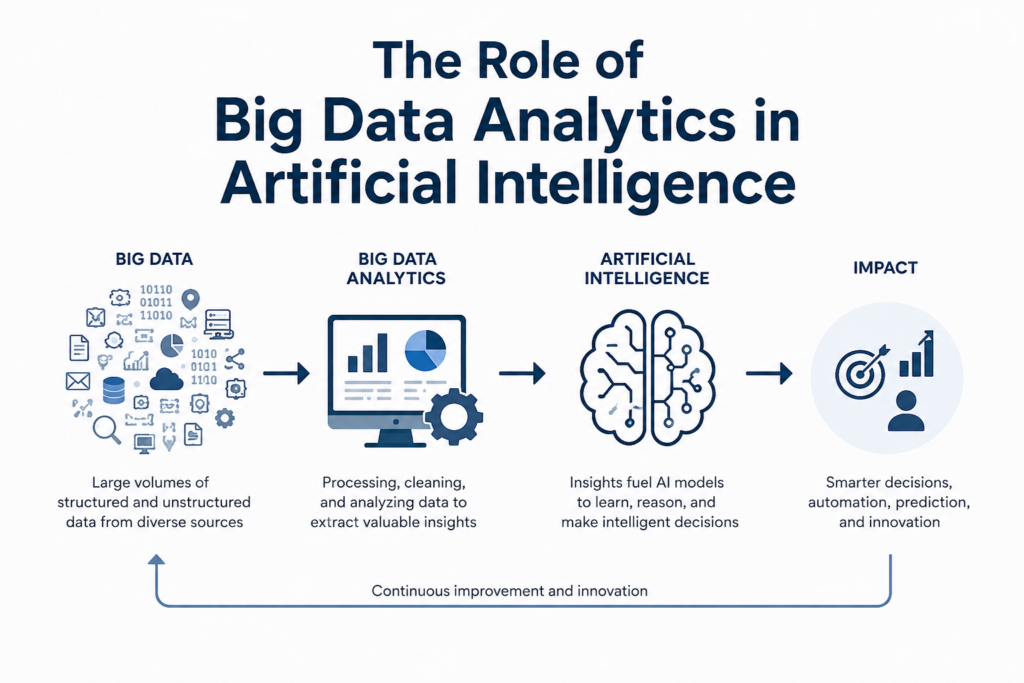
Big data analytics provides the foundation AI systems need to learn, predict, and improve. It collects, cleans, and processes massive datasets so machine learning algorithms can identify patterns, train accurately, and generate reliable outputs. Without big data analytics, AI models would lack the quality and volume of data required to function effectively at scale.
Why AI Depends on Big Data
Artificial intelligence, especially machine learning, works on a simple principle: the more relevant, high-quality data a model sees, the better it performs. AI doesn’t “understand” the world the way humans do it identifies statistical patterns from examples.
That’s where big data analytics steps in. It handles the unglamorous but essential work of:
- Gathering data from multiple sources (apps, sensors, transactions, text, images)
- Cleaning and organizing that data so it’s usable
- Structuring it in formats machine learning models can actually process
- Continuously feeding new data back into models for retraining
Think of big data analytics as the supply chain for AI. No raw material, no finished product.
How Big Data Analytics Powers Different Stages of AI
AI development isn’t one single step it’s a pipeline, and big data analytics touches almost every stage of it.
1. Data Collection and Preparation
Before any AI model can train, data needs to be collected from varied sources customer behavior, sensor readings, voice recordings, images, and more. Big data analytics tools handle this at scale, pulling in structured and unstructured data simultaneously.
2. Data Cleaning and Quality Control
Raw data is rarely usable as-is. It often contains duplicates, missing values, or inconsistencies. Big data analytics applies automated cleaning processes so AI models aren’t trained on flawed information because a model trained on bad data will confidently produce bad predictions.
3. Pattern Recognition for Model Training
This is the core link between the two fields. Big data analytics uses statistical methods to detect correlations and trends within datasets. Machine learning algorithms then build on these patterns to make predictions, classify information, or generate content.
4. Real-Time Data Processing
Many AI applications fraud detection, autonomous vehicles, recommendation engines need to process data instantly. Big data analytics frameworks like Apache Spark allow AI systems to analyze streaming data in real time rather than waiting on batch processing.
5. Continuous Learning and Model Improvement
AI models aren’t static. They improve over time as new data flows in. Big data analytics manages this ongoing data pipeline, ensuring models stay accurate as user behavior, market trends, or environmental conditions shift.
Real World Examples of Big Data Analytics Powering AI
| Industry | AI Application | Role of Big Data Analytics |
|---|---|---|
| Healthcare | Disease prediction models | Analyzing millions of patient records to detect risk patterns |
| Retail | Personalized recommendations | Processing browsing and purchase history at scale |
| Finance | Fraud detection systems | Real-time analysis of transaction patterns across millions of users |
| Transportation | Self-driving vehicles | Processing sensor and camera data continuously for split-second decisions |
| Marketing | Customer segmentation | Analyzing behavioral data to group audiences for targeted campaigns |


Big Data Analytics and Machine Learning: How They Connect
It helps to separate the roles clearly:
- Big data analytics focuses on collecting, processing, and finding patterns within large datasets.
- Machine learning uses those patterns to build predictive models and make decisions.
- AI is the broader umbrella that includes machine learning, natural language processing, computer vision, and more.
In short big data analytics prepares the ingredients, machine learning cooks the meal, and AI is the full dining experience.
Why This Relationship Matters for Businesses
Companies investing in AI often underestimate how much groundwork big data analytics requires. Skipping this step leads to:
- Inaccurate predictions due to poor-quality training data
- AI models that fail to generalize beyond narrow scenarios
- Bias in outputs caused by unbalanced or incomplete datasets
- Slow performance because data isn’t structured for real-time use
On the flip side, businesses that invest properly in big data infrastructure see:
- Faster AI deployment timelines
- More accurate and reliable predictions
- Better personalization and customer experience
- Stronger fraud detection and risk management
Challenges When Combining Big Data Analytics and AI
This pairing isn’t without friction. Common challenges include:
- Data silos – information scattered across disconnected systems
- Data privacy regulations – GDPR and similar laws restrict how data can be used for training
- Bias in datasets – skewed data leads to skewed AI behavior
- Infrastructure costs – processing data at AI-ready scale requires significant investment
- Talent shortages – few professionals understand both big data engineering and AI development
Solving these challenges typically requires a combined strategy: clean data architecture, ethical data sourcing, and cross-functional teams that understand both disciplines.
The Future: Big Data Analytics as AI’s Backbone
As AI models grow larger and more sophisticated, their hunger for high-quality, well-structured data only increases. Generative AI systems, for instance, require massive volumes of diverse data to produce coherent, accurate outputs. Big data analytics isn’t going away it’s becoming more central, not less, as AI systems scale.
Organizations that treat data infrastructure as an afterthought will struggle to keep pace with competitors who built strong data foundations from the start.
- Big data analytics provides the data foundation that AI and machine learning models rely on to learn and improve.
- It handles data collection, cleaning, structuring, and real-time processing for AI systems.
- Pattern recognition from big data analytics directly feeds machine learning model training.
- Real-world AI applications fraud detection, personalized recommendations, self-driving vehicles all depend on big data analytics pipelines.
- Poor data quality or insufficient big data infrastructure leads to inaccurate or biased AI outputs.
- Big data analytics and AI are interconnected but distinct: one prepares data, the other builds predictive intelligence from it.
- As AI scales, especially generative AI, the dependence on strong big data analytics infrastructure continues to grow.
Conclusion
Artificial intelligence often gets the spotlight, but big data analytics is doing the quiet, foundational work that makes AI possible in the first place. Every accurate prediction, every personalized recommendation, every fraud alert caught in real time traces back to a data pipeline built on solid big data analytics practices.
Businesses chasing AI capabilities without investing in their data infrastructure are essentially building on sand. The organizations seeing real results from AI are the ones that understood early on that smart algorithms need smart data behind them and that big data analytics isn’t a side function, it’s the backbone the entire system stands on.
Frequently Asked Questions
Answer:
Big data analytics provides the structured, high-quality data that AI systems need to train and function accurately. Without it, AI models would lack the volume and quality of information required to recognize patterns and make reliable predictions.
Answer:
AI can technically work with smaller datasets, but its accuracy and reliability improve significantly with large, well-processed data. Big data analytics ensures AI models have enough relevant, clean information to generalize well across real-world situations.
Answer:
Big data analytics focuses on collecting, cleaning, and finding patterns in large datasets. Machine learning uses those patterns to build models that predict outcomes or automate decisions, making the two highly complementary but distinct processes.
Answer:
Poor-quality data leads to inaccurate predictions, biased outputs, and unreliable AI behavior. Big data analytics ensures data is cleaned, validated, and properly structured, which directly improves how well an AI model performs in real-world scenarios.
Answer:
Healthcare, finance, retail, transportation, and marketing are leading industries using big data analytics to power AI applications like fraud detection, personalized recommendations, predictive diagnostics, and autonomous systems.