
The Hidden Cost of Poor Data Quality in Machine Learning Projects
The Hidden Cost of Poor Data Quality in Machine Learning Projects
Introduction
Most machine learning teams can point to a moment when a model that performed beautifully in testing fell apart once it touched real-world data. The algorithm wasn’t the problem. The infrastructure wasn’t the problem. The data quietly was. Poor data quality rarely shows up as one big failure. Instead, it erodes a project slowly. Small inconsistencies, missing values, and mislabeled records compound over time until the model’s output can no longer be trusted.
Unlike a server outage, this damage triggers no alert. It shows up as falling accuracy, confused stakeholders, and hours spent chasing a bug that turns out to be a dirty column no one flagged months ago. The cost is real, but hidden. It spreads across debugging time, lost trust, and missed opportunities rather than appearing as a single line item.
Understanding the full scope of this problem, from where it starts to how it compounds, is the first step toward building systems that catch it early.

What Counts as a Data Quality Problem
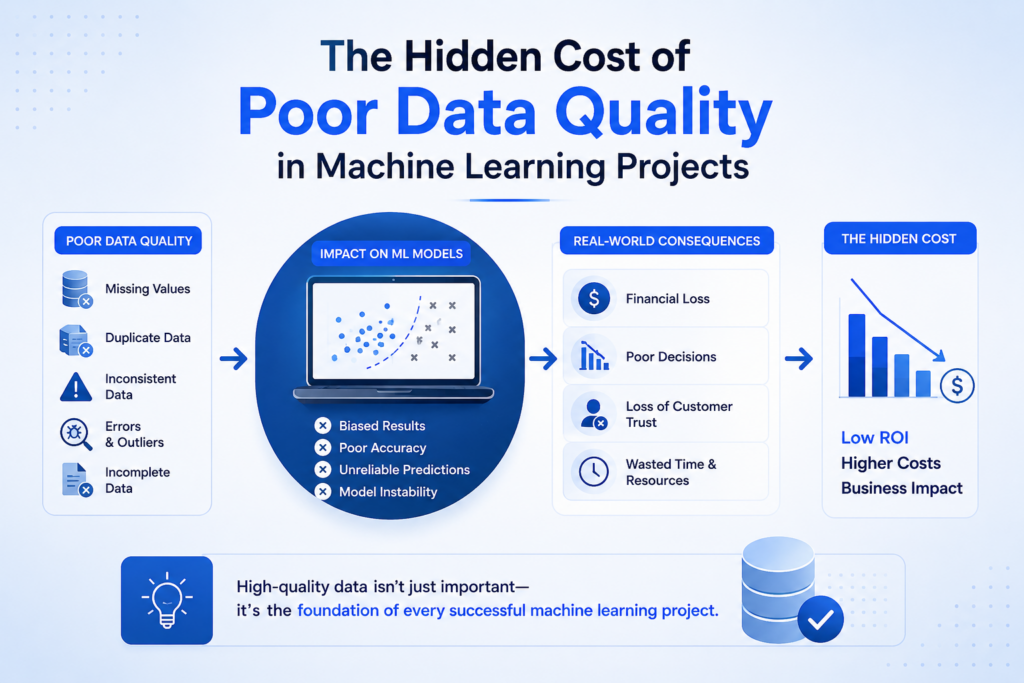
Data quality problems cover a wide range: missing values, duplicate records, inconsistent formatting, wrong labels, outdated information, and errors from data entry or pipeline transformations. Subtler issues also apply, like units that differ across sources, or category values that mean different things depending on which system created them.
- Missing values and duplicate records
- Inconsistent formatting or units across sources
- Incorrect or outdated labels
- Errors introduced during manual data entry
- Inconsistent timezone handling across regional offices
What makes this tricky is that many issues look fine in a quick visual check. A typo in a country field, or a sensor that started reporting in different units after a firmware update, won’t throw an error. The pipeline runs. The model trains. The problem only surfaces when predictions look strange, and even then it’s often blamed on the model rather than the data.
Even well-funded teams with mature pipelines regularly find that data quality issues sat quietly for months before anyone noticed. Nobody was actively looking for them.
Inconsistent timezone handling across offices is one common version. It shifts the meaning of every timestamp-based feature without producing any visible error.
Even well-intentioned entry processes introduce errors over time. Manual entry is inconsistent across people, days, and attention levels, no matter how clear the instructions.
The Direct Costs to Model Performance
There’s a well-known rule here: garbage in, garbage out. No algorithm choice or tuning can fix systematically bad inputs. A model trained on inconsistent labels learns the inconsistency. Mislabeled examples are especially dangerous. The model has no way to know they’re wrong. It treats them as ground truth and skews its understanding of the whole problem.
Research across industries consistently shows that data scientists spend more than half their time cleaning and preparing data before modeling starts. That time isn’t wasted, but it carries a large opportunity cost. Every hour fixing date formats or tracking down duplicate IDs is an hour not spent improving the model.
This is why experienced practitioners treat data quality as a primary concern, not an afterthought. No modeling skill can rescue a project built on unreliable inputs.
Some teams audit a random sample of labels before a major training run. This catches many errors that would have gone unnoticed until production behavior raised a flag.
The Business Costs Beyond the Model
The damage goes well beyond the model. A recommendation engine trained on duplicate purchase records can overstate product popularity and drive poor inventory decisions. A credit model trained on inconsistent income data may unfairly reject qualified applicants, creating both a customer relations problem and a regulatory risk.
Industry estimates put the annual cost of data quality problems in the billions. The exact figure is debated, but the pattern holds across nearly every company that has examined it: bad inputs quietly drain resources that no one budgeted for fixing.
These consequences explain why leadership now asks hard questions about data quality before approving model deployments, rather than leaving it as a quiet technical detail.
Customer-facing teams often feel these failures first. They field complaints that trace back to a model problem no one on the front line can diagnose.
- Recommendation engines overstate product popularity → poor inventory decisions
- Credit models on bad income data → unfair rejections and regulatory risk
- Customer-facing teams absorb complaints they can’t diagnose
- Leadership budget decisions rest on outputs nobody has questioned
Why It’s Often Discovered Too Late
This problem persists partly because it’s hard to catch early. Issues often start far upstream, in a third-party API, a legacy database, or a manual entry process. By the time a data scientist sees the data, it has passed through several transformations that hide where the problem came from.
Teams also over-trust data because it’s already in a clean-looking table. A column of numbers feels reliable, even if a third were entered by a tired employee at the end of a long shift. This false confidence is part of why the problem persists at every scale.
By the time someone questions the data, several models and dashboards may already rely on it. That makes fixing it far more disruptive than catching it early would have been.
Adding a simple data lineage record, showing which upstream system produced a given column, can shortcut a lot of this detective work the next time a strange value shows up somewhere downstream.
- Issues often enter through third-party APIs, legacy databases, or manual entry
- Multiple pipeline transforms hide the original source of a problem
- Clean-looking tables create false confidence in data reliability
- Data lineage records help trace strange values back to their source


Building Systems That Catch Problems Early
The most effective defense is automated validation built into the pipeline. It checks for unexpected null rates, out-of-range values, distribution shifts, and schema mismatches before data reaches a training job. Tools like Great Expectations and Deequ let teams define rules for what good data looks like and send alerts the moment those rules break.
- Define validation rules for null rates and value ranges
- Watch for sudden shifts in category distributions
- Use tools like Great Expectations or Deequ
- Fix issues at the source, not with downstream patches
Building a culture of fixing issues at the source matters just as much. A notebook patch solves today’s problem, but leaves the root cause to resurface next month. Treating data quality as a shared, ongoing responsibility, not a one-time cleanup, is what prevents recurring damage.
Some organizations also run regular data quality audits, sampling records manually and comparing them against source systems, as a complementary check alongside automated validation rules.
Pairing automated checks with clear escalation paths, so failed rules reach someone who can act quickly, matters as much as writing the rules.
The Role of Monitoring After Deployment
The work doesn’t stop when a model goes live. Live data drifts in ways training data never captured, through user behavior changes, upstream updates, or seasonal shifts. Monitoring input distributions alongside model metrics helps teams catch problems before they damage business outcomes.
- Track missing value rates against historical baselines
- Monitor average values and category frequencies
- Set alerts for metrics that drift outside normal range
- Assign clear ownership for investigating anomalies
Dashboards tracking missing rates, averages, and category frequencies against historical baselines give teams an early warning system. It’s far easier to investigate a spike immediately than to discover it weeks later through a customer complaint.
Assigning clear ownership for flagged anomalies prevents issues from sitting in a dashboard no one actually checks.
Making the Business Case for Investment
Convincing leadership to invest is hard when the benefit is preventing invisible losses rather than generating visible revenue. Framing the conversation around specific past incidents, the week the recommendation engine misfired, the quarter a credit model produced biased results, lands better than abstract statistics.
It also helps to measure the time already spent on manual cleanup and reactive debugging. That figure is usually larger than people expect once it’s tracked across a quarter.
Tips for Winning the Conversation
Bringing a concrete example to a budget conversation, ideally with an estimated dollar cost attached, tends to move the conversation forward far faster than a general appeal to best practices.
Frame the ask as a fixed investment: a few weeks of focused work plus modest ongoing monitoring. This is far more persuasive than an open-ended request for permanent headcount.
Conclusion
Damage from poor data rarely announces itself. It builds quietly through debugging hours, missed opportunities, and eroding trust in model outputs, until it forces a costly fix. Teams that build validation, monitoring, and accountability around their inputs from the start avoid the worst of it.
Addressing data quality isn’t a one-time project. It’s an ongoing discipline that must continue for as long as the model runs in production. Teams that treat it this way build more reliable, more trustworthy systems than those who treat it as an afterthought.
Teams that build this habit early tend to wonder how they ever worked without it. Debugging blind only gets harder as systems grow.
The earlier this becomes part of normal operations, the less time a team spends explaining to leadership why a model quietly stopped working.
Frequently Asked Questions
Answer:
The biggest hidden cost is usually engineering time spent debugging issues that turn out to be data problems rather than modeling problems. This time rarely gets tracked as a distinct cost, which is exactly why it stays invisible to leadership until someone actually measures it.
Answer:
No. A model can only learn patterns that exist in its training data. Flawed inputs get learned as part of the pattern, producing unreliable predictions no matter how advanced the algorithm.
Answer:
Automated validation tools like Great Expectations or Deequ can check for missing values, schema mismatches, and unexpected distribution shifts directly within the data pipeline. Catching problems at this stage is far cheaper than discovering them after a model has already been deployed.
Answer:
No. Small teams are often more at risk. They usually lack dedicated data engineering resources to catch problems early. A single mislabeled batch hits harder on a small dataset than on a large one where errors get diluted.
Answer:
Multiple surveys show data scientists spend more than half their time cleaning and preparing data before any modeling starts. This opportunity cost rarely appears in project timelines upfront.