
Reverse ETL Explained for Data Analysts
Reverse ETL Explained for Data Analysts
For years, analysts focused entirely on getting data into the warehouse. Reverse ETL for data analysts flips that direction, taking clean, modeled data back out of the warehouse and pushing it into the operational tools where sales, marketing, and support teams actually work, like a CRM, an ad platform, or a support desk.
This guide explains what reverse ETL is, how it differs from traditional ETL and ELT, the most common use cases analysts encounter, and the practical considerations for evaluating a reverse ETL tool.

What Is Reverse ETL?
Reverse ETL is the process of syncing data from a central warehouse or data platform back into the business applications a company runs on. Instead of analysts exporting a CSV and emailing it to the sales team, a reverse ETL pipeline continuously pushes the same modeled metric directly into a field inside Salesforce, HubSpot, or a similar tool.
The name comes from its position relative to traditional ETL: where ETL (extract, transform, load) moves raw data from source systems into a warehouse, reverse ETL moves transformed, trustworthy data out of the warehouse and into source systems.
How Reverse ETL Differs from Traditional ETL and ELT
- Direction — ETL and ELT move data into the warehouse; reverse ETL moves data out of the warehouse and into operational tools.
- Audience — ETL feeds analysts and dashboards; reverse ETL feeds the day-to-day tools used by sales, marketing, support, and success teams.
- Data maturity — Reverse ETL typically operates on already-modeled, business-logic-applied data, not raw source data, since it’s meant to be immediately actionable.
- Update cadence — Many reverse ETL syncs run on tighter, near-real-time schedules because operational teams often need current information to act on, not a nightly snapshot.
Why Reverse ETL Matters for Analysts Specifically
Analysts have historically been the bottleneck between clean data and the people who need to act on it. Reverse ETL removes analysts from that manual export-and-share loop, but it also raises the stakes on the models analysts build, since those models now drive live operational decisions instead of just static reports.
- Reduces one-off data pull requests from sales, marketing, and support teams.
- Turns a warehouse model directly into an operational field that updates automatically.
- Forces analysts to think about data freshness and reliability the same way engineers think about production systems.
- Gives analysts visibility into how their metrics are actually used downstream, not just how they’re displayed on a dashboard.
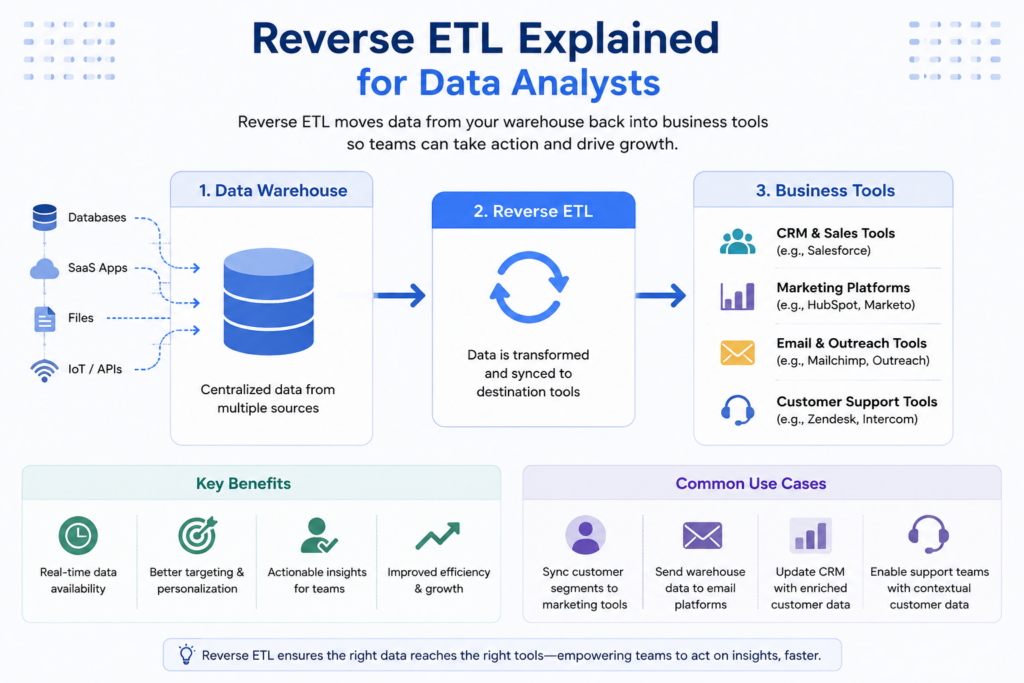
Common Reverse ETL Use Cases
Sales and Lead Scoring
A warehouse-computed lead score, built from product usage, firmographic, and engagement data, can be synced directly into a CRM field so sales reps see an up-to-date score without leaving their normal workflow.
Marketing Audience Sync
Segments built with SQL in the warehouse, such as “high-intent trial users who haven’t converted in 14 days,” can be pushed into an ad platform or email tool as a live audience, keeping campaign targeting aligned with the source of truth.
Customer Success Health Scores
A customer health score combining usage, support ticket volume, and billing status can be synced into a success platform so account managers see the same number analysts calculate, instead of a simplified proxy built inside the tool itself.
Support Prioritization
Reverse ETL can push account tier or contract value into a support desk, allowing tickets to be automatically prioritized based on warehouse-verified account data rather than manually tagged fields.


How a Reverse ETL Pipeline Actually Works
- Model the data — Build the metric or segment in the warehouse using the same transformation layer that powers dashboards, so definitions stay consistent.
- Define the sync — Map warehouse columns to the corresponding fields in the destination tool, such as a CRM object or ad platform audience.
- Set the cadence — Choose how often the sync runs, from every few minutes for time-sensitive operational data to daily for less urgent updates.
- Sync and reconcile — The reverse ETL tool pushes records to the destination system and reconciles any records that fail to sync, flagging errors for review.
- Monitor — Ongoing monitoring catches schema changes in either the warehouse or destination tool before they silently break the sync.
Additional Use Cases Analysts Are Adopting
Product-Led Growth Signals
Product usage scores computed in the warehouse, such as feature adoption depth or time-to-value, can be synced into onboarding tools so in-app messaging adapts automatically based on warehouse-verified behavior instead of a simplified event count tracked natively inside the product tool.
Finance and Billing Enrichment
Reverse ETL can push usage-based billing calculations, computed centrally in the warehouse for consistency, into a billing platform, ensuring invoices reflect the exact same usage figures that show up in internal reporting.
Personalization at Scale
Warehouse-computed customer segments and preference scores can be synced into a website personalization engine or email platform, letting marketing teams personalize experiences using the richest available data rather than the limited fields natively captured inside a single tool.
Reverse ETL and the Modern Data Stack
Reverse ETL doesn’t operate in isolation; it typically sits alongside a broader set of modern data stack components, and understanding how it fits into that stack helps analysts reason about where problems are likely to originate.
A typical flow starts with an ELT tool extracting raw data from source systems into a warehouse, followed by a transformation layer, often built with a tool like dbt, that applies business logic and produces clean, modeled tables. A semantic layer then defines consistent metric calculations on top of those tables, and reverse ETL reads from that same governed layer to push data back out. When reverse ETL instead reads from raw or partially modeled tables, bypassing the semantic layer, it reintroduces the exact definitional inconsistency problems that a modern data stack is supposed to prevent.
- Reverse ETL should sit downstream of the same transformation and semantic layer that powers dashboards, not run in parallel with its own separate logic.
- Treating reverse ETL syncs as production data pipelines, with their own testing and monitoring, prevents them from becoming an unmonitored backdoor into operational systems.
- Coordinating reverse ETL schedules with upstream transformation jobs avoids syncing stale or partially updated data mid-run.
How Analysts Can Prepare for Reverse ETL Responsibilities
As reverse ETL adoption grows, analysts are increasingly asked to own not just the model but the downstream sync built on top of it. A few habits make that transition smoother.
- Learn the destination system’s data model — Understand how the CRM, ad platform, or support tool structures its objects and fields before mapping a sync, since a mismatched object type can cause a sync to silently fail or write to the wrong place.
- Treat synced fields as production outputs — Apply the same testing rigor to a model feeding reverse ETL as to a model feeding a critical dashboard, since operational teams will act on the result immediately.
- Coordinate with the operational team receiving the data — Confirm who else edits the destination field manually, and agree on which system wins when there’s a conflict.
- Document the sync alongside the model — Note which destination systems and fields depend on a given warehouse table so future changes account for that downstream dependency.
Risks and Common Mistakes with Reverse ETL
- Syncing raw or partially modeled data instead of fully validated metrics, which pushes errors directly into operational systems.
- Overwriting fields that operational teams also edit manually, creating silent conflicts between the warehouse and the destination tool.
- Setting sync frequency too high for the destination system’s API limits, causing throttling or failed syncs.
- Skipping monitoring and alerting, so a broken sync goes unnoticed until a sales or marketing team flags stale data.
- Treating reverse ETL as a replacement for good data modeling rather than a delivery mechanism built on top of it.
Reverse ETL in a Real Business Scenario
Consider a mid-sized SaaS company where sales reps complain that lead scores inside the CRM never match the scores the data team presents in quarterly reviews. Investigating the gap reveals that the CRM’s native lead scoring feature only considers a handful of built-in fields, like email opens and form submissions, while the warehouse model incorporates product usage data, firmographic enrichment, and support ticket history that never made it into the CRM.
Rather than trying to recreate that entire model using the CRM’s limited native scoring rules, the analytics team builds the full lead score in the warehouse, where it already has access to every relevant data source, and syncs the result into a custom CRM field using reverse ETL. Sales reps see the same number analysts calculate, updated automatically every hour, and the quarterly review discrepancy disappears without either team changing how they work day to day.
Reverse ETL, Freshness, and Trust
One underappreciated risk of reverse ETL is that it makes stale data far more visible than a dashboard does. A dashboard that hasn’t refreshed in a day might go unnoticed until someone happens to open it, but a stale lead score sitting inside a CRM field is seen by every sales rep working that account, every single day.
This raises the bar for freshness monitoring considerably. Analysts supporting a reverse ETL sync need to know not just whether the underlying model ran successfully, but whether the sync itself completed and whether the destination system accepted every record without error. A model that finishes correctly but whose sync silently fails halfway through can leave half a sales team looking at outdated scores while the other half sees current ones, which is often more damaging to trust than a dashboard being uniformly out of date.
- Monitor the sync job itself, separately from the upstream transformation job, since each can fail independently.
- Set explicit freshness thresholds for synced fields and alert when a sync exceeds that threshold.
- Communicate expected update frequency to the operational team using the data, so they know what “current” means for that specific field.
Evaluating a Reverse ETL Tool
Most analysts will interact with a managed reverse ETL platform rather than build pipelines from scratch. Key evaluation criteria include:
- Destination coverage — Native connectors for the specific CRM, ad platform, or support tool your operational teams actually use.
- Sync reliability — Built-in retry logic, error logging, and alerting when a sync fails partway through.
- Field-level mapping control — The ability to map specific warehouse columns to specific destination fields without custom code.
- Governance and access control — Clear visibility into who can create or modify syncs, since a bad sync can directly affect live customer-facing systems.
- Cost model — Pricing based on rows synced, destinations connected, or sync frequency, which can vary significantly at scale.
Key Takeaways
- Reverse ETL moves modeled, trustworthy data from the warehouse back into the operational tools teams use daily.
- It differs from traditional ETL and ELT primarily in direction, audience, and the level of data maturity involved.
- Common use cases include lead scoring, marketing audience sync, customer health scores, and support ticket prioritization.
- Reverse ETL should sit on top of well-modeled data, not raw source data, to avoid pushing errors into operational systems.
- Monitoring and clear field ownership prevent the most common reverse ETL mistakes, like silently overwritten fields and broken syncs.
Frequently Asked Questions
Answer:
Not exactly; reverse ETL is a managed, warehouse-centric approach to syncing data outward, while a custom API integration is a bespoke connection typically built and maintained by an engineering team.
Answer:
Teams can build custom scripts for simple cases, but most rely on a dedicated reverse ETL platform for reliability, monitoring, and pre-built connectors as use cases scale.
Answer:
A dashboard is something people have to visit and read, while reverse ETL pushes the data directly into the tool someone is already working in, removing that extra step.
Answer:
Raw, unvalidated, or highly sensitive data that hasn’t been reviewed for accuracy and compliance shouldn’t be synced directly into operational systems.
Answer:
It depends on the use case; time-sensitive operational data like lead scores may sync every few minutes, while less urgent metrics can sync daily without issue.