
How Businesses Benefit from Data Science vs Data Analytics Approaches
How Businesses Benefit from Data Science vs Data Analytics Approaches
In today’s digital economy, organizations generate massive amounts of data every day. However, collecting data alone is not enough. Businesses must transform raw information into actionable insights that support decision-making, improve efficiency, and drive growth. This is where understanding Data Science vs Data Analytics becomes essential.
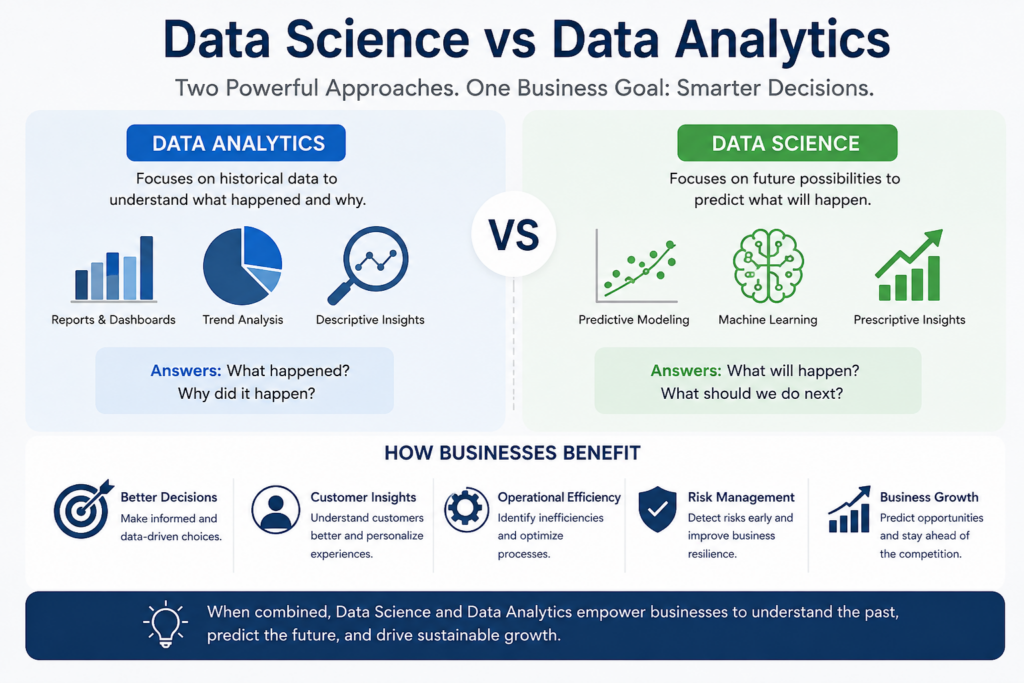
While both fields focus on extracting value from data, they serve different business purposes. Data analytics helps organizations understand what has happened and why, whereas data science focuses on predicting future outcomes and building intelligent solutions. Knowing how to leverage both approaches can provide companies with a significant competitive advantage.

Understanding Data Science and Data Analytics
Before exploring how businesses benefit from these disciplines, it is important to understand the difference between Data Science vs Data Analytics. Although the terms are often used interchangeably, they serve different purposes within an organization and contribute to business growth in unique ways.
Data Analytics primarily focuses on examining historical and current data to uncover patterns, trends, and actionable insights. It helps organizations understand what has happened in the past and what is currently happening within their operations. By analyzing data from sales, marketing, customer interactions, and business processes, companies can identify opportunities for improvement and make more informed decisions.
On the other hand, Data Science goes beyond traditional analysis by leveraging advanced technologies such as machine learning, artificial intelligence (AI), predictive analytics, and statistical modeling. Instead of only explaining past performance, data science aims to predict future outcomes, automate complex processes, and generate recommendations that support strategic decision-making.
Key Differences Between Data Science and Data Analytics
- Purpose
- Data Analytics focuses on understanding past and present business performance.
- Data Science focuses on predicting future trends and creating intelligent solutions.
- Techniques Used
- Data Analytics relies on reporting, visualization, statistical analysis, and business intelligence tools.
- Data Science incorporates machine learning algorithms, predictive models, artificial intelligence, and advanced programming techniques.
- Business Questions Answered
- Data Analytics answers questions such as:
- What happened?
- Why did it happen?
- Which areas need improvement?
- Data Science answers questions such as:
- What is likely to happen next?
- How can outcomes be optimized?
- Can processes be automated?
- Data Analytics answers questions such as:
- Outcome
- Data Analytics delivers insights that support operational and tactical decisions.
- Data Science generates predictive intelligence that supports long-term business strategy and innovation.
How They Work Together
Rather than competing disciplines, Data Science and Data Analytics complement each other. Analytics provides a strong foundation by organizing, cleaning, and interpreting business data, while data science builds upon those insights to create predictive models and automated systems.
For example:
- A retailer may use Data Analytics to identify which products generated the highest sales during the previous quarter.
- The same retailer can use Data Science to predict future product demand, optimize inventory levels, and recommend products to customers based on purchasing behavior.
Similarly:
- Data Analytics can reveal customer churn patterns.
- Data Science can predict which customers are most likely to leave and suggest personalized retention strategies.
When evaluating Data Science vs Data Analytics, businesses should recognize that both play critical roles in a modern data-driven environment. Data Analytics helps organizations understand their current position, while Data Science enables them to anticipate future opportunities and challenges. Together, they provide a comprehensive framework for improving efficiency, enhancing customer experiences, reducing risks, and driving sustainable business growth.

How Data Analytics Benefits Businesses
In today’s highly competitive business environment, organizations generate massive amounts of data from customers, operations, marketing campaigns, and digital platforms. However, data alone has little value unless it is analyzed effectively. This is where Data Analytics becomes essential. By transforming raw information into meaningful insights, data analytics helps businesses improve decision-making, optimize performance, and uncover new growth opportunities.
Companies across industries rely on analytics to understand what is happening within their business, why it is happening, and what actions should be taken to improve outcomes. From enhancing customer experiences to reducing operational costs, data analytics has become a key driver of business success.
Improved Decision Making
One of the most significant benefits of data analytics is its ability to support smarter and more accurate decision-making. Rather than relying on assumptions, intuition, or outdated information, business leaders can use real-time and historical data to guide their strategies.
Data analytics enables organizations to:
- Monitor business performance using measurable metrics.
- Identify emerging trends and market opportunities.
- Evaluate the success of products, services, and campaigns.
- Make evidence-based decisions with greater confidence.
- Reduce uncertainty when planning future initiatives.
By leveraging reliable insights, companies can make faster and more informed decisions that align with their business objectives.
Better Customer Understanding
Understanding customer needs and expectations is essential for long-term growth. Data analytics helps businesses gain deeper insights into customer behavior by analyzing interactions across websites, social media, mobile applications, and purchasing channels.
Organizations can use analytics to:
- Identify customer preferences and buying patterns.
- Segment audiences based on demographics and behavior.
- Understand customer pain points and expectations.
- Improve customer engagement strategies.
- Deliver more personalized products, services, and communications.
A better understanding of customers allows businesses to strengthen relationships, improve satisfaction levels, and increase customer loyalty.
Enhanced Operational Efficiency
Every organization aims to maximize productivity while minimizing unnecessary costs. Data analytics helps businesses identify inefficiencies within their operations and discover opportunities for optimization.
Analytics can help organizations:
- Detect workflow bottlenecks and process delays.
- Monitor resource utilization across departments.
- Improve inventory management and supply chain performance.
- Reduce waste and operational expenses.
- Streamline business processes for greater productivity.
When operational challenges are identified early, businesses can implement improvements that lead to higher efficiency and stronger profitability.
Performance Tracking and Measurement
Modern organizations depend on data-driven performance management to evaluate progress and achieve business goals. Data analytics provides detailed visibility into key performance indicators (KPIs) across departments and business functions.
Some common areas where analytics supports performance tracking include:
- Sales and revenue growth.
- Marketing campaign effectiveness.
- Customer acquisition and retention rates.
- Employee productivity and performance.
- Financial and operational outcomes.
Regular monitoring helps organizations identify successful strategies while quickly addressing areas that require improvement.
Risk Identification and Management
Business risks can arise from various sources, including market changes, customer behavior shifts, operational issues, and financial challenges. Data analytics helps organizations identify potential risks before they become major problems.
Through historical data analysis, businesses can:
- Detect patterns associated with declining sales.
- Identify customers at risk of leaving.
- Monitor operational vulnerabilities.
- Assess financial performance trends.
- Improve business continuity planning.
Early risk detection enables organizations to take proactive measures and reduce potential negative impacts on performance.
How Data Science Benefits Businesses
While data analytics focuses on understanding historical and current data, Data Science takes business intelligence to the next level by using advanced technologies such as machine learning, artificial intelligence (AI), predictive modeling, and automation. Data science helps organizations not only understand what has happened but also predict what is likely to happen in the future.
As businesses increasingly seek competitive advantages through innovation, data science has become a powerful tool for improving decision-making, enhancing customer experiences, and driving digital transformation.
Predictive Forecasting
One of the most valuable capabilities of data science is its ability to forecast future outcomes based on historical and real-time data. Predictive models help organizations anticipate market trends, customer demand, and business challenges before they occur.
Businesses use predictive forecasting to:
- Estimate future sales and revenue.
- Predict customer demand for products and services.
- Optimize inventory and supply chain planning.
- Forecast market trends and economic conditions.
- Improve resource allocation and budgeting.
Accurate forecasting enables organizations to make strategic decisions with greater confidence and preparedness.
Personalized Customer Experiences
Customers increasingly expect personalized interactions from brands. Data science helps businesses deliver customized experiences by analyzing customer behaviors, preferences, and engagement patterns.
Through machine learning algorithms, organizations can:
- Recommend products based on previous purchases.
- Deliver personalized marketing messages.
- Create targeted promotional campaigns.
- Improve customer support experiences.
- Increase engagement through customized content.
Personalization not only improves customer satisfaction but also boosts conversion rates and long term customer loyalty.
Automation and AI Solutions
Data science plays a critical role in business automation by enabling intelligent systems that can perform repetitive and complex tasks with minimal human intervention.
Common applications include:
- Automated customer support through AI chatbots.
- Intelligent document processing.
- Workflow automation and task management.
- Automated recommendation engines.
- Predictive maintenance for equipment and machinery.
By reducing manual effort, organizations can improve productivity, lower costs, and allow employees to focus on higher-value activities.
Fraud Detection and Security
As digital transactions continue to grow, businesses face increasing security and fraud-related challenges. Data science helps organizations detect suspicious activities in real time using advanced analytical models and machine learning techniques.
Businesses can leverage data science to:
- Monitor transaction patterns continuously.
- Identify unusual customer behavior.
- Detect fraudulent financial activities.
- Strengthen cybersecurity defenses.
- Reduce financial losses caused by fraud.
Real time fraud detection systems enable organizations to respond quickly and protect both customers and business assets.
Competitive Advantage and Innovation
Companies that successfully implement data science often gain a significant competitive edge in their industries. By uncovering hidden patterns and predicting future opportunities, organizations can make strategic decisions faster than their competitors.
Data science helps businesses:
- Identify emerging market opportunities.
- Launch innovative products and services.
- Improve strategic planning processes.
- Enhance customer acquisition and retention.
- Adapt quickly to changing market conditions.
Organizations that embrace data science are often better positioned to innovate, grow, and maintain long term success in an increasingly data driven marketplace.
The Combined Value of Data Analytics and Data Science
Although Data Analytics and Data Science have distinct functions, they deliver the greatest value when used together. Data analytics helps businesses understand past and present performance, while data science provides predictive insights and intelligent automation for the future.
Together, these disciplines enable organizations to:
- Make data driven decisions.
- Improve operational efficiency.
- Enhance customer experiences.
- Reduce risks.
- Drive innovation and business growth.
As digital transformation continues across industries, businesses that invest in both data analytics and data science will be better equipped to navigate challenges, seize new opportunities, and achieve sustainable competitive advantages.
Data Science vs Data Analytics: Key Business Differences
When comparing Data Science vs Data Analytics, the primary difference lies in their objectives.
| Factor | Data Analytics | Data Science |
|---|---|---|
| Primary Focus | Focuses on historical and current data analysis | Focuses on future predictions and advanced modeling |
| Key Objective | Answers what happened and why it happened | Answers what is likely to happen next |
| Approach | Uses descriptive and diagnostic analysis | Uses predictive and prescriptive analysis |
| Tools & Technologies | Uses reporting, visualization, SQL, and BI tools | Uses machine learning, AI, Python, and advanced algorithms |
| Data Usage | Analyzes structured business data | Works with structured and unstructured data |
| Decision Support | Supports operational and tactical decisions | Supports strategic and predictive decisions |
| Output | Generates reports, dashboards, and business insights | Creates predictive models and intelligent solutions |
| Business Value | Improves efficiency and performance monitoring | Drives innovation, automation, and forecasting |
| Common Applications | Performance tracking, customer analysis, KPI reporting | Demand forecasting, recommendation systems, fraud detection |
| Best For | Understanding current business performance | Predicting future opportunities and risks |
Why Businesses Need Both Approaches
The debate around Data Science vs Data Analytics should not be viewed as a competition. Modern organizations benefit most when both disciplines work together.
For example:
- Analytics identifies declining customer retention rates.
- Data science predicts which customers are most likely to leave.
- Marketing teams use these insights to create targeted retention campaigns.
- Business leaders measure results through analytics reports.
This integrated approach helps organizations move from reactive decision-making to proactive business strategy.
Conclusion
Understanding Data Science vs Data Analytics is crucial for organizations looking to maximize the value of their data. Data analytics helps businesses understand past and current performance, while data science enables future predictions and intelligent automation. Together, these approaches provide a comprehensive framework for data-driven decision-making, operational excellence, and long-term business growth.
Companies that effectively combine analytics and data science can unlock deeper insights, improve customer experiences, reduce risks, and gain a lasting competitive advantage in an increasingly data-driven world.
Frequently Asked Questions
Answer:
The primary difference between Data Science and Data Analytics is their focus. Data Analytics examines historical data to identify trends and generate insights, while Data Science uses advanced techniques such as machine learning and predictive modeling to forecast future outcomes. Both help organizations make better data-driven decisions.
Answer:
Neither is universally better because they serve different purposes. Data Analytics helps businesses understand current performance and customer behavior, while Data Science enables predictive decision-making and automation. Most successful organizations use both approaches together to maximize business value.
Answer:
Data Analytics helps companies track key performance indicators, understand customer preferences, and identify operational inefficiencies. By analyzing data trends, businesses can make informed decisions that improve productivity, customer satisfaction, and profitability.
Answer:
Data Science allows businesses to predict future trends, automate processes, and uncover hidden opportunities within large datasets. It supports advanced applications such as fraud detection, demand forecasting, personalized recommendations, and artificial intelligence-driven decision-making.
Answer:
Yes, many organizations start with Data Analytics to gain insights from historical data and improve reporting. However, as business needs become more complex, Data Science can add predictive capabilities that help companies anticipate challenges, optimize strategies, and stay competitive in evolving markets.