
How AI Is Transforming the Traditional Types of Data Analytics
How AI Is Transforming the Traditional Types of Data Analytics
Artificial Intelligence (AI) is reshaping the way organizations collect, process, and interpret data. Businesses today generate enormous amounts of information from websites, mobile applications, customer interactions, social media platforms, and operational systems. Traditional analytics methods have helped organizations understand this data for years, but AI is now taking analytical capabilities to a completely new level.
By combining machine learning, automation, and intelligent algorithms, AI enables companies to gain faster insights, improve decision making, and uncover patterns that were previously difficult to identify. As a result, the Types of Data Analytics used by organizations are becoming more efficient, accurate, and predictive than ever before.

Understanding Data Analytics in the AI Era
Data analytics is the process of collecting, organizing, analyzing, and interpreting data to uncover meaningful insights that support business decision-making. Traditionally, organizations relied on spreadsheets, statistical models, and manual reporting systems to evaluate performance and identify trends. While these methods provided valuable information, they often required significant time and effort to process large datasets and generate actionable insights.
As digital technologies evolved, businesses began generating data at an unprecedented rate from websites, mobile applications, social media platforms, customer interactions, and connected devices. This rapid growth in data volume created new challenges that traditional analytics methods were not designed to handle efficiently. As a result, organizations started adopting advanced technologies such as Artificial Intelligence (AI) to improve the speed, accuracy, and effectiveness of data analysis.
How AI Is Changing Modern Data Analytics
Artificial Intelligence has revolutionized the way organizations analyze and utilize data. AI-powered analytics tools can process massive amounts of information in real time, helping businesses discover patterns, trends, and opportunities that may be difficult to identify through manual analysis.
Some of the major ways AI is transforming data analytics include:
- Automated data collection and processing
- Real-time analysis of large datasets
- Identification of hidden trends and patterns
- Predictive forecasting for future business outcomes
- Intelligent recommendations for decision-making
- Detection of anomalies and potential risks
- Enhanced data visualization and reporting
These capabilities enable organizations to move beyond simple historical reporting and gain deeper insights into customer behavior, market trends, and operational performance.
Benefits of AI-Powered Analytics
The integration of AI into analytics provides numerous advantages for businesses across industries. Instead of spending hours preparing reports and cleaning data, analysts can focus on interpreting insights and developing strategic solutions.
Key benefits include:
- Faster and more accurate decision-making
- Improved operational efficiency
- Reduced manual workload
- Enhanced forecasting capabilities
- Better customer experience management
- Increased scalability for growing datasets
- Greater competitive advantage in data-driven markets
By leveraging AI, organizations can transform raw data into valuable business intelligence that supports long term growth and innovation.
The Role of Human Analysts in the AI Era
Despite the rapid advancement of AI technologies, human expertise remains essential in the analytics process. AI can identify patterns and generate predictions, but human analysts are responsible for understanding business context, validating results, and making strategic decisions based on analytical findings.
Human analysts continue to play important roles in:
- Defining business objectives
- Interpreting analytical results
- Ensuring data quality and accuracy
- Identifying ethical considerations
- Communicating insights to stakeholders
- Developing data-driven business strategies
Rather than replacing professionals, AI acts as a powerful assistant that enhances productivity and enables analysts to focus on higher-value tasks.
The Future of Data Analytics with AI
As Artificial Intelligence continues to evolve, the future of data analytics will become increasingly intelligent, automated, and predictive. Businesses will be able to analyze data faster, identify opportunities earlier, and respond to market changes with greater confidence. Technologies such as machine learning, natural language processing, and generative AI are expected to further improve analytical capabilities and make data insights more accessible across organizations.
Companies that successfully combine human expertise with AI-driven analytics will be better positioned to innovate, optimize operations, and maintain a competitive edge in an increasingly data-driven business environment.
The Four Core Analytics Categories and AI’s Impact
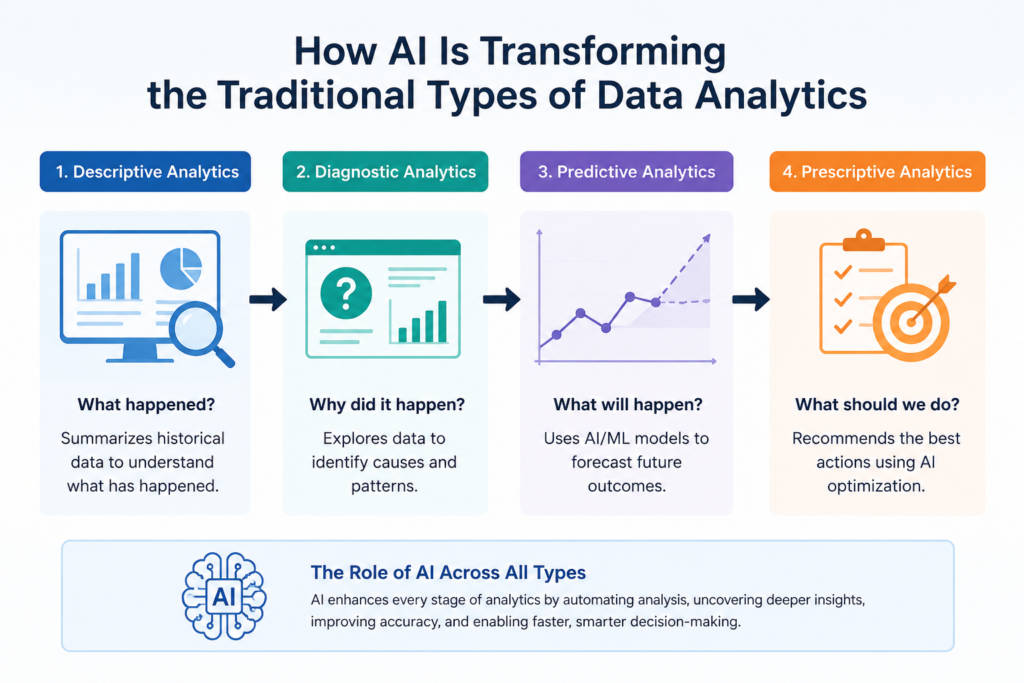
The traditional framework of analytics consists of four major categories. AI is transforming each of these areas by improving speed, accuracy, and scalability.
1. Descriptive Analytics: Smarter Insights into Past Performance
Descriptive analytics focuses on understanding historical data and answering the question:
“What happened?”
Traditionally, businesses used dashboards, reports, and spreadsheets to review past performance. AI improves this process by automatically collecting and organizing information from multiple sources.
AI-powered tools can:
- Generate automated reports
- Identify hidden trends in historical data
- Summarize large datasets instantly
- Detect unusual patterns and anomalies
As organizations modernize their reporting systems, the Types of Data Analytics used for descriptive analysis become more dynamic and less dependent on manual effort.
2. Diagnostic Analytics: Finding the Real Cause Faster
Diagnostic analytics answers an important business question:
“Why did it happen?”
Traditional root-cause analysis often required analysts to spend significant time investigating relationships between variables. AI accelerates this process by examining thousands of data points simultaneously.
Machine learning algorithms can:
- Discover correlations automatically
- Identify operational bottlenecks
- Detect customer behavior patterns
- Reveal factors influencing business outcomes
This allows decision makers to understand causes more quickly and make informed improvements based on data driven evidence.
3. Predictive Analytics: More Accurate Forecasting
Predictive analytics focuses on answering:
“What is likely to happen next?”
This area has experienced some of the most significant advancements due to AI. Traditional forecasting models relied heavily on historical trends and statistical assumptions. AI can analyze much larger datasets and continuously improve predictions through machine learning.
Common applications include:
- Sales forecasting
- Customer churn prediction
- Demand forecasting
- Financial risk assessment
- Inventory planning
AI-driven predictive models help organizations anticipate future opportunities and challenges with greater confidence. This transformation is redefining how businesses apply the Types of Data Analytics to support strategic planning.
4. Prescriptive Analytics: Intelligent Decision Recommendations
Prescriptive analytics answers the question:
“What should be done?”
Rather than simply predicting outcomes, AI can recommend specific actions based on data patterns and business objectives.
Advanced analytics systems can:
- Suggest optimal pricing strategies
- Recommend marketing campaigns
- Improve supply chain decisions
- Optimize resource allocation
- Support operational planning
By combining predictive insights with intelligent recommendations, AI enables businesses to make faster and more effective decisions.
Key AI Technologies Driving Analytics Transformation
Several AI technologies are accelerating the evolution of modern analytics.
Machine Learning
Machine learning algorithms continuously learn from data and improve prediction accuracy over time. They can identify patterns that traditional statistical methods may overlook.
Natural Language Processing (NLP)
NLP allows users to interact with analytics platforms using everyday language. Instead of writing complex queries, decision-makers can ask questions and receive meaningful insights instantly.
Deep Learning
Deep learning models are capable of analyzing complex datasets such as images, videos, customer interactions, and unstructured text. This expands the scope of business intelligence and advanced analytics.
Automation and Intelligent Reporting
AI automates repetitive analytical tasks such as data cleaning, report generation, and trend identification. This reduces manual workload and improves productivity.
Benefits of AI-Powered Data Analytics
Organizations adopting AI-enhanced analytics experience several advantages:
- Faster decision-making
- Improved forecasting accuracy
- Reduced manual analysis
- Real-time business insights
- Better customer understanding
- Enhanced operational efficiency
- Increased competitive advantage
These benefits demonstrate why AI is becoming an essential component of modern data analysis methods across industries.
Challenges Businesses Should Consider
Despite its advantages, AI implementation also comes with challenges:
- Data quality issues
- Privacy and security concerns
- Integration with existing systems
- Skill gaps within teams
- High initial investment requirements
Organizations must establish strong data governance practices to maximize the value of AI-powered analytics solutions.
The Future of Analytics with Artificial Intelligence
The future of analytics is increasingly intelligent, automated, and predictive. As AI technologies continue to evolve, businesses will gain access to more sophisticated tools capable of processing vast amounts of information in real time.
Future developments may include:
- Fully automated decision-support systems
- Real-time predictive business intelligence
- AI-driven customer personalization
- Advanced scenario planning
- Self-learning analytical platforms
As these innovations become mainstream, the Types of Data Analytics organizations rely on will continue to evolve, creating smarter and more proactive business strategies.
Conclusion
Artificial Intelligence is fundamentally changing how businesses analyze and use data. From descriptive reporting to prescriptive decision making, AI enhances every stage of the analytics process through automation, machine learning, and intelligent forecasting.
The transformation of the Types of Data Analytics is helping organizations move beyond traditional reporting and embrace data-driven innovation. Businesses that successfully combine AI with modern analytics strategies will be better positioned to improve efficiency, predict future trends, and make informed decisions in an increasingly competitive digital landscape.
Frequently Asked Questions
Answer:
Artificial Intelligence is transforming traditional data analytics by automating data processing, identifying hidden patterns, and generating insights faster than manual methods. AI-powered systems can analyze large datasets in real time, helping businesses make quicker and more accurate decisions. This improves efficiency and reduces the time spent on repetitive analytical tasks.
Answer:
AI enhances data analytics by improving accuracy, speeding up analysis, and enabling predictive forecasting. It can process both structured and unstructured data, uncover trends that humans may miss, and provide actionable recommendations. As a result, organizations can make more informed business decisions and gain a competitive advantage.
Answer:
AI is not designed to replace data analysts but to support and enhance their work. While AI can automate routine tasks such as data cleaning and report generation, analysts are still needed to interpret results, define business objectives, and make strategic decisions. Human expertise remains essential for understanding context and applying insights effectively.
Answer:
All analytics categories benefit from AI, but predictive and prescriptive analytics experience the greatest impact. AI-powered models can forecast future trends, identify potential risks, and recommend optimal actions. This allows businesses to move from reactive decision-making to proactive planning and strategy development.
Answer:
AI-powered data analytics is widely used across industries such as healthcare, finance, retail, manufacturing, education, and marketing. Organizations leverage AI to improve customer experiences, optimize operations, detect fraud, forecast demand, and enhance overall business performance. Its versatility makes it valuable for businesses of all sizes.