
Data Science vs Artificial Intelligence vs Machine Learning
What's the difference between Data Science and AI?
Data Science vs Artificial Intelligence vs Machine Learning is one of the most common comparisons for students and professionals exploring careers in technology. These terms are often used interchangeably, but they are not the same.
While all three fields involve working with data and technology, each has a different purpose, skill set, and career path. Understanding how they relate to one another can help you choose the right learning path and develop the skills that align with your career goals.
So, what exactly is the difference between Data Science, Artificial Intelligence (AI), and Machine Learning (ML)?

Understanding the Relationship
Before diving into the differences, it’s important to understand that these fields are closely connected.
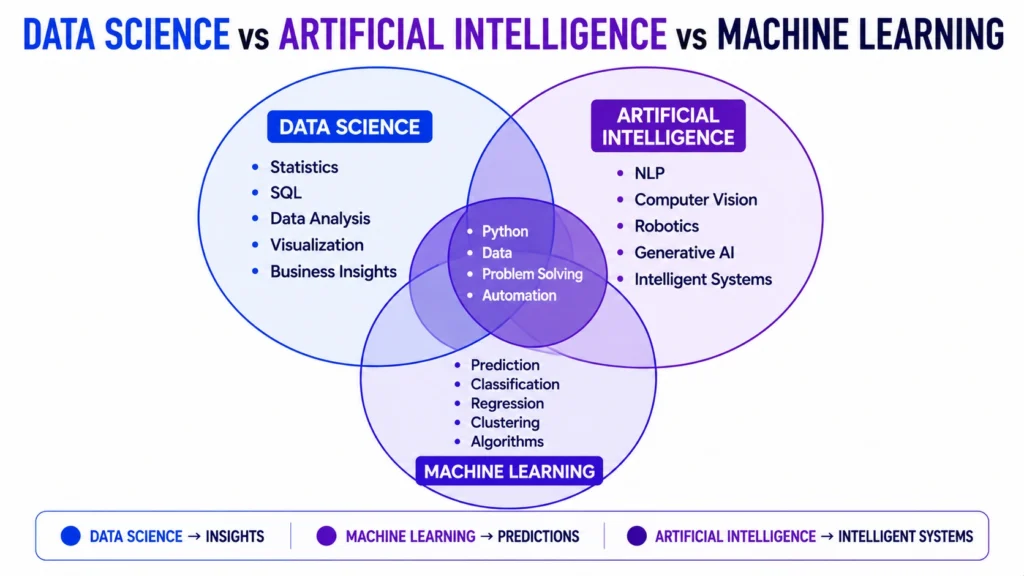
Think of them as overlapping areas:
- Data Science focuses on extracting insights from data.
- Artificial Intelligence focuses on creating systems that can perform tasks requiring human intelligence.
- Machine Learning is a subset of AI that enables systems to learn from data and improve over time.
In simple terms:
Machine Learning ⊂ Artificial Intelligence
and
Data Science often uses Machine Learning and AI techniques to solve business problems.
What Is Data Science?
Data Science is the process of collecting, cleaning, analyzing, and interpreting data to generate actionable insights.
The primary goal of Data Science is to help organizations make better decisions using data.
Common Activities in Data Science:
- Data Collection
- Data Cleaning
- Exploratory Data Analysis (EDA)
- Statistical Analysis
- Data Visualization
- Predictive Modeling
- Business Reporting
Common Tools: Python, SQL, Excel, Tableau, Power BI, Pandas and NumPy.
Example: An E commerce company wants to understand why sales are declining.
A Data Scientist may:
- Analyze customer behavior
- Identify purchasing trends
- Build dashboards
- Forecast future sales
The focus is on understanding and solving business problems through data.
What Is Artificial Intelligence?
Artificial Intelligence refers to the broader field of creating systems that can mimic aspects of human intelligence.
AI systems can:
- Understand language
- Recognize images
- Make decisions
- Solve problems
- Generate content
The goal is to develop intelligent systems capable of performing tasks that normally require human intervention.
Examples of AI Applications:
- Virtual Assistants
- Chatbots
- Recommendation Systems
- Self Driving Vehicles
- Image Recognition
- Generative AI Tools
Common AI Technologies:
- Machine Learning
- Deep Learning
- Natural Language Processing (NLP)
- Computer Vision
AI is the umbrella field that includes several specialized technologies.
What Is Machine Learning?
Machine Learning is a branch of Artificial Intelligence that enables systems to learn patterns from data without being explicitly programmed for every scenario.
Instead of following fixed rules, ML models learn from historical data and make predictions or decisions.
Common Machine Learning Tasks:
- Customer Churn Prediction
- Fraud Detection
- Sales Forecasting
- Sentiment Analysis
- Recommendation Systems
Popular Machine Learning Algorithms:
- Linear Regression
- Logistic Regression
- Decision Trees
- Random Forest
- K Means Clustering
Common Tools: Python, Scikit Learn, TensorFlow and PyTorch
Machine Learning focuses on building models that learn from data.
Data Science vs Artificial Intelligence vs Machine Learning
| Aspect | Data Science | Artificial Intelligence | Machine Learning |
|---|---|---|---|
| Primary Goal | Generate insights from data | Build intelligent systems | Enable systems to learn from data |
| Focus Area | Analysis and decision-making | Human-like intelligence | Pattern recognition and prediction |
| Uses Data? | Yes | Often | Yes |
| Uses Statistics? | Extensively | Sometimes | Frequently |
| Includes Machine Learning? | Often | Yes | Core field |
| Business Reporting | Major focus | Limited | Limited |
| Predictive Models | Yes | Yes | Core focus |
| Common Tools | SQL, Python, Tableau, Power BI | Python, NLP, Deep Learning Frameworks | Python, Scikit-Learn, TensorFlow |
How These Fields Work Together
In many real world projects, Data Science, AI, and Machine Learning are used together.
Consider an online streaming platform.
Although the responsibilities differ, they often contribute to the same business objective.
Which Field Should You Choose?
The answer depends on your interests.
Choose Data Science If You Enjoy….
- Data Analysis
- Statistics
- Business Problem Solving
- Dashboards and Reporting
- Data Visualization
Choose Machine Learning If You Enjoy….
- Predictive Modeling
- Algorithms
- Programming
- Model Optimization
Choose Artificial Intelligence If You Enjoy….
- Intelligent Systems
- Deep Learning
- NLP
- Computer Vision
- Generative AI
Many professionals start with Data Science and later specialize in Machine Learning or AI.
Skills Required in Each Field
Data Science
- Statistics
- SQL
- Python
- Data Visualization
- Business Analytics
Artificial Intelligence
- Python
- Deep Learning
- NLP
- Computer Vision
- AI Frameworks
Machine Learning
- Mathematics
- Statistics
- Python
- Model Development
- Feature Engineering
There is significant overlap between these skill sets, especially in Python and data analysis.
Conclusion is that….
Data Science, Artificial Intelligence, and Machine Learning are closely related fields, but they serve different purposes. Data Science focuses on extracting insights from data, Machine Learning focuses on building systems that learn from data, and Artificial Intelligence focuses on creating intelligent systems capable of performing complex tasks.
Rather than viewing them as competing fields, it’s better to see them as complementary disciplines that work together to solve modern business and technology challenges.
Understanding their differences can help you choose the right learning path and build a strong foundation for a future ready career.
Build Skills in Data Science, Machine Learning, and GenAI with Career247
As the boundaries between Data Science, Machine Learning, and Artificial Intelligence continue to evolve, employers increasingly seek professionals with a well rounded skill set.
Career247’s Data Science and Machine Learning with GenAI Certification Powered by IBM is designed to help learners build expertise in Statistics, Python, SQL, Machine Learning, Data Visualization, Generative AI, and real world projects.
By combining foundational concepts with practical applications, learners gain the skills needed to work across modern data and AI driven environments.
Frequently Asked Questions
Answer:
No. Data Science focuses on extracting insights from data, while Artificial Intelligence focuses on building intelligent systems that can perform tasks similar to human intelligence.
Answer:
Yes. Machine Learning is a subset of Artificial Intelligence that enables systems to learn from data and improve performance over time.
Answer:
Neither is inherently better. The right choice depends on your interests and career goals. Data Science emphasizes analysis and business insights, while Machine Learning focuses on predictive models and algorithms.
Answer:
Yes. Many Data Scientists use Machine Learning and AI techniques as part of their work and may transition into AI focused roles.
Answer:
Most beginners benefit from starting with statistics, Python, SQL, and data analysis before moving into Machine Learning and Artificial Intelligence concepts.