
Common Big Data Problems and Practical Solutions
Common Big Data Problems and Practical Solutions
In today’s digital world, organizations generate enormous amounts of data from websites, mobile applications, social media platforms, IoT devices, and business operations. While big data provides valuable insights for decision making, managing such vast datasets comes with several challenges. Understanding Common Big Data Problems and Practical Solutions helps businesses maximize the value of their data while minimizing operational risks.
As data continues to grow rapidly, businesses need efficient systems to manage and analyze it effectively. By addressing big data challenges early, organizations can improve data accuracy, enhance security, and make faster, more informed decisions.

What Is Big Data?
Big data refers to extremely large and complex datasets that cannot be processed, stored, or analyzed efficiently using traditional data management systems. These datasets are generated from various sources, including websites, mobile applications, social media platforms, sensors, IoT devices, online transactions, and enterprise systems. The rapid growth of digital technologies has significantly increased the amount of data organizations collect every day.
Businesses leverage big data analytics to uncover valuable insights, identify trends, understand customer behavior, improve operational efficiency, and support data-driven decision-making. By analyzing large volumes of information, organizations can make more accurate forecasts, personalize customer experiences, detect risks, and gain a competitive advantage in their industries.
Big data is often characterized by the “Five Vs”:
- Volume: Massive amounts of data generated every second.
- Velocity: The speed at which data is created and processed.
- Variety: Different data formats, including structured, semi-structured, and unstructured data.
- Veracity: The accuracy and reliability of data.
- Value: The meaningful insights that can be extracted from data.
Despite its benefits, managing big data presents several challenges. As data volumes continue to expand, organizations often struggle with storage limitations, data integration issues, security concerns, processing complexity, and maintaining data quality. Without the right infrastructure and strategies, these challenges can affect business performance and limit the effectiveness of analytics initiatives.
Understanding Common Big Data Problems and Practical Solutions is essential for organizations looking to harness the full potential of their data while ensuring efficiency, security, and scalability.
Why Businesses Need to Address Big Data Challenges
As organizations collect and process larger volumes of data, addressing big data challenges becomes essential for maintaining efficiency, accuracy, and competitiveness. Data is one of the most valuable business assets, but without proper management, it can quickly become a source of operational problems rather than a strategic advantage.
When big data challenges are ignored, businesses may struggle to extract meaningful insights from their information. Poor data governance, outdated infrastructure, and inefficient processing systems can negatively impact decision-making and overall business performance.
Some of the major consequences of failing to address big data challenges include:
- Poor Data Quality: Incomplete, duplicate, or inaccurate data can reduce the reliability of reports and analytics.
- Inaccurate Business Insights: Decisions based on flawed data often lead to ineffective strategies and missed opportunities.
- Increased Operational Costs: Managing large datasets inefficiently can result in higher storage, processing, and maintenance expenses.
- Security Vulnerabilities: Weak data protection measures can expose sensitive information to cyber threats and data breaches.
- Slow Decision-Making Processes: Delays in data processing can prevent organizations from responding quickly to market changes and customer needs.
- Reduced Customer Satisfaction: Poor data management can affect customer experiences, leading to lower engagement and retention rates.
- Compliance Risks: Failure to properly manage and secure data can result in regulatory violations and financial penalties.
- Limited Scalability: Organizations may find it difficult to support future growth if their data infrastructure cannot handle increasing volumes of information.
The Benefits of Solving Big Data Challenges
Organizations that proactively address big data challenges gain significant advantages, including:
- Better data accuracy and reliability
- Faster access to business insights
- Improved operational efficiency
- Stronger data security and compliance
- Enhanced customer experiences
- More confident and data-driven decision-making
- Greater scalability for future growth
By implementing effective data management strategies, modern analytics tools, and robust security practices, businesses can overcome these obstacles and unlock the full value of their data assets. This allows organizations to transform raw data into actionable insights that drive innovation, efficiency, and long-term success.
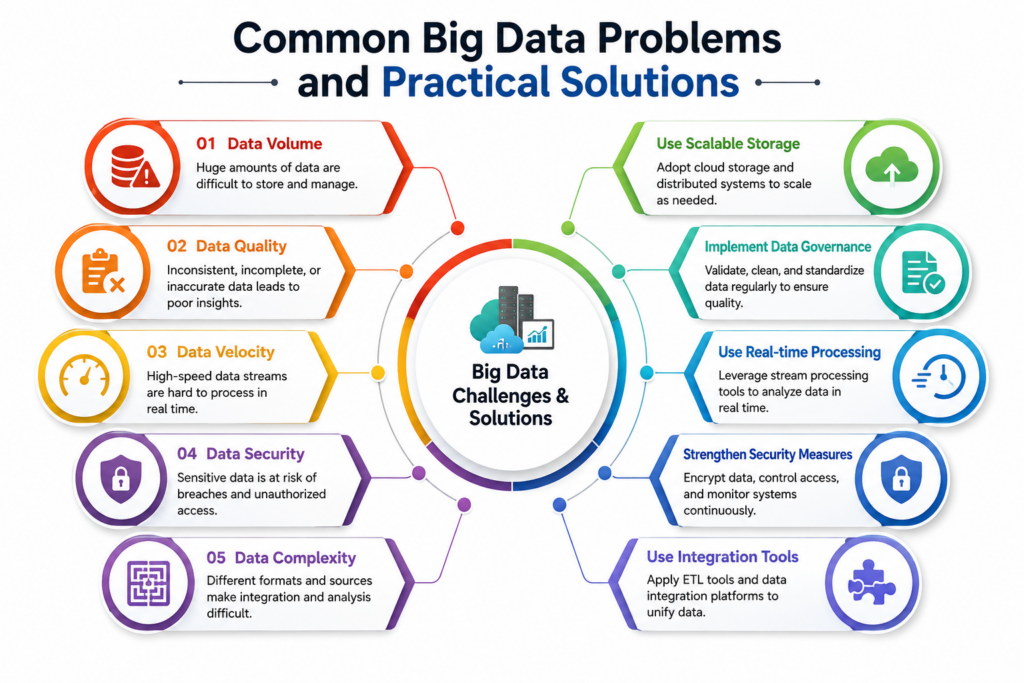


The Most Common Big Data Challenges Businesses Face Today
1. Data Quality and Accuracy Issues
One of the biggest concerns in big data management is maintaining data quality. Organizations often collect data from multiple sources, leading to inconsistencies, duplicates, and incomplete records. Poor quality data can negatively impact reporting, forecasting, and decision making processes.
As data volumes continue to grow, ensuring accuracy becomes even more important. Businesses that fail to maintain high-quality datasets often struggle to generate meaningful insights and may make decisions based on incorrect information.
Common Causes
- Human data entry errors
- Duplicate datasets
- Missing information
- Outdated records
- Inconsistent formatting
Practical Solutions
- Implement automated data validation tools.
- Use data cleansing processes regularly.
- Establish standardized data collection methods.
- Monitor data quality metrics continuously.
Addressing data quality is a critical part of Common Big Data Problems and Practical Solutions because accurate data leads to more reliable analytics outcomes.
2. Managing Massive Data Volumes
The rapid growth of digital information has made data storage a major challenge for modern organizations. Businesses generate enormous amounts of data every day through websites, applications, transactions, sensors, and customer interactions.
Without a scalable storage strategy, organizations may experience slower system performance, increased costs, and difficulties accessing critical information when needed. Efficient storage management is essential for long term success.
Challenges
- Storage limitations
- Higher infrastructure costs
- Slower data retrieval
- Increased maintenance requirements
Practical Solutions
- Adopt cloud-based storage platforms.
- Use scalable data lakes and warehouses.
- Archive inactive data periodically.
- Implement efficient data compression techniques.
Modern cloud infrastructure allows organizations to scale storage resources based on demand while reducing costs.
3. Data Security and Privacy Risks
Protecting sensitive information has become one of the most critical responsibilities for organizations managing large datasets. As cyber threats become more sophisticated, businesses face increasing risks related to unauthorized access and data breaches.
Additionally, regulations such as data protection and privacy laws require companies to implement strong security measures. Failure to comply can result in financial penalties and reputational damage.
Security Risks
- Unauthorized access
- Data theft
- Insider threats
- Compliance violations
Practical Solutions
- Encrypt sensitive data.
- Implement role-based access controls.
- Conduct regular security audits.
- Train employees on cybersecurity best practices.
- Use multi-factor authentication (MFA).
Organizations focusing on Common Big Data Problems and Practical Solutions must prioritize security to protect both customer information and business reputation.
4. Integrating Data from Multiple Sources
Modern businesses rely on information from various platforms, including CRM systems, marketing tools, ERP software, websites, mobile applications, and IoT devices. Bringing all this information together can be a complex task.
Poor integration often creates data silos, making it difficult for teams to access a complete view of business operations. Effective integration ensures consistency and improves collaboration across departments.
Common Integration Issues
- Different data formats
- Incompatible systems
- Duplicate records
- Data synchronization delays
Practical Solutions
- Use data integration platforms.
- Implement ETL (Extract, Transform, Load) processes.
- Standardize data formats across systems.
- Create centralized data repositories.
Effective integration improves data accessibility and supports better business intelligence initiatives.
5. Real Time Data Processing Challenges
Businesses increasingly depend on real-time data to make quick and informed decisions. Whether monitoring customer behavior, detecting fraud, or managing supply chains, organizations need immediate access to accurate insights.
However, processing large streams of data in real time requires advanced infrastructure and optimized systems. Without proper planning, delays can reduce the value of time-sensitive information.
Challenges
- High processing demands
- Network latency
- Delayed analytics
- Infrastructure bottlenecks
Practical Solutions
- Implement stream processing frameworks.
- Upgrade computing infrastructure.
- Use edge computing for faster processing.
- Optimize database performance.
Real time analytics enables businesses to respond quickly to market changes and customer needs.
6. Lack of Skilled Big Data Professionals
Technology alone cannot solve big data challenges. Organizations also need skilled professionals who can manage data infrastructure, analyze information, and implement advanced analytics solutions.
The demand for data scientists, data engineers, and analytics experts continues to grow, making talent acquisition increasingly competitive. Many businesses struggle to fill critical positions quickly.
Skills Gap Challenges
- Limited technical expertise
- Higher recruitment costs
- Project delays
- Reduced innovation
Practical Solutions
- Invest in employee training programs.
- Partner with data consulting firms.
- Encourage continuous learning.
- Utilize user-friendly analytics platforms.
Building internal expertise helps organizations successfully address Common Big Data Problems and Practical Solutions over the long term.
7. Ensuring Scalability and Performance
As organizations collect more data, maintaining system performance becomes increasingly challenging. Systems that work efficiently today may struggle to handle future growth if scalability is not considered from the beginning.
A lack of scalability can lead to slow analytics, increased downtime, and poor user experiences. Businesses must build flexible infrastructures capable of adapting to changing demands.
Performance Challenges
- Slow query execution
- System downtime
- Resource limitations
- Increased operational complexity
Practical Solutions
- Use distributed computing technologies.
- Implement scalable cloud architectures.
- Optimize database indexing.
- Monitor system performance regularly.
A scalable infrastructure ensures businesses can continue handling growing data demands efficiently.
Conclusion
Big data offers tremendous opportunities for organizations seeking competitive advantages, but it also introduces significant challenges. From data quality issues and security risks to scalability concerns and skills shortages, businesses must proactively address these obstacles.
Understanding Common Big Data Problems and Practical Solutions enables organizations to develop effective strategies that improve data management, enhance decision-making, and drive long-term growth. By implementing the right technologies, processes, and governance practices, companies can transform big data challenges into valuable business opportunities.
Frequently Asked Questions
Answer:
The most common big data challenges include poor data quality, data security risks, storage limitations, integration difficulties, real-time processing issues, and a shortage of skilled professionals. These challenges can impact decision-making, operational efficiency, and business growth. Organizations must implement effective data management strategies to address them successfully.
Answer:
Data quality is essential because analytics results are only as accurate as the data being analyzed. Inaccurate, incomplete, or duplicate data can lead to misleading insights and poor business decisions. Regular data cleansing, validation, and governance practices help maintain reliable and trustworthy datasets.
Answer:
Businesses can improve big data security by encrypting sensitive information, implementing multi-factor authentication, using role-based access controls, and conducting regular security audits. Employee cybersecurity training is also important because human error remains one of the leading causes of data breaches and security incidents.
Answer:
Cloud-based storage solutions, data lakes, and scalable data warehouses are among the most effective ways to manage growing data volumes. These technologies provide flexibility, cost efficiency, and the ability to scale resources as business needs change. Proper data archiving and compression can further optimize storage management.
Answer:
Technologies such as Artificial Intelligence (AI), Machine Learning (ML), automation tools, and cloud-native analytics platforms help organizations process data faster and more accurately. These solutions improve efficiency, support real-time decision-making, and reduce the complexity of managing large and diverse datasets.