
Can Non Technical Students Learn Data Analytics
Data Analytics Course for Non Technical Students
Can non technical students learn data analytics? It’s one of the most common questions asked by students from Commerce, Arts, Management, Economics, Psychology, and other non engineering backgrounds.
The short answer is yes.
In fact, many successful Data Analysts today did not start with Computer Science or Engineering degrees. What helped them succeed was not advanced programming knowledge, it was curiosity, problem solving ability, and a willingness to learn how data supports business decisions.

What Does a Data Analyst Actually Do?
Many beginners assume Data Analysts spend their entire day writing complex code. Reality is often very different.
A Data Analyst typically:
- Collects data from different sources
- Cleans and prepares datasets
- Analyzes trends and patterns
- Creates reports and dashboards
- Tracks business KPIs
- Helps teams make better decisions
For example:
A retail company may want to know:
- Which products sell the most?
- Which customers spend the most?
- Which marketing campaigns generate revenue?
A Data Analyst helps answer these questions using data.
The role is often a mix of business understanding, analytical thinking, and technical skills.
Why Non Technical Students Have an Advantage
This may sound surprising, but many non technical students already possess skills that are highly valuable in analytics.
1. Commerce Students:
Strong understanding of:
- Business processes
- Finance
- Accounting
- Market trends
2. Arts and Humanities Students
Strong skills in:
- Research
- Communication
- Critical thinking
- Storytelling
3. Economics Students
Strong foundation in:
- Statistics
- Data interpretation
- Business analysis
4. Management Students
Strong understanding of:
- Business strategy
- Operations
- Decision making
Modern analytics teams need more than coding skills. They need professionals who can connect data with business problems.
Do You Need Coding to Learn Data Analytics?
One of the biggest myths about analytics is that you need to be an expert programmer before getting started.
The reality is much more encouraging.
Many beginners start with:
- Excel
- Basic Statistics
- SQL
- Power BI
- Tableau
Python is often introduced later as learners become comfortable with analytical concepts.
The focus should be understanding data first, then learning tools that help analyze it.

Skills Non Technical Students Should Learn
Instead of trying to learn everything at once, focus on building skills in stages.
Stage 1: Excel
Learn:
- Data Cleaning, Sorting and Filtering
- Pivot Tables
- Basic Charts
Stage 2: Statistics Fundamentals
Understand:
- Mean, Median and Mode
- Probability
- Correlation
- Hypothesis Testing
You do not need advanced mathematics to get started.
Stage 3: SQL
SQL helps you retrieve and analyze data stored in databases.
It is one of the most important skills for Data Analysts and is generally easier to learn than traditional programming languages.
Stage 4: Data Visualization
Learn how to create dashboards using:
- Power BI
- Tableau
Visualization is where business insights become easier to understand.
Stage 5: Python (Optional at First)
Python becomes useful for:
- Automation
- Advanced Analysis
- Machine Learning
Many beginners learn Python after becoming comfortable with analytics fundamentals.
Common Challenges Faced by Non Technical Students
Starting something new can feel overwhelming.
Some common concerns include:
- “I Am Not Good at Mathematics”: Most entry level analytics work focuses on practical statistics rather than advanced mathematics.
- “I Have Never Written Code”: Many analytics tools are beginner friendly and allow learners to start without extensive coding knowledge.
- “I Come from an Arts or Commerce Background”: Employers increasingly value analytical thinking and business understanding alongside technical skills.
- “I Am Switching Careers”: Many professionals successfully transition into analytics from finance, marketing, operations, education, and customer service roles.

How Businesses Use Data Analysts
Data Analysts are needed in almost every industry.
- Marketing: Campaign Analysis, Customer Segmentation and Lead Tracking.
- Finance: Revenue Analysis, Budget Monitoring and Risk Assessment
- E-Commerce: Customer Behavior Analysis, Product Performance Tracking and Sales Forecasting
- Healthcare: Patient Analytics, Resource Planning and Operational Reporting
The demand for data driven decision making continues to expand across sectors.
Practical Learning Roadmap for Non Technical Students
A beginner friendly roadmap could look like this:
- Excel
- Statistics Fundamentals
- SQL
- Power BI or Tableau
- Python Basics
- Real World Projects
- Portfolio Development
- Interview Preparation
Following a structured path often produces better results than jumping between multiple tools and courses.
So the conclusion is that….
Coming from a non technical background does not prevent you from building a career in data analytics. While there is a learning curve, the field is accessible to students who are willing to develop analytical thinking, learn modern tools, and work on practical projects.
The most successful learners are often not those with the strongest technical backgrounds, but those who consistently practice, solve real business problems, and keep building their skills over time.
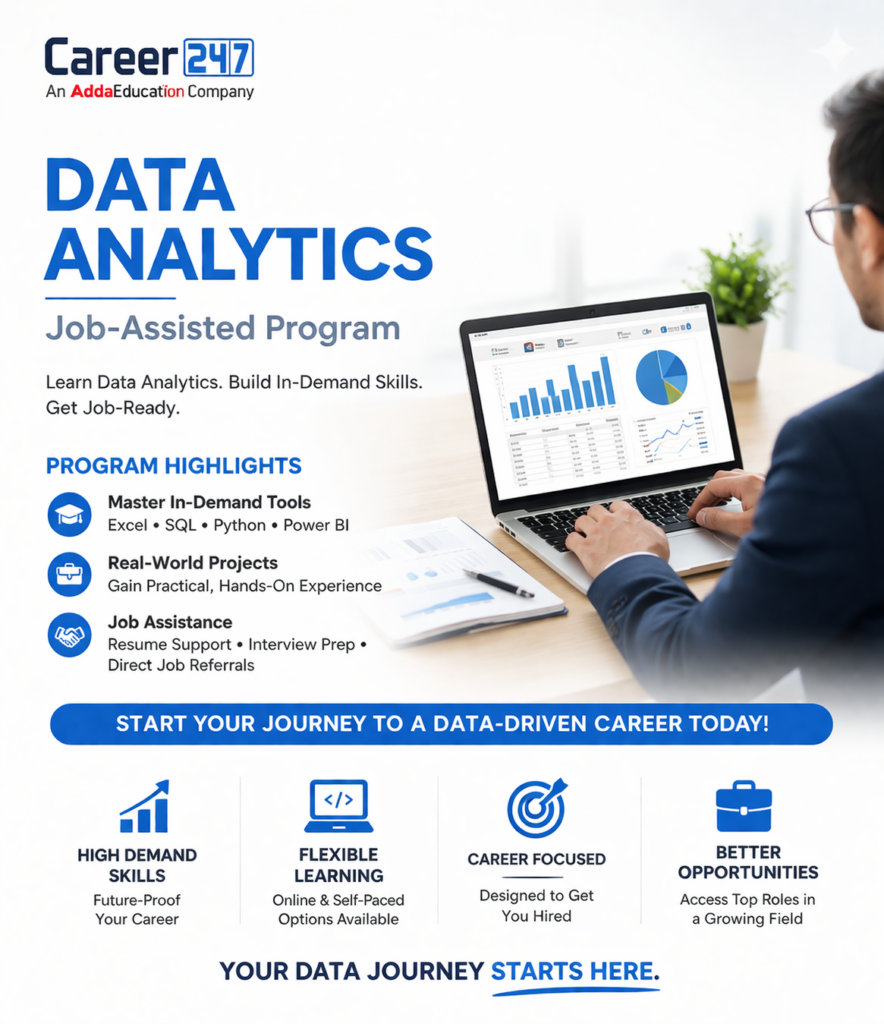
Build Job Ready Data Analytics Skills with Career247
For non technical students, one of the biggest challenges is knowing where to start. Career247’s Data Analytics with GenAI Course provides a structured learning path covering Excel, Statistics, SQL, Python, Power BI, Tableau, Dashboard Design, Data Storytelling, and real world analytics projects.
The program is designed to help learners from diverse educational backgrounds build practical skills and gain confidence in applying data analytics to real business scenarios.
Frequently Asked Questions
Answer:
Yes. Students from Commerce, Arts, Management, Economics, and other non technical backgrounds can successfully learn data analytics by building skills gradually.
Answer:
No. Beginners often start with Excel, Statistics, SQL, and dashboard tools before learning programming languages such as Python.
Answer:
Yes. Commerce students often bring strong business and financial understanding, which is valuable in analytics roles.
Answer:
Like any skill, analytics requires consistent learning, but many concepts can be learned step by step without an engineering background.
Answer:
A structured learning approach covering Excel, Statistics, SQL, Power BI, Tableau, and practical projects can help beginners build job ready analytics skills effectively.