
Common Challenges in Data Science
Common Challenges in Data Science and How to Overcome Them
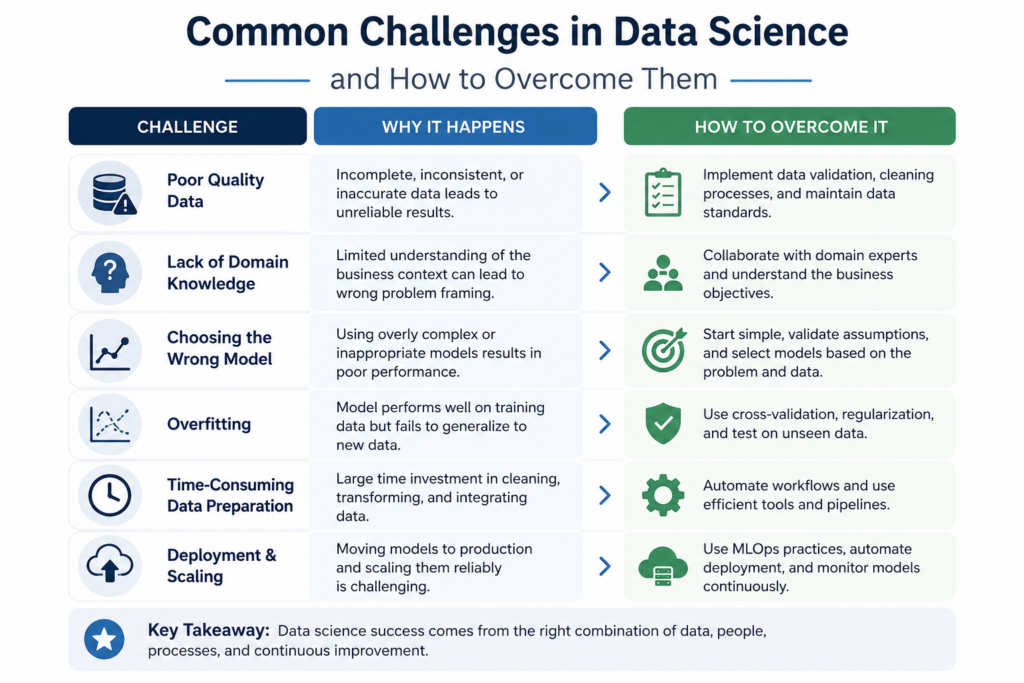
Data science has become a critical component of modern business decision-making. Organizations across industries use data science to gain insights, improve operations, and create competitive advantages. However, despite its growing importance, professionals often encounter various Challenges in Data Science that can impact project success, accuracy, and efficiency.
Understanding these challenges and implementing effective solutions can help organizations maximize the value of their data initiatives. This article explores the most common obstacles in data science and practical strategies to overcome them.

What Are the Major Challenges in Data Science?
Data science projects involve collecting, processing, analyzing, and interpreting large volumes of data. Throughout this process, teams may face technical, operational, and organizational difficulties that affect outcomes.
Some of the most significant Challenges in Data Science include:
- Poor data quality
- Data integration issues
- Managing large datasets
- Skill shortages
- Model selection complexities
- Data security concerns
- Lack of business understanding
- Scalability challenges
Addressing these issues is essential for achieving reliable and actionable results.
Poor Data Quality
One of the biggest challenges faced by data scientists is dealing with poor-quality data. Inaccurate, incomplete, duplicate, or inconsistent data can significantly affect analysis and model performance.
Common Data Quality Problems
- Missing values
- Duplicate records
- Incorrect formatting
- Outdated information
- Human data entry errors
How to Overcome It
Organizations should establish strong data governance practices and implement regular data validation processes.
Key solutions include:
- Automated data cleaning tools
- Data quality monitoring systems
- Standardized data collection methods
- Regular audits and validation checks
High quality data creates a strong foundation for successful data science projects.
Data Integration from Multiple Sources
Modern organizations collect information from various platforms, including CRM systems, websites, mobile applications, social media, and IoT devices. Combining these sources into a unified dataset can be difficult.
Why It Is Challenging
Different systems often use different formats, structures, and standards, making integration complex and time-consuming.
How to Overcome It
Businesses can improve integration by:
- Using centralized data warehouses
- Implementing ETL (Extract, Transform, Load) processes
- Adopting cloud-based integration platforms
- Establishing consistent data standards
These practices help create a single source of truth for analysis.

Managing Large Volumes of Data
As organizations generate more information than ever before, handling massive datasets becomes increasingly challenging.
Challenges Associated with Big Data
- Storage limitations
- Slow processing speeds
- Increased infrastructure costs
- Complex data management requirements
How to Overcome It
Organizations should leverage scalable technologies and cloud infrastructure to manage growing datasets efficiently.
Recommended approaches include:
- Distributed computing frameworks
- Cloud storage solutions
- Data compression techniques
- Real-time processing platforms
These solutions improve performance while reducing operational complexity.
Lack of Skilled Professionals
The demand for experienced data scientists often exceeds the available talent pool. This skills gap remains one of the most persistent Challenges in Data Science across industries.
Skills Required in Data Science
Successful professionals typically need expertise in:
- Statistics
- Programming
- Machine learning
- Data visualization
- Business analysis
- Communication skills
How to Overcome It
Organizations can address talent shortages by:
- Investing in employee training programs
- Offering continuous learning opportunities
- Partnering with educational institutions
- Utilizing automated analytics tools
Building internal expertise helps organizations strengthen their data capabilities over time.
Selecting the Right Machine Learning Model
Choosing the appropriate machine learning algorithm can be difficult, especially when dealing with complex business problems.
Common Challenges
- Overfitting and underfitting
- Poor model performance
- Limited training data
- Incorrect feature selection
How to Overcome It
Data science teams should focus on:
- Thorough exploratory data analysis
- Proper feature engineering
- Cross-validation techniques
- Continuous model evaluation
Testing multiple models before deployment often leads to better results.
Data Security and Privacy Concerns
As data volumes increase, protecting sensitive information becomes more important than ever. Security risks are among the most critical Challenges in Data Science today.
Potential Risks
- Data breaches
- Unauthorized access
- Compliance violations
- Identity theft
How to Overcome It
Organizations should implement robust security measures such as:
- Data encryption
- Access control systems
- Regular security audits
- Compliance monitoring
Maintaining strong security practices helps build trust with customers and stakeholders.
Lack of Clear Business Objectives
Many data science projects fail because teams focus on technology rather than business outcomes.
Why This Happens
Projects may begin without clearly defined goals, making it difficult to measure success or align efforts with organizational priorities.
How to Overcome It
Businesses should:
- Define measurable objectives
- Involve stakeholders early
- Establish key performance indicators (KPIs)
- Align analytics initiatives with business goals
A clear strategy ensures that data science efforts deliver meaningful value.
Scalability Issues
A model that performs well on a small dataset may struggle when deployed across larger environments.
Common Scalability Problems
- Increased processing times
- Infrastructure limitations
- Higher operational costs
- Reduced model performance
How to Overcome It
Organizations can improve scalability through:
- Cloud computing platforms
- Automated workflows
- Distributed data processing
- Efficient model deployment practices
Scalable solutions help support long-term growth and evolving business needs.
Interpreting and Communicating Results
Even the most accurate analysis can fail to create impact if stakeholders cannot understand the findings.
Communication Challenges
- Technical complexity
- Poor visualization
- Lack of business context
- Misinterpretation of insights
How to Overcome It
Data professionals should focus on:
- Clear storytelling techniques
- Interactive dashboards
- Simple visualizations
- Business focused reporting
Effective communication helps decision-makers act on data-driven insights with confidence.
Best Practices for Overcoming Data Science Challenges
Organizations can improve project success rates by following proven best practices:
- Prioritize data quality management.
- Invest in scalable technology infrastructure.
- Strengthen security and privacy controls.
- Focus on continuous skill development.
- Establish clear business objectives.
- Monitor and optimize models regularly.
- Encourage collaboration between technical and business teams.
These practices help minimize risks and improve overall project outcomes.
Conclusion
While data science offers tremendous opportunities for innovation and growth, organizations must navigate several obstacles to achieve success. From data quality issues and integration complexities to security concerns and talent shortages, the most common Challenges in Data Science can significantly impact project outcomes. By adopting best practices, investing in technology, and maintaining a strong focus on business objectives, organizations can overcome these challenges and unlock the full potential of their data-driven initiatives.
Frequently Asked Questions
Answer:
The biggest challenges in data science include poor data quality, data integration issues, security concerns, scalability problems, and a shortage of skilled professionals. These obstacles can affect the accuracy of insights and the overall success of data-driven projects. Organizations must address them to maximize the value of their data initiatives.
Answer:
Data quality directly impacts the reliability of analysis and machine learning models. Incomplete, inaccurate, or inconsistent data can lead to incorrect conclusions and poor business decisions. Maintaining clean and well-structured data helps improve model performance and analytical accuracy.
Answer:
Organizations can overcome challenges by implementing strong data governance, investing in employee training, using scalable cloud infrastructure, and adopting advanced analytics tools. Establishing clear business goals and continuously monitoring project performance also improves success rates.
Answer:
Data scientists need a combination of technical and business skills, including programming, statistics, machine learning, data visualization, and problem-solving abilities. Strong communication skills are also important for presenting insights to stakeholders and supporting decision-making.
Answer:
Data security and privacy are critical because organizations often work with sensitive customer and business information. Failure to protect data can result in breaches, regulatory penalties, and loss of trust. Implementing encryption, access controls, and compliance measures helps reduce these risks and ensures responsible data usage.