
Benefits of Data Analytics in 2026
Benefits of Data Analytics
Benefits of data analytics go far beyond creating dashboards or reports. Data analytics helps businesses understand performance, identify customer behavior, reduce costs, improve decision making, and predict future trends. As companies collect more data from websites, apps, CRMs, sales platforms, payment systems, and customer interactions, analytics has become a core business function.

Why Data Analytics is Important ?
Importance of data analytics lies in its ability to replace guesswork with evidence based decision making. Without analytics, businesses may depend on assumptions, incomplete reports, or delayed insights. With analytics, teams can track performance in real time, identify problems early, and take action based on facts.
Data analytics is used across departments such as:
- Marketing and Sales
- Finance
- Operations and Human Resources
- Customer Support
- Product Management
This makes analytics useful not only for technical teams but also for business leaders, managers, and decision makers.
7 Major Benefits of Data Analytics
1. Better Decision Making
One of the biggest benefits of data analytics is improved decision making. Businesses can use real data to understand performance, compare options, and choose the best strategy.
For example, instead of guessing which product should be promoted, a company can analyze sales trends, customer demand, profit margins, and seasonal patterns. This leads to smarter and more confident decisions.
Data driven decision making also helps reduce emotional or biased decisions because choices are supported by measurable evidence.
2. Improved Customer Understanding
Data analytics helps businesses understand customers more deeply. Companies can analyze purchase history, browsing behavior, feedback, complaints, reviews, and support interactions.
This helps identify:
- Customer preferences
- High value customers
- Repeat buyers
- Customer pain points
- Churn risk
- Buying patterns
McKinsey research found that intensive users of customer analytics were far more likely to outperform competitors in customer acquisition, loyalty, and profitability compared with companies that used customer analytics less effectively.
3. Increased Revenue Growth
Data analytics helps businesses find new revenue opportunities. By studying customer demand, product performance, pricing patterns, and market trends, companies can identify where growth is possible.
For example:
- E-commerce companies can recommend products based on customer behavior.
- Retail brands can plan seasonal offers using historical sales data.
- SaaS companies can identify which users are likely to upgrade.
- Marketing teams can increase ROI by focusing on high-performing campaigns.
This makes data analytics directly connected with business growth.
4. Cost Reduction and Efficiency
Another major advantage of data analytics is cost reduction. Businesses can identify waste, delays, low performing campaigns, inventory issues, and inefficient processes.
Examples include:
- Reducing excess inventory
- Optimizing marketing spend
- Improving delivery routes
- Reducing customer support delays
- Identifying unnecessary operational costs
When companies know where money is being wasted, they can take corrective action faster.
5. Risk Management
Data analytics helps businesses detect risks early. This is especially important in finance, insurance, fintech, healthcare, and operations.
Common risk related uses include:
- Fraud detection
- Credit risk analysis
- Insurance claim monitoring
- Customer churn prediction
- Operational risk tracking
- Cybersecurity alerts
For example, banks and payment platforms can analyze transaction patterns to detect suspicious activity. Insurance companies can analyze claims data to identify unusual patterns.
6. Better Forecasting and Planning
Predictive analytics helps businesses estimate future outcomes using historical data. This supports better planning and resource allocation.
Businesses use forecasting for:
- Sales prediction
- Demand planning
- Inventory forecasting
- Budget planning
- Customer churn prediction
- Workforce planning
For example, if a company knows demand usually increases during a festival season, it can prepare inventory, marketing campaigns, and staffing in advance.
7. Competitive Advantage
Businesses that use analytics effectively can act faster than competitors. They can spot market changes, customer behavior shifts, and performance gaps earlier.
Data analytics gives companies an advantage by helping them:
- Identify trends early
- Personalize customer experiences
- Improve products
- Optimize pricing
- Make faster decisions
- Reduce business uncertainty
In competitive markets, faster and smarter decisions can make a major difference.

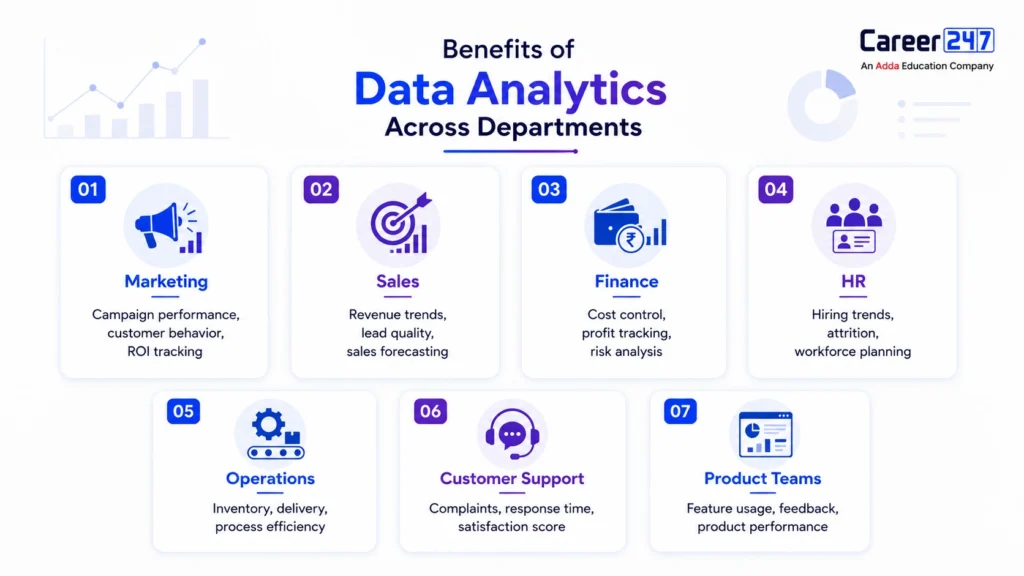
Benefits of Data Analytics Across Departments
Data analytics is useful because it supports almost every department in an organization. Each team uses data differently, but the goal is the same: better decisions and improved performance.
| Department | How Data Analytics Helps |
|---|---|
| Marketing | Tracks campaign performance, customer behavior, conversions, and ROI |
| Sales | Analyzes revenue trends, lead quality, product performance, and sales forecasts |
| Finance | Monitors expenses, revenue, profit margins, risks, and budget variance |
| HR | Tracks hiring trends, employee performance, attrition, and workforce planning |
| Operations | Improves inventory, delivery, resource allocation, and process efficiency |
| Customer Support | Analyzes complaints, response time, satisfaction scores, and service quality |
| Product Teams | Studies user behavior, feature usage, feedback, and product performance |
This cross functional value is one of the biggest business benefits of data analytics.
Challenges in Getting Full Benefits from Data Analytics
Even though data analytics is powerful, businesses may not get full value if they do not use it correctly.
Common challenges include:
- Poor data quality
- Lack of skilled analysts
- Data stored in disconnected systems
- Over complicated dashboards
- Wrong metrics
- Lack of business context
- Insights not converted into action
To get real benefits, companies need clean data, the right tools, skilled people, and a culture of data driven decision making.
Data Analytics Benefits for Small Businesses
Data analytics is not only for large companies. Small businesses can also use analytics to improve performance.
Small businesses can use data analytics to:
- Track sales
- Understand customers
- Improve pricing
- Reduce unnecessary expenses
- Monitor marketing results
- Identify best selling products
- Improve customer retention
Even simple tools like Excel, Google Analytics, CRM reports, and dashboard tools can help small businesses make better decisions.
Data Analytics Benefits for Learners and Career Growth
The growth of data analytics has also created strong career opportunities. Businesses need professionals who can work with data, build dashboards, analyze trends, and explain insights.
Learning data analytics helps learners build skills in:
- Excel
- SQL and Python
- Tableau and Power BI
- Statistics and Data visualization
- Business problem solving
For learners who want a structured path, a practical data analytics course can help connect concepts with real world projects. Career247’s Data Analytics Course focuses on tools like Excel, SQL, Python, Tableau, dashboards, and real business datasets, helping learners build job ready analytics skills through guided practice.
Best Practices to Get More Value from Data Analytics
To maximize the benefits of data analytics, businesses should:
- Define clear business goals
- Use clean and reliable data
- Track meaningful KPIs
- Build simple and actionable dashboards
- Train teams to understand data
- Use analytics regularly, not occasionally
- Turn insights into decisions and actions
Data analytics is most useful when it is connected to business outcomes.
So the conclusion is....
The benefits of data analytics are clear for both businesses and learners.
- For businesses, analytics improves decision making, customer understanding, revenue growth, cost control, risk management, and forecasting.
- For learners, it opens career opportunities in data analytics, business intelligence, reporting, and decision making roles.
- As businesses continue to generate more data, the ability to analyze and interpret that data will become even more valuable.
Data analytics is not just a technical skill; it is a practical business skill that helps organizations grow smarter, faster, and more efficiently.
Frequently Asked Questions
Answer:
The main benefits of data analytics include better decision making, improved customer understanding, cost reduction, revenue growth, risk management, forecasting, and improved business performance.
Answer:
Data analytics is important because it helps businesses make fact based decisions, understand customers, track performance, reduce risks, and identify growth opportunities.
Answer:
Data analytics improves decision making by providing accurate insights from real data. It helps businesses compare options, identify trends, and choose strategies based on evidence instead of assumptions.
Answer:
Small businesses can use data analytics to track sales, understand customers, improve marketing, manage expenses, and identify profitable products or services.
Answer:
Marketing, sales, finance, HR, operations, customer support, and product teams all benefit from data analytics because each department uses data to improve performance and decisions.
Answer:
Yes, data analytics is a strong career skill because businesses across industries need professionals who can analyze data, build dashboards, interpret trends, and support data driven decisions.