Find the Longest Palindrome in an Array using Python
Longest Palindrome in an Array
Here, in this page we will discuss the program to find the longest palindrome in an array in python programming language, we will discuss two different methods to find the longest palindromic element in the given array.
Here in this page we will discuss the following methods to find the longest palindromic number.
- Method 1 : Using Naive Approach
- Method 2 : Using Sorting
Method 1 :
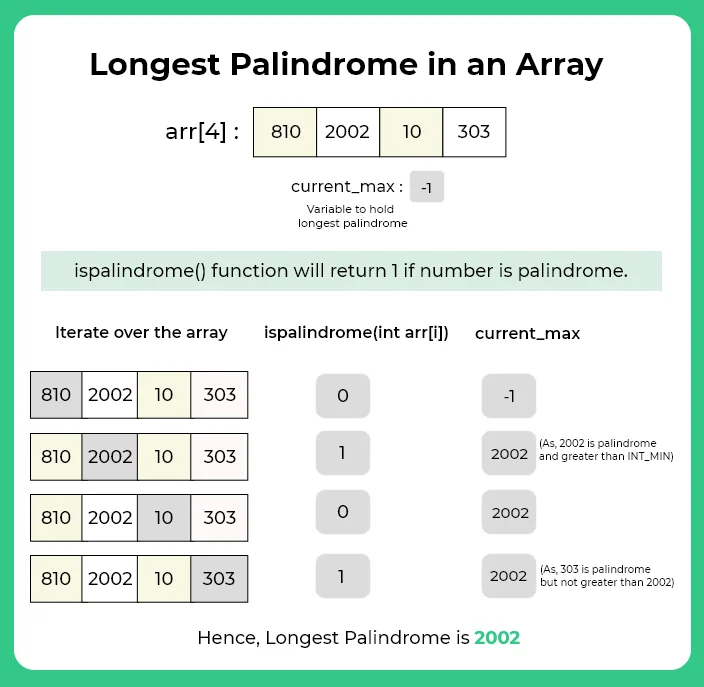
- Create a function ispalindrome(int n), it will return 1 if the passing number is palindrome otherwise return 0.
- Inside the main function, create a variable say res = -1, that hold the maximum palindrome number.
- Run a loop from [0, n), and check if(ispalindrome(arr[i]) && res<arr[i]), then set res = arr[i].
- Print the value of res.
Method 1 : Code in Python
Run
# Function to check if n is palindrome
def isPalindrome(n):
divisor = 1
while (int(n / divisor) >= 10):
divisor *= 10
while (n != 0):
leading = int(n / divisor)
trailing = n % 10
if (leading != trailing):
return False
n = int((n % divisor) / 10)
divisor = int(divisor / 100)
return True
# Function to find the largest palindromic element
def largestPalindrome(arr, n):
currentMax = -1
for i in range(0, n, 1):
if (arr[i] > currentMax and isPalindrome(arr[i])):
currentMax = arr[i]
return currentMax
# Driver Code
arr = [1, 232, 5545455, 909090, 161]
n = len(arr)
# print required answer
print(largestPalindrome(arr, n))Output
5545455
Prime Course Trailer
Related Banners
Get PrepInsta Prime & get Access to all 200+ courses offered by PrepInsta in One Subscription
Method 2 :
In this method we first sort the array and then start traversing the array from end, and return the element that satisfy the condition, that it is palindrome.
- Sort the array using inbuilt sort() function.
- Start traversing from end of the array,
- Print the element if it is palindrome.
- If no element found then print -1.
About sort() function in Python
The sort() method is a built-in Python method that, by default, sorts the list in ascending order.However, you can modify the order from ascending to descending by specifying the sorting criteria.
array_name.sort(reverse=True|False, key=myFunc) , this will sort the array in descending order.
Method 2 : Code in Python
Run
# Function to check if n is palindrome
def isPalindrome(n):
divisor = 1
while (int(n / divisor) >= 10):
divisor *= 10
while (n != 0):
leading = int(n / divisor)
trailing = n % 10
if (leading != trailing):
return False
n = int((n % divisor) / 10)
divisor = int(divisor / 100)
return True
# Function to find the largest palindromic element
def largestPalindrome(A, n) :
# Sort the array
A.sort()
for i in range(n - 1, -1, -1) :
# If number is palindrome
if (isPalindrome(A[i])) :
return A[i]
# If no palindromic number found
return -1
# Driver Code
arr = [1, 232, 5545455, 909090, 161]
n = len(arr)
# print required answer
print(largestPalindrome(arr, n))Output
5545455
Login/Signup to comment

arr = [33, 44, 2002, 9823, 8930, 3980, 3]
l = 0
for i in arr:
s=str(i)
if s==s[::-1]:
if len(s)>len(str(l)):
l=i
print(l)
arr=[int(p) for p in input().split()]
long=0
for i in arr:
s=str(i)
if s==[::-1]:
if i>long:
long=i
if long!=-1:
print(“longest palindrome”,long)
else :
print(“no longest palindrome “)
arr=[int(p) for p in input().split()]
long=-1
for i in arr:
temp=i
rev=0
while temp>0:
digit=temp%10
rev=rev*10+digit
temp=temp//10
if rev==i:
if i>long:
long=rev
if long!=-1:
print(“longest palindrome”,long)
else :
print(“no longest palindrome “)
a =[123,1121211,2002,731,4000]
b =[]
for num in a:
c=int(str(num)[: :-1])
if num == c:
b.append(num)
print(max(b))