
Will AI Replace Data Scientists?
Understanding the Future of Data Science Careers
Will AI replace Data Scientists? It’s one of the biggest questions being asked by students, professionals, and career switchers today.
With tools like ChatGPT, AI agents, AutoML platforms, and Large Language Models becoming more powerful every month, it’s easy to understand why many people are concerned. AI can now write code, generate reports, analyze datasets, build machine learning models, and even suggest business insights in seconds. So, does this mean Data Scientists will become obsolete?
Not quite. The reality is far more interesting. AI is transforming the way Data Scientists work, but it is not eliminating the need for them. In fact, professionals who learn how to work with AI may become even more valuable in the years ahead.

Why Are People Asking If AI Will Replace Data Scientists?
The rapid growth of Generative AI has changed how organizations approach data and analytics.
Today’s AI tools can:
- Generate Python code
- Write SQL queries
- Build dashboards
- Create data visualizations
- Summarize datasets
- Recommend machine learning models
As these capabilities improve, many assume that Data Scientists may no longer be needed.
However, this assumption focuses only on the technical side of the role and ignores the bigger picture.
What Does a Data Scientist Actually Do?
Many people think Data Scientists spend most of their time building machine learning models.
In reality, their responsibilities are much broader.
A Data Scientist typically works on:
- Understanding business problems
- Collecting and preparing data
- Feature engineering
- Statistical analysis
- Machine learning development
- Model evaluation
- Communicating insights
- Supporting business decisions
The real value of a Data Scientist lies in connecting data with business outcomes.
That is much harder to automate than writing a few lines of code.

What AI Can Already Automate....
1. Code Generation
Modern AI tools can generate Python scripts, SQL queries, and data processing workflows within seconds.
This significantly improves productivity.
2. Data Cleaning Support
AI can identify:
- Missing values
- Duplicate records
- Data inconsistencies
- Formatting issues
It can also suggest methods to clean and prepare data.
3. Exploratory Data Analysis
AI powered tools can quickly:
- Detect patterns
- Generate summaries
- Create visualizations
- Identify anomalies
Tasks that once took hours can now be completed much faster.
4. Automated Machine Learning
AutoML platforms can:
- Select algorithms
- Train models
- Tune hyperparameters
- Compare performance metrics
This reduces manual effort during model development.
What AI Cannot Fully Replace....
1. Understanding Business Context
Data Science is not just about data.
Every analysis must align with:
- Business objectives
- Market conditions
- Customer behavior
- Organizational priorities
AI can process information, but humans provide context.
2. Asking the Right Questions
Before analysis begins, someone must decide:
- What problem should be solved?
- What data is relevant?
- Which metrics matter most?
This process requires critical thinking and domain knowledge.
3. Stakeholder Communication
Data Scientists regularly collaborate with:
- Executives
- Product teams
- Marketing departments
- Business leaders
Explaining findings, influencing decisions, and managing expectations remain deeply human skills.
4. Ethical Decision Making
AI systems can introduce:
- Bias
- Privacy concerns
- Fairness issues
Human oversight is essential to ensure responsible and ethical AI deployment.
How AI Is Changing Data Science Careers
Instead of replacing Data Scientists, AI is reshaping their role.
As repetitive tasks become automated, professionals can focus on:
- Strategic decision making
- Advanced analytics
- Business problem solving
- Innovation
- AI governance
Think of AI as a powerful assistant rather than a replacement.
The most successful Data Scientists are increasingly becoming AI enabled professionals.
Will Entry Level Data Science Jobs Be Affected?
This is where the biggest changes are likely to happen.
Tasks involving:
- Basic reporting
- Simple dashboard creation
- Routine coding
- Standard model building
are becoming easier to automate.
As a result, recruiters are raising expectations for entry level candidates.
Today’s employers increasingly prefer professionals who understand:
- Data Science
- Machine Learning
- Deep Learning
- Generative AI
- Business Analytics
rather than candidates who only know basic tools.
Data Science Skills That Will Remain Valuable
If you’re worried about AI replacing jobs, focus on developing skills that complement AI rather than compete with it.
- Machine Learning: Understanding how models work remains a highly valuable skill.
- Deep Learning: AI applications continue to rely heavily on neural networks and deep learning architectures.
- Natural Language Processing (NLP): NLP is becoming increasingly important due to the rise of Large Language Models.
- Generative AI: Professionals who know how to use AI effectively will have a significant advantage.
- Business Understanding: Connecting technical solutions to business goals remains difficult to automate.
- Communication Skills: The ability to explain insights clearly is one of the most future-proof skills in Data Science.
AI and Data Scientists Will Work Together
History provides a useful lesson.
- Calculators did not replace accountants.
- Spreadsheets did not eliminate finance professionals.
Similarly, AI is unlikely to replace Data Scientists entirely.
Instead, it will help them:
- Work faster
- Automate repetitive tasks
- Improve productivity
- Focus on higher value work
Organizations will still need professionals who understand data, business strategy, ethics, and decision making.
What Should Aspiring Data Scientists Learn?
Instead of worrying about AI taking over jobs, focus on becoming an AI enabled Data Scientist.
A strong learning roadmap includes:
- Python and SQL
- Statistics
- Machine Learning and Deep Learning
- Natural Language Processing
- Generative AI
- Prompt Engineering
This combination will remain highly relevant as the industry evolves.
So the final thought is….
The real question is not “Will AI replace Data Scientists?” but rather “How will AI change the role of Data Scientists?”
AI is automating repetitive tasks, improving productivity, and making analytics more accessible.
At the same time, it is increasing the value of professionals who can combine technical expertise with business understanding, critical thinking, and communication skills.
The future belongs to Data Scientists who learn how to work alongside AI, not compete against it. As businesses continue investing in data, analytics, and artificial intelligence, the demand for skilled professionals who can bridge technology and business is expected to remain strong.
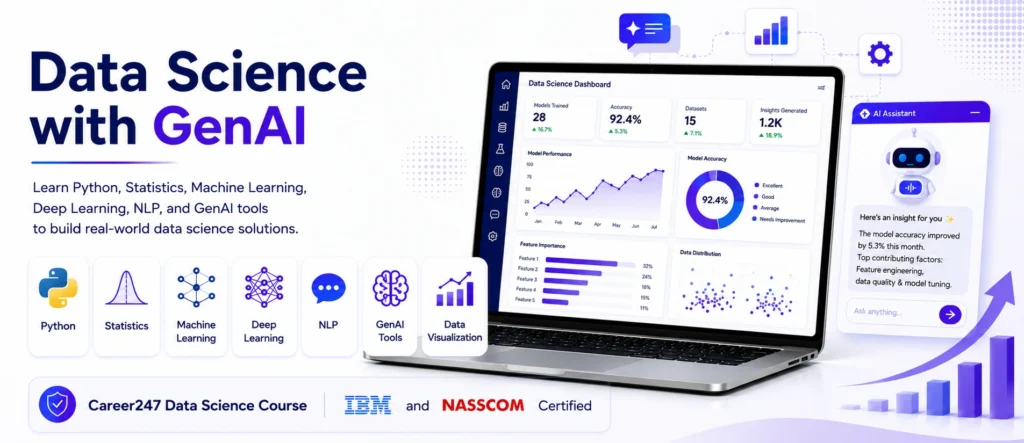
Career247’s Data Science and Machine Learning with GenAI Certification Powered by IBM helps learners build practical expertise in Python, SQL, Statistics, Machine Learning, Deep Learning, NLP, and Generative AI.
Frequently Asked Questions
Answer:
No. AI can automate certain technical tasks, but human expertise is still needed for business understanding, problem solving, communication, and strategic decision making.
Answer:
Yes. AI can assist with coding, data cleaning, visualization, reporting, and machine learning model development. However, it cannot fully replace human judgment and business context.
Answer:
Yes. Data Science remains one of the fastest growing career fields, especially for professionals who understand AI, Machine Learning, and Generative AI technologies.
Answer:
Machine Learning, Deep Learning, NLP, Generative AI, business analytics, problem solving, and communication skills are expected to remain highly valuable.
Answer:
Learn core Data Science fundamentals, build real world projects, and develop expertise in AI tools that enhance productivity rather than replace human decision making.