
Generative AI for Data Science
How Data Scientists Use ChatGPT and GenAI
Generative AI for Data Science is quickly becoming one of the most discussed topics in the technology industry. Over the last few years, tools like ChatGPT, GitHub Copilot, Gemini, and other large language models have transformed the way professionals work with data, code, and business insights.
Traditionally, Data Scientists spent significant time cleaning data, writing code, building models, creating reports, and communicating findings. While these responsibilities remain important, Generative AI is helping professionals complete many of these tasks faster and more efficiently.

What Is Generative AI?
Generative AI refers to Artificial Intelligence systems that can create new content based on patterns learned from large datasets.
Unlike traditional AI systems that primarily classify or predict outcomes, Generative AI can generate:
- Text
- Images
- Audio
- Code
- Reports
- Summaries
- Business Insights
Popular Generative AI tools include:
- ChatGPT
- Gemini
- Claude
- GitHub Copilot
- DALL-E
These systems use advanced Deep Learning and Transformer architectures to understand prompts and generate human like responses.
Why Generative AI Matters in Data Science
Data Science is not just about building machine learning models. It involves multiple stages including data preparation, analysis, visualization, communication, and decision making.
Generative AI helps accelerate many of these activities.
Benefits of GenAI for Data Science:
- Faster coding and scripting
- Improved productivity
- Automated documentation
- Quicker data exploration
- Better report generation
- Enhanced business communication
- Faster learning for beginners
As organizations continue adopting AI powered workflows, Generative AI is becoming an important skill for modern Data Scientists.

How Data Scientists Use ChatGPT and Generative AI
1. Writing Python Code Faster
Data Scientists frequently work with Python for data analysis and machine learning.
Instead of searching documentation repeatedly, they can use ChatGPT to:
- Generate code snippets
- Explain programming concepts
- Create functions
- Debug errors
- Optimize existing code
This helps reduce development time and improves productivity.
2. Data Cleaning and Preparation
Data cleaning is often one of the most time consuming stages of a project.
Generative AI can assist with:
- Missing value handling
- Data transformation suggestions
- Feature creation ideas
- Data preprocessing workflows
Although human review remains essential, AI can significantly speed up the preparation process.
3. Exploratory Data Analysis (EDA)
Before building models, Data Scientists explore datasets to identify patterns and trends.
Generative AI can help:
- Suggest analytical approaches
- Generate summary statistics
- Explain correlations
- Recommend visualizations
This allows analysts to gain insights more quickly.
4. SQL Query Generation
Many Data Science projects involve retrieving information from databases.
Generative AI can generate SQL queries based on business requirements.
For example: A Data Scientist may ask:
“Show total sales by region for the last six months.”
ChatGPT can generate a starting SQL query that can then be validated and refined.
This makes database interactions more efficient.
5. Machine Learning Model Development
Generative AI can support machine learning workflows by helping with:
- Algorithm selection
- Feature engineering ideas
- Hyperparameter suggestions
- Model evaluation approaches
- Code implementation
While AI does not replace machine learning expertise, it can act as a valuable assistant during development.
6. Report Writing and Documentation
One of the most overlooked aspects of Data Science is communication.
Business stakeholders often need clear explanations rather than technical details.
Generative AI can help create:
- Project summaries
- Executive reports
- Business recommendations
- Documentation
- Presentation content
This allows Data Scientists to communicate insights more effectively.
7. Data Storytelling and Insight Generation
Organizations don’t just want numbers, they want actionable insights.
Generative AI can help transform analytical findings into understandable narratives.
For example: Instead of presenting a chart alone, AI can help explain:
- What happened
- Why it happened
- Potential business impact
- Recommended actions
This improves decision making and stakeholder engagement.
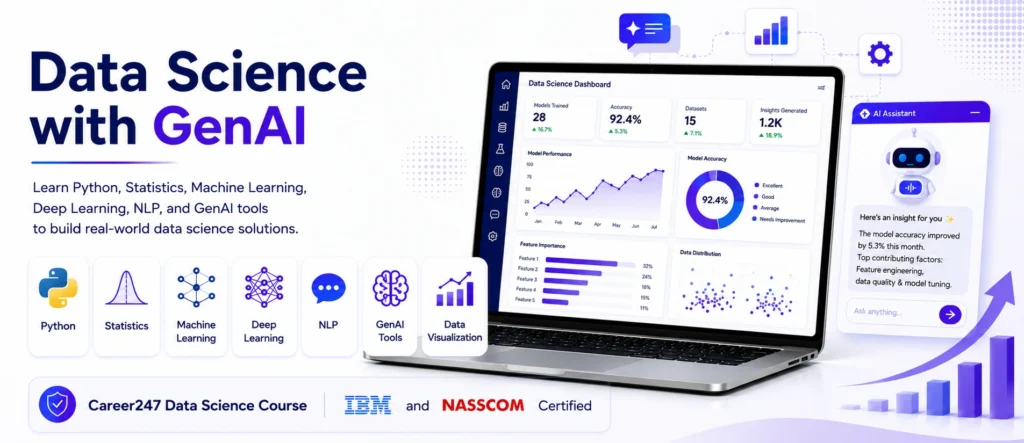
Real World Applications of Generative AI in Data Science
- Customer Churn Prediction: AI helps summarize customer behavior patterns and generate business recommendations.
- Fraud Detection: Generative AI can assist in documenting fraud patterns and creating investigative reports.
- Demand Forecasting: Businesses can use AI generated summaries to understand inventory and sales predictions.
- Resume Screening: Natural Language Processing models combined with Generative AI help analyze resumes and match candidates with job roles.
- Sentiment Analysis: Generative AI can interpret customer opinions and summarize large volumes of feedback quickly.
Generative AI vs Traditional Data Science
| Aspect | Traditional Data Science | Data Science with GenAI |
|---|---|---|
| Coding | Mostly Manual | AI Assisted |
| Documentation | Time Consuming | Automated |
| Report Writing | Manual | AI Generated Drafts |
| Data Exploration | Manual Analysis | AI Assisted Insights |
| Productivity | Standard | Higher |
| Decision Support | Human Driven | Human + AI Collaboration |
The future is not AI replacing Data Scientists. The future is Data Scientists working alongside AI.
Skills Needed for Data Science with GenAI
As Generative AI becomes more common, professionals should develop a combination of technical and AI related skills.
Core Data Science Skills:
- Python
- SQL
- Statistics
- Machine Learning
- Data Visualization
- Data Analytics
GenAI Skills:
- Prompt Engineering
- Large Language Models (LLMs)
- AI Assisted Analytics
- AI Workflow Automation
- Responsible AI Practices
Professionals who combine these skills are likely to have a significant advantage in the evolving job market.
Will Generative AI Replace Data Scientists?
This is one of the most frequently asked questions today.
The short answer is no.
Generative AI can automate certain tasks, but it cannot replace:
- Business understanding
- Domain expertise
- Critical thinking
- Decision making
- Problem solving
- Strategic analysis
Organizations still need professionals who can interpret results, understand business objectives, and make informed recommendations.
Instead of replacing Data Scientists, Generative AI is making them more productive.
Conclusion….
Generative AI is transforming how Data Scientists work by making data analysis, coding, reporting, and communication faster and more efficient. Tools like ChatGPT are helping professionals automate routine tasks and focus more on solving business problems and generating meaningful insights.
As organizations continue investing in AI driven solutions, the combination of Data Science and Generative AI is becoming increasingly important. Professionals who understand both traditional analytics and modern GenAI tools will be better positioned to adapt to changing industry demands and create greater business value.
Build Future Ready AI Skills with Career247
The future of Data Science is increasingly connected with Generative AI.
Career247’s Data Science and Machine Learning with GenAI Certification Powered by IBM is designed to help learners develop expertise in Data Science, Machine Learning, Deep Learning, Natural Language Processing, and Generative AI applications.
Through hands on projects such as: Fraud Detection, Customer Churn Prediction, Demand Forecasting, Resume Screening using NLP, and Sentiment Analysis, learners gain practical experience with industry relevant tools and techniques.
By combining traditional Data Science foundations with modern GenAI capabilities, the program helps aspiring professionals prepare for the next generation of data driven careers.
Frequently Asked Questions
Answer:
Generative AI refers to AI systems that can generate content such as text, code, reports, and insights to support Data Science workflows.
Answer:
Data Scientists use ChatGPT for coding assistance, data analysis, SQL generation, documentation, report writing, and brainstorming analytical approaches.
Answer:
No. Generative AI acts as a productivity tool that helps Data Scientists work more efficiently rather than replacing them.
Answer:
Python, SQL, Statistics, Machine Learning, Data Visualization, Prompt Engineering, and familiarity with Large Language Models are valuable skills.
Answer:
Generative AI helps automate repetitive tasks, improve productivity, accelerate analysis, and enhance business communication, making it an important skill for modern data professionals.