
Data Quality Management Process Explained Step by Step
From Raw Data to Reliable Insights: The Journey Every Organization Must Take
Every organization today sits on mountains of data but not all data is created equal. The difference between a business that thrives on its data and one that struggles with it often comes down to a single discipline: Data Quality Management. Understanding the step-by-step process behind it is not just a technical exercise it is the foundation upon which modern analytics, AI adoption, and intelligent decision-making are built.
Data doesn’t arrive clean. It comes from dozens of sources CRMs, ERPs, third-party APIs, IoT sensors, web forms, and manual inputs each with its own format, logic, and potential for error. Without a structured data quality management process, those errors compound silently, corrupting reports, skewing forecasts, and ultimately misleading the very leaders who depend on data to steer the business.

What Is the Data Quality Management Process?
The data quality management process is a structured, repeatable methodology for identifying, measuring, improving, and sustaining the quality of data across an organization’s systems and workflows. It spans the full data lifecycle from the moment data is created or ingested to how it is stored, transformed, and consumed by analytics and business applications.
Key concepts that fall under this process include:
- Data quality assessment — evaluating current data against defined quality standards
- Data profiling — analyzing data structure, content, and relationships to surface issues
- Data cleansing and enrichment — correcting, standardizing, deduplicating, and completing data
- Data validation — enforcing rules that prevent poor-quality data from entering systems
- Data governance framework — the policies, roles, and accountability structures that sustain quality over time
- Data lineage — tracking where data originates, how it moves, and how it transforms
- Master data management (MDM) — maintaining a single authoritative record for core business entities
- Data observability — continuous monitoring of data pipelines for anomalies, freshness, and completeness
Together, these practices form an end-to-end data quality management system designed for scale, reliability, and trust.
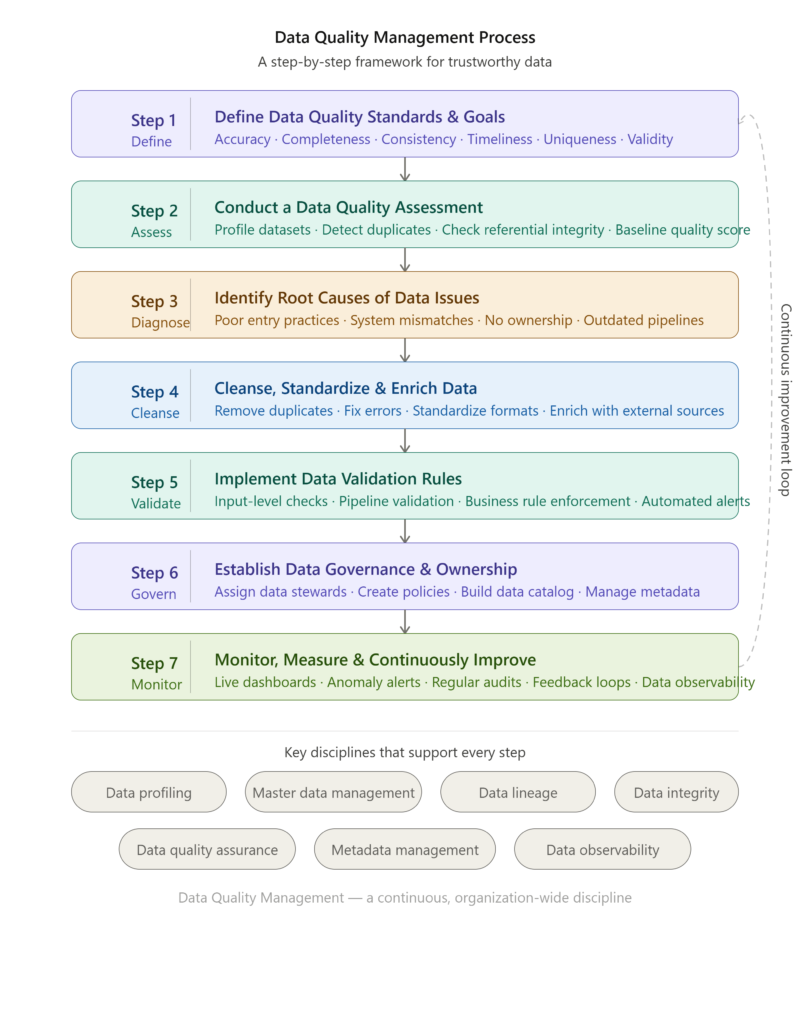


The Step-by-Step Data Quality Management Process
Step 1: Define Data Quality Standards and Goals
Every effective data quality management initiative starts with clarity. Before you can measure or improve quality, you need to define what “good data” means for your organization. This involves establishing data quality dimensions the measurable attributes your data must meet:
- Accuracy — does the data correctly reflect real-world values?
- Completeness — are all required fields populated?
- Consistency — is the same data represented the same way across different systems?
- Timeliness — is the data up to date and available when needed?
- Uniqueness — are there duplicate records distorting your analysis?
- Validity — does the data conform to defined formats, ranges, and business rules?
Defining these standards upfront, in collaboration with both business and technical stakeholders, ensures that quality goals are aligned with actual business needs not just IT preferences.
Step 2: Conduct a Data Quality Assessment
Once standards are defined, the next step is to assess where your data currently stands. A thorough data quality assessment involves auditing key datasets across your enterprise systems databases, data warehouses, CRMs, ERPs, and third-party feeds.
During this phase, teams use data profiling tools to automatically analyze:
- Column-level statistics (null rates, value distributions, min/max ranges)
- Duplicate detection across records and systems
- Referential integrity between related tables
- Format inconsistencies and pattern violations
The output is a clear picture of your data’s health a baseline that makes it possible to prioritize remediation efforts and track improvement over time.
Step 3: Identify Root Causes of Data Quality Issues
Fixing symptoms without addressing root causes is a losing battle. Once issues are surfaced through profiling, the next critical step is root cause analysis. Common culprits include:
- Poor data entry practices — manual inputs without validation rules or dropdown constraints
- System integration failures — mismatched schemas when data moves between platforms
- Lack of ownership — no clear data steward accountable for specific datasets
- Outdated data pipelines — ETL processes that haven’t kept pace with changing source systems
- No data governance policies — teams creating and modifying data without standards or oversight
Understanding root causes allows organizations to implement targeted fixes rather than repeatedly cleaning the same problems downstream.
Step 4: Cleanse, Standardize, and Enrich Data
This is where the hands on work of data cleansing and enrichment takes place. Based on the findings from the assessment and root cause analysis, data teams systematically:
- Remove or merge duplicate records to create clean, unified entities
- Correct inaccurate values flagged during profiling or reported by business users
- Standardize formats date formats, phone number structures, address conventions, and naming conventions
- Fill in missing values using logical defaults, derived calculations, or third-party enrichment sources
- Enrich records with additional context from external data providers industry data, demographic information, firmographic attributes
Master data management plays a central role here ensuring that core entities like customers, suppliers, and products have a single, authoritative, deduplicated record that all systems reference consistently.
Step 5: Implement Data Validation Rules
Cleansing data after the fact is reactive. The goal of a mature data quality management process is to prevent poor-quality data from entering systems in the first place. This is achieved through data validation rules implemented at key ingestion points:
- Input-level validation on forms and APIs (format checks, mandatory fields, allowed value lists)
- Pipeline-level validation in ETL/ELT workflows to catch schema violations before data lands in the warehouse
- Business rule validation that flags records which don’t conform to logical constraints (e.g., order dates that precede customer registration dates)
Automated validation shifts the organization from reactive data firefighting to proactive data quality assurance saving enormous amounts of time and rebuilding trust in data systems.
Step 6: Establish Data Governance and Ownership
Technology alone cannot sustain data quality. A robust data governance framework is essential to maintain what has been built. This involves:
- Assigning data stewards — business-side owners who are accountable for the quality of data within their domain
- Creating data policies — documented rules for how data should be created, updated, shared, and retired
- Building a data catalog — a searchable inventory of data assets with definitions, ownership, and quality scores
- Enabling metadata management — capturing the context around data so teams understand what it means and how it should be used
Governance transforms data quality management from a project into a permanent organizational capability.
Step 7: Monitor, Measure, and Continuously Improve
Data quality is not a destination it is an ongoing journey. The final step is establishing data observability practices that keep a continuous pulse on the health of your data:
- Automated monitoring dashboards that track quality KPIs over time
- Alerting systems that notify data stewards when anomalies, freshness failures, or volume drops are detected
- Regular data quality audits tied to business reporting cycles
- Feedback loops between analytics consumers and data producers to surface quality issues proactively
By closing the loop between data production and data consumption, organizations build a self-improving data quality management system that gets better with every iteration.
Final Thoughts
A well-executed Data Quality Management process is the difference between an organization that talks about being data-driven and one that actually is. By following a structured, step-by-step approach from defining standards and profiling data, to cleansing, governing, and continuously monitoring businesses can transform data from a liability into their most powerful competitive asset.
The organizations winning in today’s market are not necessarily those with the most data. They are those with the best data. Start your data quality management journey today, and build the foundation your analytics strategy truly deserves.
Frequently Asked Questions
The most widely recognized dimensions of data quality are accuracy, completeness, consistency, timeliness, uniqueness, and validity. Each dimension measures a different aspect of how trustworthy and usable data is for business and analytics purposes. Most organizations prioritize different dimensions depending on their use case for example, a healthcare provider may prioritize accuracy and completeness above all, while a real-time fraud detection system may place timeliness at the top of its requirements.
Answer:
Data Quality Management focuses specifically on the processes and tools used to measure, improve, and maintain the quality of data including profiling, cleansing, validation, and monitoring. Data governance, on the other hand, is the broader framework of policies, roles, standards, and accountability structures that define how data is managed across the entire organization. Think of data governance as the rulebook and organizational structure, while data quality management is the active execution of keeping data clean and trustworthy within that structure.
Answer:
Poor data quality directly undermines the reliability of business analytics. When reports are built on inaccurate, incomplete, or inconsistent data, decision-makers act on a distorted view of reality leading to misguided strategy, wasted marketing spend, inaccurate financial forecasting, and missed growth opportunities. Over time, persistent data quality issues also erode confidence in analytics tools and data teams, pushing organizations back toward gut-feel decision-making instead of evidence-based strategy.
Answer:
There is a wide ecosystem of data quality tools available today, ranging from enterprise-grade platforms to open-source solutions. Popular options include Informatica Data Quality, Talend Data Fabric, IBM InfoSphere QualityStage, Microsoft Purview, Great Expectations (open source), and Monte Carlo for data observability. The right choice depends on your data stack, volume, and maturity level. Most modern data teams combine a dedicated quality tool with a data catalog solution and pipeline monitoring for end-to-end coverage.
Answer:
The timeline for implementing a data quality management process varies significantly depending on the size of the organization, the complexity of its data landscape, and the current state of data maturity. A focused initial assessment and cleansing effort for a single critical dataset can be completed in four to eight weeks. Building a full, enterprise-wide data governance framework with automated monitoring, stewardship roles, and a data catalog typically takes six to eighteen months. The key is to start small, demonstrate value quickly, and expand incrementally rather than attempting a big-bang transformation.