
Can Non Technical Students Learn Data Science?
Data Science Course for Non Technical Students
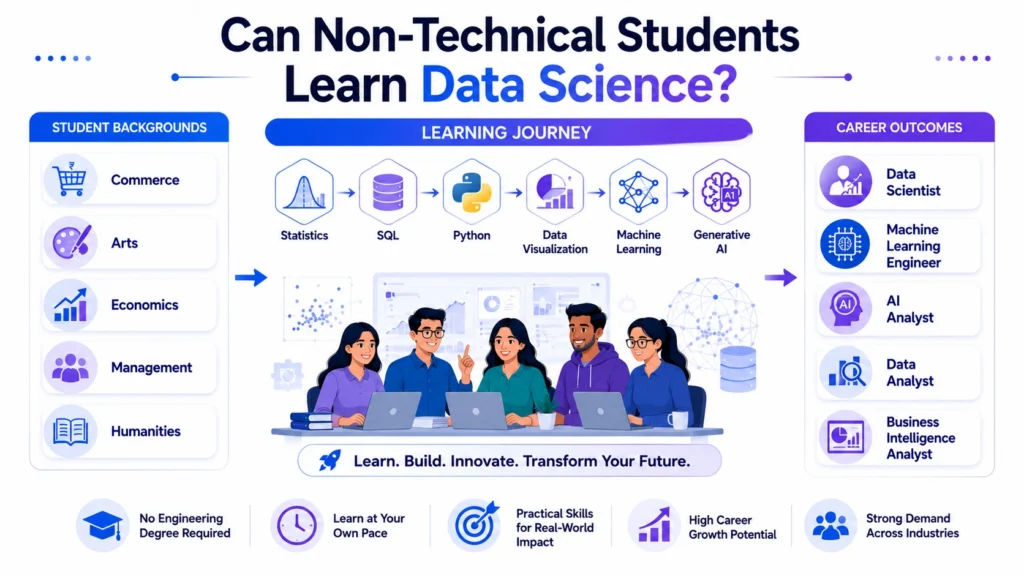
Can non technical students learn data science? If you’ve ever wondered whether a Commerce, Arts, Economics, Management, or Humanities background can lead to a career in Data Science, you’re not alone.
Many people assume Data Science is reserved for Computer Science graduates or experienced programmers. The reality is more nuanced.
While Data Science does involve technical concepts such as programming, statistics, machine learning, and artificial intelligence, it is not limited to engineering students. In fact, professionals from finance, economics, marketing, healthcare, and business backgrounds are increasingly entering the field.
What Does a Data Scientist Actually Do?
A Data Scientist uses data to solve business problems, identify patterns, make predictions, and support decision-making.
Their responsibilities often include:
- Collecting and preparing data
- Analyzing trends and patterns
- Building predictive models
- Applying machine learning algorithms
- Creating visualizations and reports
- Communicating insights to stakeholders
For example, a Data Scientist might help:
- e-commerce company predict future sales
- bank detect fraudulent transactions
- healthcare provider forecast patient demand
- streaming platform recommend content to users
The goal is not just to analyze data but to uncover insights that can influence future decisions.
Is Data Science Only for Engineers?
One of the biggest misconceptions about Data Science is that only engineers can succeed in it.
The truth is that many Data Science skills can be learned regardless of academic background.
Different backgrounds often bring different strengths:
1. Commerce Students
- Business understanding
- Financial analysis
- Market knowledge
2. Economics Students
- Statistics
- Quantitative reasoning
- Forecasting concepts
3. Management Students
- Business strategy
- Problem solving
- Decision making
4. Arts and Humanities Students
- Communication
- Research
- Storytelling
- Critical thinking
Technical skills can be learned. Analytical thinking and curiosity are often harder to teach.
What Skills Do Non Technical Students Need for Data Science?
You do not need to master everything on day one.
A better approach is to build skills step by step.
1. Statistics Fundamentals
Statistics forms the foundation of Data Science.
Main concepts include:
- Probability
- Mean and Median
- Hypothesis Testing
- Correlation
- Regression
- Probability Distributions
You don’t need advanced mathematics initially, but you should be comfortable interpreting data.
2. Python Programming
Python is the most widely used programming language in Data Science.
Common applications include:
- Data Analysis
- Data Cleaning
- Automation
- Machine Learning
- AI Development
The good news is that Python is considered beginner friendly compared to many programming languages.
3. SQL
Before analyzing data, you need to access it.
SQL helps Data Scientists:
- Retrieve data
- Filter records
- Join tables
- Analyze business information
SQL remains one of the most important skills across analytics and data science roles.
4. Data Visualization
Insights become more valuable when people can understand them.
Popular tools include:
- Tableau
- Power BI
- Python Visualization Libraries
Visualization helps transform complex data into actionable business insights.
5. Machine Learning
Machine Learning allows systems to learn patterns from data and make predictions.
Examples include:
- Sales Forecasting
- Fraud Detection
- Recommendation Systems
- Customer Churn Prediction
This is often the stage where learners transition from analytics into Data Science.
Data Analytics vs Data Science for Non Technical Students
Many beginners confuse these two fields.
| Aspect | Data Analytics | Data Science |
|---|---|---|
| Focus | Understanding Past Data | Predicting Future Outcomes |
| Programming Requirement | Moderate | Higher |
| Statistics Requirement | Moderate | Higher |
| Machine Learning | Limited | Core Skill |
| Learning Curve | Easier | More Advanced |
| Typical Tools | Excel, SQL, Power BI | Python, SQL, Machine Learning |
For many non technical learners, Data Analytics serves as an excellent entry point before moving into Data Science.
Common Challenges Non Technical Students Face
- Fear of Coding: Most beginners worry about programming. In reality, coding becomes easier when learned alongside practical projects.
- Mathematics Anxiety: You do not need advanced calculus to start learning Data Science. Focus first on applied statistics and data interpretation.
- Information Overload: Many learners try to study Python, SQL, Machine Learning, AI, and Statistics simultaneously. A structured roadmap works far better.
- Lack of Practical Experience: Employers often value projects and problem solving ability as much as theoretical knowledge.
Beginner Friendly Data Science Roadmap
A practical roadmap could look like this:
- Statistics Fundamentals
- Excel for Analysis
- SQL
- Python Basics
- Data Visualization
- Exploratory Data Analysis
- Machine Learning Fundamentals
- Generative AI Concepts
- Real World Projects
- Portfolio Development
Learning progressively helps reduce overwhelm and build confidence.
So the final verdict is….
A non technical background is not a barrier to learning Data Science. While the field requires commitment and continuous learning, many successful professionals have entered Data Science from Commerce, Economics, Management, and other non engineering disciplines.
The journey may take time, but with the right roadmap, practical projects, and consistent practice, non technical students can build the skills needed to work in one of today’s fastest-growing fields.
Build Job Ready Data Science Skills with Career247
Data Science is most effectively learned through a combination of theory, practical projects, and real world applications.
Career247’s Data Science and Machine Learning with GenAI Certification Powered by IBM helps learners build skills in Statistics, Python, SQL, Machine Learning, Data Visualization, Prompt Engineering, Generative AI, and business problem solving.
Through hands on projects and industry relevant learning, students from both technical and non technical backgrounds can develop the skills required for modern Data Science and AI roles.
Frequently Asked Questions
Answer:
Yes. Students from Commerce, Arts, Management, Economics, and other non-technical backgrounds can learn Data Science through a structured approach that combines statistics, programming, and practical projects.
Answer:
Yes, programming is an important part of Data Science. Python is the most commonly used language and is beginner friendly for most learners.
Answer:
Generally, yes. Data Science involves machine learning, predictive modeling, and deeper statistical concepts, making it more advanced than Data Analytics.
Answer:
Absolutely. Commerce students often bring valuable business knowledge that complements technical Data Science skills.
Answer:
Start with statistics, SQL, and Python fundamentals before moving into machine learning, AI, and real world projects.