
Essential Tools and Libraries in Python for Data Science Projects
Essential Tools and Libraries in Python for Data Science Projects
The success of modern analytics projects depends heavily on the tools used to collect, process, visualize, and interpret information. Today, organizations across industries rely on Python for Data Science because of its extensive ecosystem of libraries that simplify complex analytical tasks.
Whether professionals are building machine learning models, performing statistical analysis, or creating interactive dashboards, the right tools can significantly improve productivity and accuracy. Understanding these essential libraries is a crucial step for anyone looking to excel in data analytics and artificial intelligence.
Why Specialized Libraries Matter
Data driven projects often involve handling massive volumes of information, performing complex mathematical calculations, and building predictive models. Developing every required function from scratch would not only consume significant time but also increase the chances of coding errors and inconsistencies. This is where specialized Python libraries become essential.
Python offers a vast collection of well developed libraries that simplify data analysis, machine learning, visualization, and statistical computing. These libraries are created and maintained by global developer communities, ensuring reliability, continuous improvements, and compatibility with modern technologies.
Key benefits of specialized libraries include:
- Faster project development through ready to use functions and tools
- Reduced coding effort and improved productivity
- Pre-built analytical and statistical algorithms
- Better performance when processing large datasets
- Enhanced code readability and maintainability
- Easier collaboration among developers, analysts, and data scientists
- Strong community support and extensive documentation
Another major advantage is consistency. Standardized libraries allow teams to follow common workflows, making projects easier to manage, update, and scale over time. Organizations can also integrate these libraries with cloud platforms, databases, and business intelligence tools to create complete data solutions.
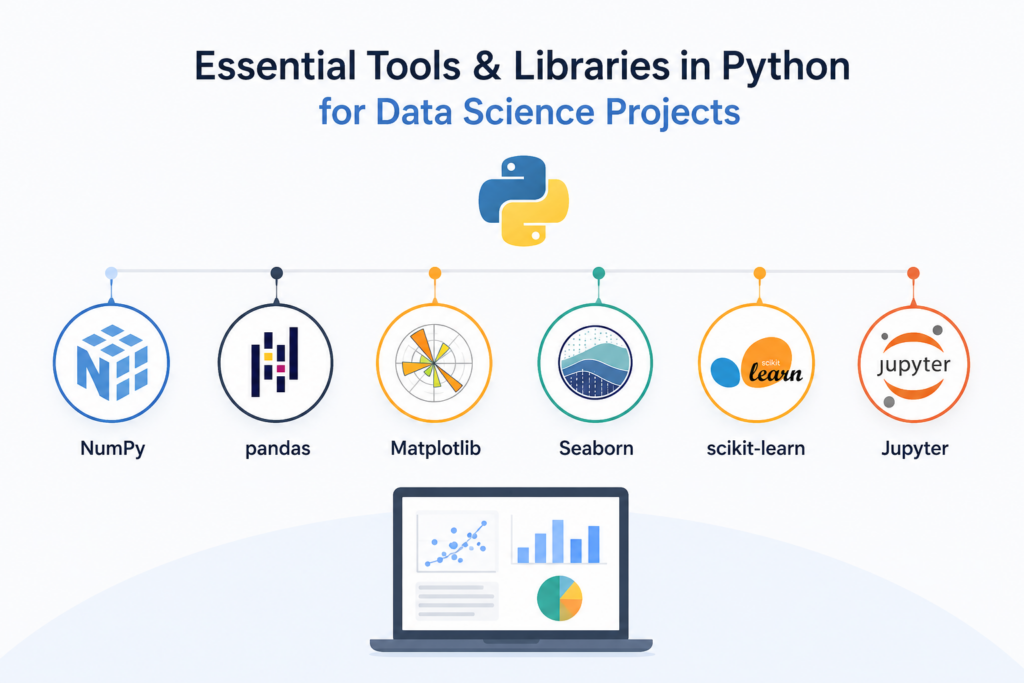
Popular libraries such as Pandas, NumPy, Matplotlib, Scikit learn, and TensorFlow provide specialized capabilities for data manipulation, visualization, machine learning, and artificial intelligence. By leveraging these tools, professionals can focus more on solving business problems and generating insights rather than building foundational components from the ground up.
This rich ecosystem is one of the primary reasons why Python for Data Science remains the preferred choice for researchers, analysts, and organizations worldwide. The availability of powerful libraries enables faster innovation, more accurate analysis, and the efficient development of scalable data driven applications.

Pandas The Foundation of Data Analysis
Pandas is one of the most widely used libraries in modern analytics workflows and is considered the backbone of data manipulation in Python. It provides powerful data structures such as DataFrames and Series that make it easier to organize, process, and analyze structured information from various sources, including spreadsheets, databases, and CSV files.
Organizations use Pandas to transform raw datasets into meaningful business insights. Its flexible functionality allows analysts to clean inconsistent data, perform calculations, and generate reports with minimal effort.
Common applications include:
- Data cleaning
- Data filtering
- Merging datasets
- Handling missing values
- Creating summary reports
Pandas also supports time-series analysis, grouping operations, and advanced data transformations, making it an essential tool for business intelligence, financial analysis, and operational reporting. For professionals working with large volumes of information, Pandas significantly improves productivity and analytical efficiency.
NumPy High Performance Numerical Computing
Numerical calculations form the foundation of many analytical and machine learning projects. NumPy is a powerful library designed to perform mathematical and scientific computations quickly and efficiently. It introduces multidimensional arrays that enable faster processing compared to traditional Python data structures.
Its optimized architecture allows users to handle large datasets while maintaining excellent computational performance. NumPy is widely used in scientific research, engineering applications, and predictive analytics.
Benefits of NumPy include:
- Faster mathematical operations
- Efficient memory usage
- Advanced statistical calculations
- Support for scientific computing
- Integration with numerous analytical libraries
Many advanced machine learning frameworks and artificial intelligence platforms rely on NumPy as their computational backbone because of its speed, reliability, and scalability.
Matplotlib for Data Visualization
Data becomes far more valuable when it can be easily understood and communicated. Matplotlib is one of the most popular visualization libraries that helps transform complex numerical information into meaningful charts and graphs.
Visualization plays a crucial role in identifying patterns, trends, and anomalies within datasets. Businesses often use visual reports to support strategic planning and decision-making processes.
Popular visualization types include:
- Line charts
- Bar graphs
- Scatter plots
- Histograms
- Pie charts
Matplotlib offers extensive customization options, allowing analysts to create professional-quality visualizations suitable for presentations, reports, and dashboards. Effective visual storytelling helps stakeholders understand key insights quickly and accurately.
Seaborn for Advanced Visual Analytics
Seaborn is built on top of Matplotlib and provides a more user friendly approach to creating sophisticated statistical visualizations. It simplifies the process of generating attractive charts while reducing the amount of code required.
The library is particularly useful for exploratory data analysis, where analysts need to identify relationships, distributions, and patterns within datasets.
Key advantages include:
- Attractive chart designs
- Statistical visualizations
- Correlation analysis
- Distribution plots
- Heatmaps
Seaborn enables analysts to present findings in a visually appealing and professional manner. When working on Python for Data Science projects, it helps communicate complex analytical results more effectively to technical and non technical audiences.
Scikit learn for Machine Learning Development
Scikit learn is one of the most trusted machine learning libraries available in the Python ecosystem. It provides a comprehensive collection of algorithms and tools for building predictive models and analyzing data.
Its simple interface makes machine learning accessible even for beginners while offering sufficient flexibility for advanced practitioners. Businesses use Scikit-learn to solve a wide range of predictive and classification problems.
Common use cases include:
- Classification models
- Regression analysis
- Clustering techniques
- Recommendation systems
- Customer segmentation
The library also includes tools for model evaluation, feature selection, and data preprocessing. Its extensive documentation and strong community support have made it a preferred choice for machine learning development.
TensorFlow for Artificial Intelligence Applications
TensorFlow is a powerful open-source framework developed to support artificial intelligence and deep learning projects. It enables organizations to build intelligent systems capable of processing large amounts of data and making data-driven predictions.
The framework is highly scalable and can run efficiently across CPUs, GPUs, and cloud computing environments, making it suitable for enterprise-level AI applications.
Organizations use TensorFlow for:
- Image recognition
- Natural language processing
- Neural networks
- Deep learning models
- Intelligent automation
From virtual assistants to recommendation engines and predictive analytics systems, TensorFlow powers many modern AI solutions used across industries worldwide.
PyTorch for Research and Innovation
PyTorch has become one of the fastest-growing deep learning frameworks, particularly within research and academic communities. Its dynamic computational graph and flexible architecture allow developers to experiment with models more efficiently.
Researchers often prefer PyTorch because it simplifies model development and debugging, enabling rapid innovation and testing of new ideas.
Advantages include:
- Easy model customization
- Faster prototyping
- Strong deep learning support
- Research friendly architecture
- Growing industry adoption
Today, many organizations are adopting PyTorch for production environments as well, thanks to its scalability, performance, and extensive deep learning capabilities.
Jupyter Notebook for Interactive Development
Jupyter Notebook has transformed the way analysts, researchers, and data scientists work with data. It provides an interactive environment where users can combine executable code, visualizations, explanations, and results within a single document.
This integrated approach makes projects easier to understand, reproduce, and share among team members.
Key benefits include:
- Interactive coding
- Real time visualization
- Easy project sharing
- Better collaboration
- Improved learning experience
Jupyter Notebook is widely used for experimentation, training, data exploration, and model development. It serves as a central workspace for many Python for Data Science projects.
SQL Integration for Data Management
While analytical libraries provide powerful processing capabilities, much of an organization’s data is stored in databases. SQL integration enables analysts to efficiently retrieve, manage, and manipulate information before performing advanced analysis.
Combining database management skills with Python allows professionals to create end-to-end analytical workflows that support business intelligence and decision-making.
Benefits include:
- Faster data access
- Efficient storage management
- Better reporting capabilities
- Streamlined analytics pipelines
- Improved business intelligence processes
SQL and Python work together to create powerful data ecosystems. Professionals who understand both technologies can extract valuable insights more effectively and contribute to the development of scalable data driven solutions.
Choosing the Right Tool for Your Project
One of the greatest strengths of the Python ecosystem is the availability of specialized tools designed for different stages of the data analysis and machine learning lifecycle. However, not every library is suitable for every task. Selecting the right tool depends on several factors, including project objectives, dataset size, computational requirements, and the level of analytical complexity involved.
A well-planned technology stack can significantly improve productivity, reduce development time, and enhance the overall performance of a project. By understanding the strengths and limitations of each library, professionals can make informed decisions and create more efficient workflows.
Before selecting a tool, consider the following factors:
- Type and volume of data being processed
- Complexity of analytical requirements
- Machine learning or deep learning needs
- Visualization and reporting objectives
- Performance and scalability requirements
- Team expertise and project timeline
General recommendations include:
- Pandas for data preparation, cleaning, transformation, and exploratory analysis
- NumPy for high-performance numerical computations and mathematical operations
- Matplotlib and Seaborn for creating charts, graphs, and statistical visualizations
- Scikit-learn for machine learning model development and predictive analytics
- TensorFlow and PyTorch for deep learning, neural networks, and artificial intelligence applications
- Jupyter Notebook for interactive development, experimentation, testing, and documentation
In many real world scenarios, these tools are not used independently. Instead, they work together as part of a complete analytics pipeline. For example, data may first be cleaned using Pandas, processed with NumPy, visualized using Seaborn, and then used to train machine learning models with Scikit-learn or deep learning models with TensorFlow.
Choosing the appropriate technology also helps optimize resource utilization. Lightweight projects may only require basic data manipulation and visualization tools, while enterprise level AI solutions often demand advanced frameworks capable of handling large-scale datasets and complex computations.
As organizations continue to rely on data-driven decision making, professionals who understand when and how to use these tools gain a significant advantage. Developing expertise in selecting the right library for specific business challenges leads to more accurate analysis, faster project delivery, and scalable long-term solutions.
Ultimately, mastering these technologies is an important step toward building successful analytical applications. Understanding the strengths of each tool enables data professionals to design efficient workflows, solve complex problems, and create high value solutions that support organizational growth and innovation.
Conclusion
Modern analytics relies on a powerful ecosystem of libraries that simplify data processing, visualization, machine learning, and artificial intelligence development. From Pandas and NumPy to TensorFlow and PyTorch, these tools provide everything needed to transform raw information into actionable insights.
As businesses continue investing in data-driven strategies, mastering Python for Data Science and its essential libraries remains one of the most valuable skills for aspiring analysts, engineers, and AI professionals.
Frequently Asked Questions
Answer:
Pandas is considered one of the most important libraries for data analysis because it simplifies data cleaning, transformation, and manipulation. It allows users to work efficiently with structured datasets and perform complex analytical tasks using simple commands. Most data science projects begin with Pandas for data preparation and exploration.
Answer:
NumPy provides powerful support for numerical computing and mathematical operations. It offers high-performance arrays and functions that enable fast calculations on large datasets. Many other data science and machine learning libraries are built on top of NumPy, making it a core component of analytical workflows.
Answer:
Scikit-learn is one of the most popular machine learning libraries for Python. It includes a wide range of algorithms for classification, regression, clustering, and predictive modeling. Its user-friendly interface and extensive documentation make it suitable for both beginners and experienced professionals.
Answer:
Matplotlib and Seaborn are among the most widely used data visualization libraries. They help analysts create charts, graphs, and statistical visualizations that make complex data easier to understand. Effective visualizations improve reporting, communication, and decision-making across organizations.
Answer:
TensorFlow and PyTorch are advanced frameworks used for artificial intelligence and deep learning applications. They enable developers to build neural networks, image recognition systems, and natural language processing models. These tools are essential for projects that require sophisticated machine learning and AI capabilities.