
KPI in Data Analytics
How Businesses Measure Performance
KPI in data analytics is one of the most important concepts that businesses use to measure success and track performance. Organizations generate large amounts of data every day, but raw data alone does not help decision makers understand whether their goals are being achieved. This is where Key Performance Indicators (KPIs) become valuable.
KPIs help businesses monitor progress, evaluate performance, and make data driven decisions. Whether it is a sales team tracking revenue, a marketing team measuring campaign effectiveness, or a finance department monitoring profitability, KPIs provide a clear picture of business performance.

What is a KPI in Data Analytics?
A KPI (Key Performance Indicator) is a measurable value that helps organizations evaluate how effectively they are achieving a specific business objective.
Simply put, KPIs answer questions such as:
- Are sales increasing?
- Is customer retention improving?
- Are marketing campaigns generating leads?
- Is the company meeting revenue targets?
- Are operational costs under control?
Instead of reviewing thousands of data points, businesses focus on a few critical metrics that directly impact their goals.
Example:
A retail company may track:
- Total Revenue
- Monthly Sales Growth
- Customer Retention Rate
- Average Order Value
These KPIs help management understand overall business performance.
Why KPIs Matter in Data Analytics
Data analytics helps organizations collect and analyze information, while KPIs help determine whether business objectives are being achieved.
Without KPIs, businesses often struggle to identify:
- Performance trends
- Growth opportunities
- Operational issues
- Customer behavior patterns
- Areas requiring improvement
KPIs transform raw data into actionable insights that support decision making.
Characteristics of a Good KPI
Not every metric qualifies as a KPI.
A good KPI should be:
- Specific: The KPI should clearly define what is being measured.
- Measurable: It must be quantifiable using reliable data.
- Relevant: The KPI should align with business goals.
- Actionable: Teams should be able to take action based on the results.
- Time Bound: Performance should be measured within a defined timeframe.
Common Types of KPIs Used by Businesses
1. Sales KPIs
Sales teams commonly monitor:
- Total Revenue
- Sales Growth Rate
- Conversion Rate
- Average Deal Size
- Customer Acquisition Cost
These metrics help evaluate business growth and sales effectiveness.
2. Marketing KPIs
Marketing teams focus on:
- Website Traffic
- Lead Generation
- Conversion Rate
- Cost Per Lead
- Return on Marketing Investment (ROMI)
These KPIs help determine campaign performance.
3. Financial KPIs
Finance departments track:
- Profit Margin
- Revenue Growth
- Operating Costs
- Cash Flow
- Budget Variance
Financial KPIs support strategic planning and investment decisions.
4. Customer KPIs
Customer focused metrics include:
- Customer Satisfaction Score
- Retention Rate
- Churn Rate
- Customer Lifetime Value
These KPIs help businesses improve customer relationships and loyalty.
5. Operational KPIs
Operations teams often monitor:
- Productivity
- Process Efficiency
- Inventory Turnover
- Order Fulfillment Time
These indicators help optimize business operations.
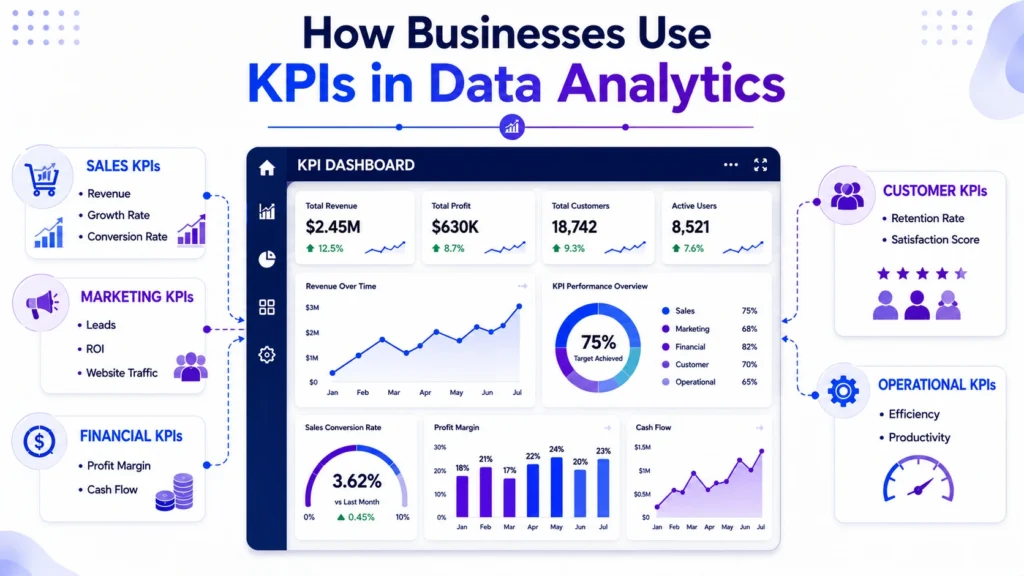
KPI Dashboards in Data Analytics
Most organizations use dashboards to monitor KPIs in real time. A KPI dashboard typically displays:
- Main business metrics
- Trend analysis
- Performance comparisons
- Targets versus actual results
- Interactive filters
Tools such as Tableau and Power BI are commonly used to create KPI dashboards because they allow decision makers to quickly understand business performance.
Example KPI Dashboard Metrics….
| KPI | Target | Current Value |
|---|---|---|
| Revenue Growth | 15% | 12% |
| Customer Retention | 90% | 88% |
| Conversion Rate | 5% | 4.8% |
| Profit Margin | 20% | 18% |
This type of dashboard immediately highlights areas requiring attention.

Common KPI Mistakes Businesses Make
Many organizations track too many metrics.
Some common mistakes include:
- Measuring everything instead of focusing on key goals
- Choosing KPIs that are not aligned with business objectives
- Ignoring data quality issues
- Tracking vanity metrics with little business value
- Failing to review KPI performance regularly
Effective KPI reporting focuses on meaningful metrics that support decision-making.
Why KPI Knowledge is Important for Data Analysts
Understanding KPIs is important because almost every analytics role involves performance measurement.
Recruiters often expect data analysts to:
- Understand business goals
- Build KPI dashboards
- Analyze performance trends
- Present insights clearly
- Support strategic decision making
This is why KPI analysis, dashboard creation, and business reporting are commonly included in modern data analytics learning paths.
Building KPI and Dashboard Skills with Career247
As businesses increasingly rely on data-driven decision making, professionals must learn how to track, analyze, and communicate KPI performance effectively.
Career247’s Data Analytics with GenAI Course helps learners build practical skills in Excel, SQL, Python, Statistics, Tableau, Dashboard Design, Data Storytelling, and business analytics projects.
These skills help aspiring analysts understand how KPIs are measured, visualized, and used to support real business decisions.
Conclusion…….
KPIs play a critical role in data analytics by helping businesses measure performance, track progress, and make informed decisions.
- Rather than relying on assumptions, organizations use KPI dashboards and analytics tools to understand what is working, what needs improvement, and where opportunities exist.
- For data analysts, understanding KPIs is more than a technical skill. It is the foundation of business focused analytics.
As organizations continue to embrace data driven strategies, professionals who can analyze, visualize, and communicate KPI performance will remain highly valuable across industries.
Frequently Asked Questions
Answer:
A KPI (Key Performance Indicator) is a measurable metric used to evaluate how effectively a business is achieving its goals and objectives.
Answer:
KPIs help organizations measure performance, track progress, identify trends, and make data driven business decisions.
Answer:
Common KPIs include revenue growth, conversion rate, customer retention rate, profit margin, customer acquisition cost, and customer satisfaction score.
Answer:
A metric measures business activity, while a KPI is a strategically important metric directly tied to business goals.
Answer:
Beginners can start by learning Excel, statistics, dashboard design, Tableau, and business analytics concepts. Structured programs such as Career247’s Data Analytics with GenAI Course can help learners understand how KPIs are used in real world business reporting and decision making.