
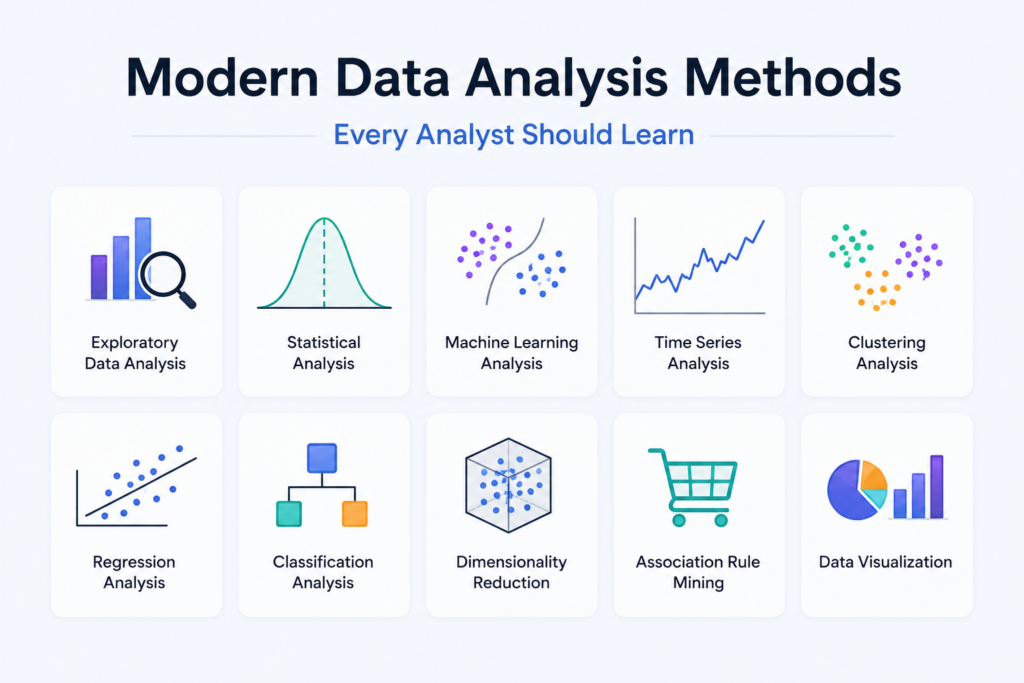
Modern Data Analysis Methods Every Analyst Should Learn
Modern Data Analysis Methods Every Analyst Should Learn
Data has become one of the most valuable assets for modern businesses. Companies across industries now depend on skilled analysts to transform raw numbers into meaningful insights. Because of this growing demand, understanding modern data analysis methods has become an essential skill for every data professional.
Today’s analysts are expected to do more than create spreadsheets and reports. They must identify trends, predict outcomes, solve business problems, and communicate insights clearly. Learning advanced and modern analytical techniques helps analysts stay competitive and improve career opportunities.

Why Modern Data Analysis Skills Matter
In today’s digital world, businesses generate massive amounts of data every second through websites, mobile applications, social media platforms, online transactions, customer feedback systems, and cloud-based software. This data contains valuable insights that can help companies improve performance, understand customer needs, and make smarter business decisions. However, raw data alone is not useful unless professionals know how to collect, organize, analyze, and interpret it effectively.
Modern data analysis skills allow businesses to transform complex information into actionable insights. Skilled analysts can identify patterns, trends, and opportunities that may otherwise remain hidden. By using advanced analytical techniques, organizations can better understand customer preferences, monitor market changes, and improve overall business strategies.
These modern analysis methods help analysts:
- Discover hidden trends and business opportunities
- Improve decision-making with data-driven insights
- Predict customer behavior and future market demands
- Increase operational efficiency and productivity
- Support long-term business growth and innovation
- Reduce risks, errors, and unnecessary costs
- Enhance customer experience through personalized services
- Optimize marketing campaigns and sales performance
- Improve financial forecasting and resource planning
- Track business performance in real time
Companies across industries such as healthcare, finance, retail, marketing, e-commerce, and technology now rely heavily on data analytics to stay competitive. Businesses no longer depend only on intuition or traditional decision making methods. Instead, they use data-backed strategies to achieve better accuracy and faster results.
Organizations also prefer professionals who can combine technical data analysis skills with strong business understanding. Modern analysts are expected not only to work with tools and datasets but also to explain insights clearly, solve real business problems, and help management make informed decisions. This combination of analytical thinking, technical expertise, and communication skills makes modern data analysts highly valuable in today’s job market.
Essential Modern Data Analysis Methods
In today’s data-driven business environment, organizations rely heavily on data analysis to improve decision-making, increase efficiency, and gain a competitive advantage. Modern data analysis methods help businesses convert raw information into meaningful insights that support growth and innovation. From understanding past performance to predicting future outcomes, these analytical techniques play a critical role across industries such as finance, healthcare, marketing, retail, and technology.
Below are some of the most important data analysis methods every analyst should understand in today’s rapidly evolving digital world.
Descriptive Analysis Understanding Past Performance
Descriptive analysis focuses on summarizing historical data to explain what happened during a business process, campaign, or project. It is one of the most commonly used forms of analytics because it provides a clear overview of business performance using reports, dashboards, charts, and visualizations.
This method helps organizations track important metrics and identify trends over a specific period. Analysts use descriptive analytics to convert large datasets into simple, understandable insights that support day-to-day business monitoring.
- Common Examples
- Monthly sales reports
- Website traffic summaries
- Revenue dashboards
- Customer engagement reports
- Social media performance tracking
- Operational performance reports
Key Benefits
- Helps businesses understand historical performance
- Improves KPI monitoring and reporting
- Supports better business planning
- Simplifies large and complex datasets
- Provides a foundation for advanced analytics
Descriptive analytics is usually the first step in every data analysis project because it creates a clear picture of existing business conditions and overall organizational performance.
Diagnostic Analysis Finding the Root Cause
Diagnostic analysis helps analysts determine why a specific event or business outcome occurred. Unlike descriptive analysis, which only explains what happened, diagnostic analytics investigates the reasons behind performance changes and business challenges.
This method uses deeper data exploration techniques to identify relationships, patterns, and influencing factors that affect business results. Companies use diagnostic analysis to solve operational problems, improve customer experience, and optimize business strategies.
Example Scenario
If customer sales suddenly decrease, diagnostic analysis may investigate:
- Product pricing changes
- Marketing campaign performance
- Competitor activity
- Customer behavior shifts
- Seasonal demand fluctuations
- Website or application issues
- Techniques Used
- Data drilling
- Correlation analysis
- Root cause analysis
- Comparative reporting
- Trend comparison
- Statistical analysis
Key Benefits
- Helps identify business problems quickly
- Supports strategic decision-making
- Improves operational efficiency
- Reduces recurring issues and errors
- Enhances performance optimization
Diagnostic analysis is highly useful for organizations that want to understand performance gaps and make informed improvements based on real business data.
Predictive Analysis Forecasting Future Trends
Predictive analysis uses historical data, machine learning algorithms, artificial intelligence, and statistical models to estimate future outcomes and business trends. This method helps organizations make proactive decisions instead of reacting only after problems occur.
Modern businesses widely use predictive analytics to improve planning, reduce uncertainty, and gain a competitive advantage in rapidly changing markets. By identifying patterns from previous data, predictive models can estimate future customer behavior, sales performance, and operational risks.
- Modern Business Applications
- Sales forecasting
- Customer retention analysis
- Demand prediction
- Fraud detection
- Inventory planning
- Financial forecasting
- Risk management
- Healthcare predictions
Why Analysts Should Learn It
Predictive analytics has become one of the most in demand analytical skills because companies increasingly rely on data-backed forecasting and strategic planning. Businesses want professionals who can analyze trends, build prediction models, and support future business growth using data driven insights.
Professionals with predictive analysis expertise often access better career opportunities in:
- Data science
- Business intelligence
- Financial analytics
- Marketing analytics
- Artificial intelligence
- Machine learning
As industries continue adopting AI-powered technologies, predictive analytics is becoming an essential skill for modern data analysts.
Prescriptive Analysis Recommending Smart Decisions
Prescriptive analysis is one of the most advanced forms of data analytics because it not only predicts future outcomes but also recommends the best possible actions to achieve desired results. This method combines predictive analytics, artificial intelligence, optimization models, and business rules to guide strategic decision-making.
Prescriptive analytics helps businesses choose the most effective solution among multiple options while considering risks, costs, and expected outcomes.
Example Scenario
If data predicts low customer engagement, prescriptive analysis may recommend:
- Personalized marketing campaigns
- Product discounts and promotional offers
- Content optimization strategies
- Customer loyalty programs
- Improved customer support initiatives
Major Advantages
- Improves decision-making accuracy
- Optimizes business operations
- Saves time and operational resources
- Enhances productivity and efficiency
- Supports automation and strategic planning
- Reduces business risks
Large organizations use prescriptive analytics extensively in logistics, finance, healthcare, supply chain management, and digital marketing to improve performance and maximize business outcomes.
- Python
- SQL
- Power BI
- Tableau
- Microsoft Excel
- R Programming

Exploratory Data Analysis (EDA)
Exploratory Data Analysis, commonly known as EDA, is one of the most important processes in modern data analytics. It helps analysts examine, understand, and prepare datasets before applying advanced statistical models, machine learning algorithms, or business intelligence techniques. The primary goal of EDA is to explore the structure of the data, identify problems, and uncover meaningful insights that can improve decision-making and analytical accuracy.
Before businesses can generate reliable insights, analysts must first understand the quality and behavior of the available data. Exploratory Data Analysis allows professionals to investigate datasets in detail and detect patterns or inconsistencies that may affect final results. Without proper exploration, businesses risk making decisions based on incomplete, incorrect, or misleading information.
EDA mainly focuses on discovering:
- Hidden relationships between variables
- Important data patterns and trends
- Outliers and abnormal values
- Missing or incomplete data
- Unusual behavior in datasets
- Data distribution and variability
- Correlations between different business metrics
- Errors, duplicates, or inconsistencies in data
By analyzing these elements early in the process, analysts can improve data quality and ensure that future analysis is more accurate and meaningful.
Popular EDA Techniques
Analysts use various visualization and statistical techniques during Exploratory Data Analysis to better understand the dataset and simplify complex information.
Histograms
Histograms help analysts understand data distribution by showing how frequently values appear within specific ranges. This technique is useful for identifying skewness, concentration, and variation in data.
Heatmaps
Heatmaps visually represent relationships and correlations between variables using color intensity. Businesses often use heatmaps to identify strong or weak connections within large datasets.
Scatter Plots
Scatter plots help analysts study relationships between two variables. They are highly effective for detecting trends, clusters, and correlations in business and customer data.
Box Plots
Box plots are useful for identifying outliers, median values, and data spread. They help analysts quickly detect unusual observations that may impact analysis accuracy.
Correlation Analysis
This technique measures the strength of relationships between variables, helping analysts understand which factors influence business outcomes the most.
Data Profiling
Data profiling involves reviewing dataset structure, data types, missing values, and duplicates to improve overall data quality before advanced analysis.
Why Exploratory Data Analysis Is Important
EDA is considered one of the most critical stages in data preparation because accurate business insights depend heavily on clean, organized, and reliable data. Even the most advanced analytical models can produce poor results if the underlying data contains errors or inconsistencies.
Modern organizations use EDA to:
- Improve data accuracy and reliability
- Reduce analytical errors
- Identify business opportunities and trends
- Enhance machine learning model performance
- Support better strategic decision-making
- Save time during data cleaning and preparation
- Increase confidence in final analytical results
Exploratory Data Analysis also helps analysts choose the right statistical methods, visualization techniques, and predictive models based on the characteristics of the data.
Role of EDA in Modern Business Analytics
Today, businesses across industries such as healthcare, finance, e-commerce, marketing, and technology rely on EDA to gain a deeper understanding of customer behavior, operational performance, and market trends. It acts as the foundation for advanced analytics, artificial intelligence, and machine learning projects.
Professionals with strong EDA skills are highly valuable because they can transform raw and unstructured datasets into meaningful information that supports smarter business decisions. As data continues to grow rapidly, Exploratory Data Analysis remains an essential skill for every modern data analyst and business intelligence professional.
Future Trends in Data Analysis
The field of data analytics continues to evolve rapidly. Analysts who stay updated with modern technologies will remain highly valuable in the job market.
- Emerging Trends Include
- AI-powered analytics
- Real-time data processing
- Automated reporting systems
- Machine learning integration
- Cloud-based analytics platforms
Companies increasingly rely on automation and artificial intelligence to improve data-driven decision-making.
Final Thoughts
Learning modern data analysis methods is essential for analysts who want to succeed in today’s competitive market. From descriptive analytics to predictive modeling and exploratory analysis, every method offers valuable insights for businesses.
Analysts who combine technical expertise with business understanding can deliver more accurate insights, support strategic growth, and build stronger careers in the data industry.
Frequently Asked Questions
Answer:
Modern data analysis methods are advanced techniques used to collect, process, and interpret data for better decision-making. These methods include descriptive, predictive, diagnostic, and prescriptive analysis. Businesses use them to identify trends, improve performance, and forecast future outcomes more accurately.
Answer:
Modern businesses rely heavily on data-driven decisions, making analytical skills highly valuable. Analysts who understand modern methods can solve business problems, predict customer behavior, and create actionable insights. These skills also improve career opportunities in data analytics, business intelligence, and data science.
Answer:
Predictive analysis is the most commonly used method for forecasting future trends. It uses historical data, machine learning, and statistical models to estimate future business performance. Companies use predictive analytics for sales forecasting, customer retention, and market trend analysis.
Answer:
Popular tools used in modern data analysis include Python, SQL, Tableau, Power BI, Microsoft Excel, and R Programming. These tools help analysts clean data, create visualizations, automate reporting, and perform advanced analytics efficiently. The right tool depends on project requirements and data complexity.
Answer:
Exploratory Data Analysis (EDA) helps analysts understand datasets before applying advanced models. It identifies hidden patterns, missing values, outliers, and relationships within the data. EDA improves data quality and helps analysts choose the most suitable analytical approach for accurate results.