
Best Data Analysis Methods for Accurate Business Insights
Best Data Analysis Methods for Accurate Business Insights
In today’s competitive market, businesses rely heavily on data to make smarter decisions. From customer behavior to sales performance, every piece of information can help companies improve strategies and increase profits. However, raw data alone is not enough. Organizations need the right data analysis methods to convert complex information into meaningful business insights.
Choosing the correct analysis technique helps companies identify trends, reduce risks, improve customer experience, and make accurate predictions for future growth.

Why Data Analysis Matters for Businesses
In today’s digital world, businesses collect data from almost every activity, including website visits, customer purchases, social media interactions, marketing campaigns, and sales performance. However, raw data alone has little value unless it is properly analyzed and transformed into meaningful insights. This is where data analysis becomes an essential part of business growth and decision making.
Data analysis helps organizations understand patterns, identify opportunities, and solve problems using real information instead of assumptions. Businesses that rely on accurate data can make smarter strategies, improve customer experiences, and respond quickly to changing market conditions. Whether it is a small startup or a large enterprise, every company benefits from using data driven insights to improve performance and long term success.
Key Reasons Why Data Analysis Is Important for Businesses
Better Understanding of Customer Behavior
Businesses can analyze customer data to understand:
- Buying habits
- Customer interests
- Preferred products or services
- Online browsing behavior
- Customer feedback and satisfaction levels
This information helps companies create personalized marketing campaigns and improve customer experiences, leading to higher customer retention and loyalty.
Improved Decision Making
Data analysis allows businesses to make decisions based on facts and measurable insights rather than guesswork. Managers and business leaders can use reports, trends, and forecasts to make strategic decisions with greater confidence.
For example, businesses can identify:
- Which products perform best
- Which marketing campaigns generate more revenue
- Which business areas need improvement
- Future growth opportunities
Accurate decision making reduces risks and helps businesses operate more efficiently.
Increased Operational Efficiency
Analyzing operational data helps companies identify inefficiencies in workflows, production processes, and resource management. Businesses can use these insights to optimize daily operations and improve productivity.
Benefits include:
- Faster workflow management
- Reduced manual errors
- Better employee productivity
- Improved inventory management
- Efficient use of resources
Operational improvements often lead to significant time and cost savings.
Identification of Market Trends
Market trends constantly change due to customer demands, technology advancements, and industry competition. Data analysis helps businesses stay updated with these changes and adapt quickly.
Companies can use analytics to:
- Monitor industry trends
- Analyze competitor performance
- Predict customer demands
- Identify emerging business opportunities
Organizations that quickly respond to trends often gain a stronger competitive advantage in their market.
Higher Revenue and Profitability
One of the biggest advantages of data analysis is its ability to improve profitability. Businesses can identify profitable products, successful marketing channels, and high-value customer segments through proper analysis.
Data-driven strategies help businesses:
- Increase sales performance
- Improve conversion rates
- Reduce unnecessary expenses
- Optimize pricing strategies
- Improve return on investment (ROI)
As a result, businesses can maximize profits while maintaining better financial stability.
Risk Management and Problem Detection
Data analysis also plays a major role in identifying potential business risks before they become serious problems. Companies can monitor unusual patterns, detect fraud, and identify declining performance early.
This helps organizations:
- Reduce financial risks
- Prevent operational failures
- Improve cybersecurity monitoring
- Detect customer dissatisfaction early
- Maintain business continuity
Early problem detection allows businesses to take corrective actions faster and minimize losses.
The Growing Importance of Data Driven Businesses
Modern companies operate in highly competitive environments where fast and accurate decisions are essential. Businesses that effectively use data analysis can adapt more quickly, understand their audience better, and improve overall business performance.
Today, industries such as healthcare, finance, retail, marketing, e-commerce, education, and technology heavily rely on advanced data analysis methods to support growth and innovation. Companies that ignore data analytics often struggle to keep up with competitors who use data-driven strategies for continuous improvement.
As technology continues to evolve, the importance of business data analysis will only continue to grow in the future.
Top Data Analysis Methods for Accurate Business Insights
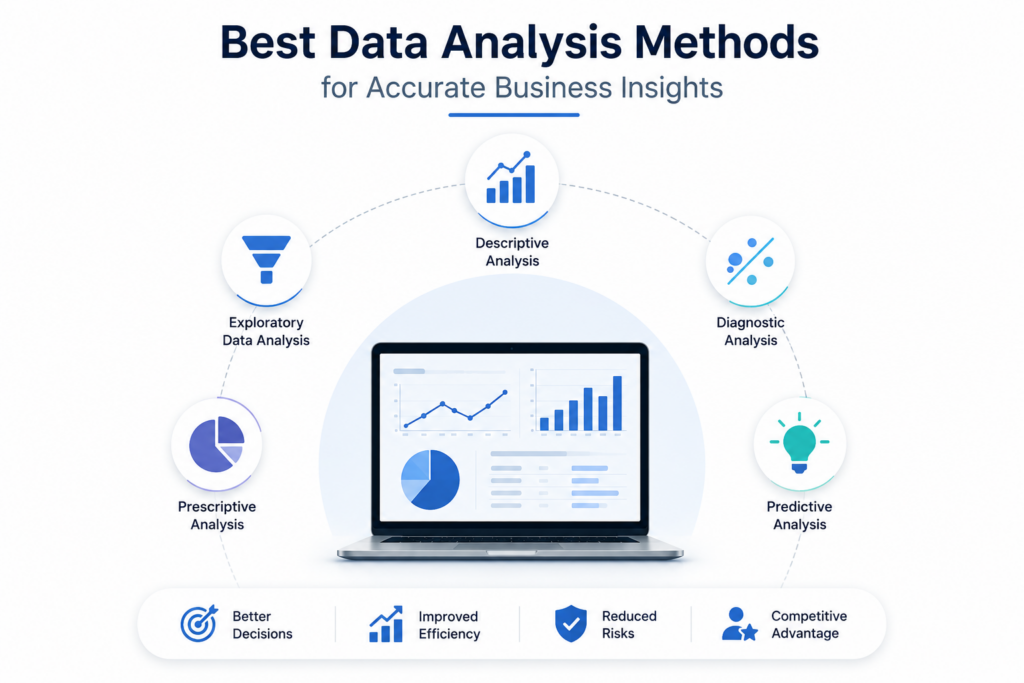
Businesses use different data analysis methods to solve specific problems, improve performance, and make smarter decisions. Each method provides unique insights that help organizations understand business trends, customer behavior, and future opportunities more effectively.
Below are some of the most widely used data analysis methods in modern businesses.
1. Descriptive Analysis
Descriptive analysis focuses on reviewing historical data to understand past business performance. It helps companies identify patterns, trends, and overall business results through reports and visual dashboards.
This method answers questions such as:
- What happened in the business?
- Which product generated the highest sales?
- How did customers interact with the website?
Businesses commonly use descriptive analytics for monthly reports, revenue tracking, and performance monitoring.
Key Benefits
- Simplifies large amounts of data
- Helps identify trends and patterns
- Improves reporting accuracy
- Supports business planning
Descriptive analysis acts as the foundation of business intelligence by providing a clear overview of company performance.
2. Diagnostic Analysis
Diagnostic analysis helps businesses understand why a specific event or outcome happened. Instead of only presenting results, it identifies the root causes behind business problems or successes.
For example, if customer engagement suddenly decreases, diagnostic analysis can help determine whether the issue is related to pricing, competition, marketing, or customer preferences.
Common Techniques
- Root cause analysis
- Correlation analysis
- Data mining
- Drill down reporting
Business Advantages
- Detects operational issues
- Supports smarter decision making
- Improves business efficiency
- Helps solve recurring problems
This method is highly valuable for organizations aiming to improve processes and reduce business risks.
3. Predictive Analysis
Predictive analysis uses historical data, machine learning, and statistical models to forecast future outcomes. It helps businesses prepare for upcoming trends and make proactive decisions.
Companies use predictive analytics to forecast:
- Customer buying behavior
- Future sales performance
- Market demand
- Inventory requirements
- Potential business risks
Main Benefits
- Improves future planning
- Reduces uncertainty and risks
- Supports better investments
- Enhances customer targeting
Predictive analytics has become one of the most important tools for modern business growth and strategic planning.
4. Prescriptive Analysis
Prescriptive analysis recommends the best possible action based on business data and predictive insights. It helps organizations optimize decisions and improve overall operational efficiency.
For example, if data predicts low product demand, prescriptive analytics may recommend adjusting pricing strategies or launching promotional campaigns.
Key Advantages
- Improves strategic decisions
- Optimizes workflows and operations
- Saves time and business resources
- Enhances productivity
Large companies often use prescriptive analytics in finance, supply chain management, and marketing automation.
5. Exploratory Data Analysis (EDA)
Exploratory Data Analysis helps analysts identify hidden trends, relationships, and unusual patterns within datasets before applying advanced analytical models.
Analysts commonly use visual tools such as:
- Scatter plots
- Histograms
- Heatmaps
- Box plots
Why EDA Is Important
- Detects missing or incorrect data
- Improves data quality
- Helps choose the right analytical method
- Identifies business opportunities
EDA is considered a critical step in modern business analytics projects because it improves the accuracy of future analysis.
6. Statistical Analysis
Statistical analysis uses mathematical and statistical techniques to interpret business data accurately. It helps businesses validate assumptions and make evidence based decisions.
Common Statistical Methods
- Mean and median analysis
- Probability analysis
- Regression analysis
- Hypothesis testing
- Standard deviation
Business Applications
- Market research
- Financial forecasting
- Customer satisfaction analysis
- Product performance evaluation
Businesses that rely on statistical analysis often achieve more accurate insights and better long-term decision making results.

Best Tools Used for Data Analysis
Businesses use multiple tools to perform accurate analysis efficiently.
Popular Data Analysis Tools
- Microsoft Excel
- Python
- SQL
- Power BI
- Tableau
- Google Looker Studio
- R Programming
Each tool offers different features depending on business size, industry, and analytical requirements.
How to Choose the Right Data Analysis Method
Selecting the best analysis method depends on business objectives and data complexity.
Consider These Factors
Business Goals
Choose whether you want to understand past performance, predict future outcomes, or improve decision-making.
Data Volume
Large datasets may require AI-powered or machine learning-based analysis methods.
Industry Requirements
Healthcare, finance, marketing, and retail industries often use different analytical approaches.
Technical Expertise
Some methods require advanced analytical skills and specialized tools.
Future of Data Analysis in Business
The future of business analytics is rapidly evolving with artificial intelligence and automation technologies.
Emerging trends include:
- AI-powered analytics
- Real time data monitoring
- Automated reporting systems
- Predictive customer intelligence
- Cloud based business analytics
Companies investing in advanced data analysis methods are expected to achieve better operational efficiency and long-term growth.
Conclusion
Using the right data analysis methods is essential for businesses that want accurate insights and smarter decision-making. From descriptive analysis to predictive and prescriptive techniques, every method offers unique advantages depending on business goals.
Organizations that effectively analyze their data can improve customer experiences, optimize operations, reduce risks, and stay ahead of competitors. As technology continues to evolve, data-driven decision-making will become even more important for business success.
Frequently Asked Questions
Answer:
The main types of data analysis methods include descriptive, diagnostic, predictive, prescriptive, and statistical analysis. Each method serves a different purpose, such as understanding past performance, identifying problems, forecasting future trends, or recommending business actions. Companies often combine multiple methods for better decision-making.
Answer:
Predictive analysis is considered the best method for forecasting future business outcomes. It uses historical data, machine learning, and statistical models to identify patterns and estimate future sales, customer behavior, and market demand. Many businesses use predictive analytics to reduce risks and improve planning.
Answer:
Data analysis helps businesses make informed decisions based on real information instead of assumptions. It improves operational efficiency, identifies market opportunities, enhances customer experience, and supports long-term growth strategies. Companies that use data effectively often achieve better profitability and competitive advantages.
Answer:
Popular data analysis tools include Microsoft Excel, Python, SQL, Tableau, Power BI, and Google Looker Studio. These tools help businesses collect, organize, visualize, and interpret data more efficiently. The choice of tool depends on the complexity of the data and business requirements.
Answer:
Businesses choose data analysis methods based on their goals, industry requirements, data size, and technical resources. For example, descriptive analysis is useful for understanding past performance, while predictive analysis helps forecast future trends. Selecting the right method ensures more accurate and actionable business insights.